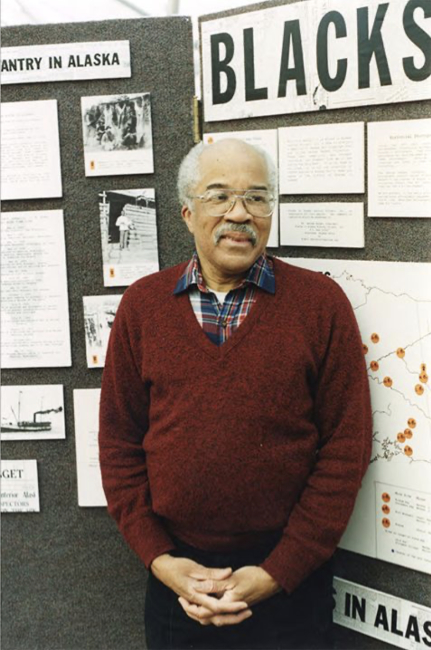
I love talking to people who are passionate about something. It doesn't matter whether it's flowers, running, or history - the energy is contagious. George Harper was one of those people. I don't remember whether he found me or I found him in 1997, shortly after I opened the website that would, 4 years later, become ExploreNorth, but we corresponded fairly often, sharing ideas and information, mostly about the history of Alaska and the Yukon. In his obituary, he was quoted as saying that one of his favorite statements was "What good is having knowledge if you don't pass it on?" That's what connected us, as it's exactly why I've been doing this for 28 years now.
When George came to Alaska in 1981 to work as a computer specialist for the Bureau of Land Management, he found a gap in Alaska history that he felt he could fill, and in 1990, Blacks in Alaska History was born. By the time we met, it seemed like the project had pretty much taken over his life, and when he retired from his normal job in 1992, his work blossomed.
On February 11, 2004, the Anchorage Daily News commented "George Harper was not a formally trained historian. But if a historian's role is to illuminate the past, then George Harper more than earned the honorable title of historian. He brought light to history ignored, found life stories that had been lost due to bigotry, indifference or ignorance."
The links and articles below will give you a glimpse at what George accomplished in the 14 years between the formation of Blacks in Alaska History and his death in 2004. He had a very full life, but it's a legacy he was particularly proud of creating.
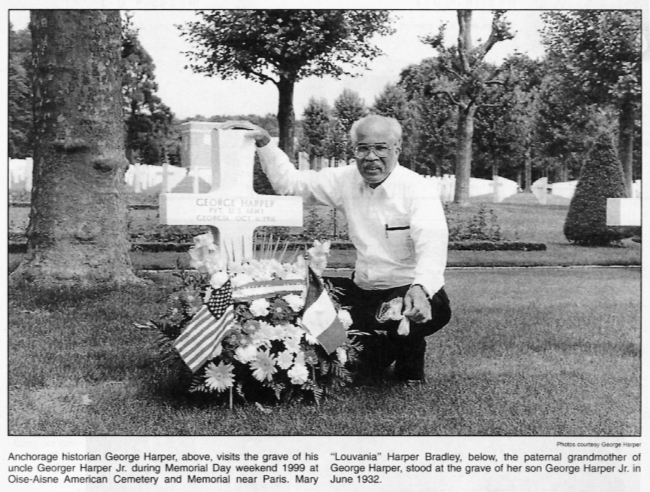
On Memorial Day weekend, George Harper fulfilled a childhood fantasy. He made a pilgrimage to France and visited the grave of his uncle - George Harper Jr. "Uncle George" was a World War I soldier who died there in October 1918, about three months after he was drafted into the U.S. Army.
While there, Harper laid a wreath on the grave. He also sprinkled a little soil from his uncle's home state of Georgia onto the plot as a symbolic gesture.
"When you go through a moment like that, it's emotional," Harper said. "I had completed a journey that I had set out to do, and now I could go home."
Harper, 69, is a Korean War veteran. He also is founder of the Blacks in Alaska History Project Inc.
Harper began researching his family roots in 1979 after his father died. During a taped interview with his uncle's step-brother, Vincent Bradley, he found out that both were shipped overseas on the same troop ship after basic training. A major flu epidemic broke out.
On the tape, Bradley said: "We just coincidentally got on the same ship. We ran into each other in the latrine one day. We both were sick with the flu. And he was sicker than I was. He wasn't able to come around and see me. I went around and saw him three times, and then I had got so weak, I wasn't able to go back."
The USS Leviathan arrived Oct. 7, 1918, on the coast of France. "Uncle George" was transferred to the Naval Base Hospital near Brest, France, where he died of bronchopneumonia on Oct. 11, 1918 - just a month before the war ended.
It wasn't until 1922 that his remains were permanently interred at the Oise-Aisne American Cemetery and Memorial,about 70 miles northeast of Paris.
Oise-Aisne American Cemetery is the second largest of eight permanent American World War I military cemeteries on foreign soil. Congress authorized its retention as a permanent cemetery in 1921.
Harper is one of 1,268 black Americans interred in American foreign cemeteries.
Anchorage historian George Harper's grandmother, Mary "Louvania" Harper Bradley, visited her son's grave in France in June 1932.
Known as "Big Ma," she started her trip to Europe by horse and wagon from Tignall to Washington, Ga. There, she boarded a Georgia Railroad train to Barnett, then to Augusta, Ga. At Augusta, she took a sleeper to New York. White travelers could take luxury liners; black travelers crossed the Atlantic in commercial steamers, which was better than what "Big Ma" was accustomed to, Harper said.
At that time, she was 69. During the trip, she was chosen as the "honor pilgrim" to place a wreath on the Tomb of the Unknown Soldier at the Arc de Triomphe.
Bradley returned to Georgia with some stones from her son's grave to show others that she had actually been there.
Bradley was a member of the Gold Star Mothers, a group formed during World War I. Each of these mothers had lost a son or daughter in the war.
Harper has fond childhood memories of summer visits to his grandparents' sharecropping farms in Wilkes County, Ga. He and his brothers would gather around on the floor. Bradley would take out a shoe box of mementos from her trip to France. She retold the story about how she "was treated like white folks" there.
"In the '30's, black people could go to Europe and be treated like human beings," Harper said.
As Harper remembers his May visit, a light, warm rain was falling as Brig. Gen. Paul Patrick prepared to deliver his memorial address. The general revised his speech by stating that the men interred at Oise-Aisne Cemetery fought in spite of the rain. By the time he finished, the rain stopped and the sun came out. "I thought that the rain was covering up the tears being shed by the audience and me," Harper said.
Ret. U.S. Army Maj. Alexander Bassert named Harper as the person who traveled the longest distance to attend the ceremony.
His uncle is among 124,914 war dead in 24 overseas cemeteries - some of whom have never had a visitor from home, Harper said.
While watching a historical documentary about World War I recently, Harper noticed a war trench running through the current cemetery area, a place of peaceful farmland and rolling green hills now.
"World War I was probably the last one we fought like that - when we line up on two rows and face each other and start firing," Harper said. "The re-enactment showed how hard it was because they showed this landscape devoid of vegetation. Stumps of trees had been completely defoliated from the constant bombs and things going off. Grass was all muddy and trampled down. It's remarkable how Mother Nature has recovered."
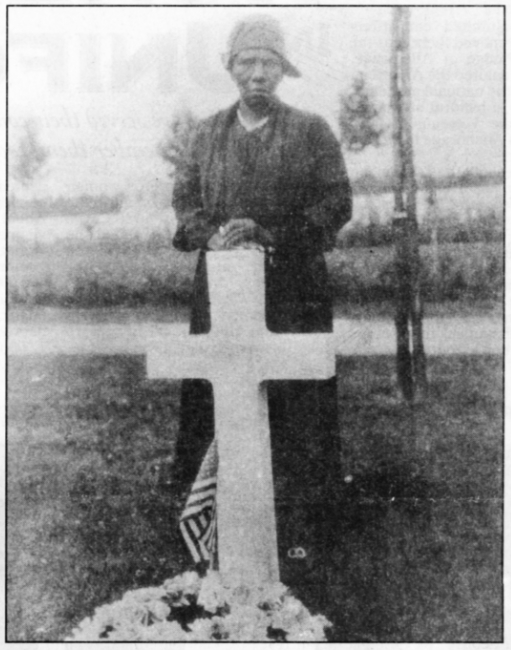
Mary "Louvania" Harper Bradley, visited her son's grave in France in June 1932.
George T. Harper, who chronicled the history of blacks in Alaska, died Jan. 21, 2004, at Providence Extended Care Center.
A celebration of his life will be at noon Saturday, on what would have been his 74th birthday, at Out North, 1325 Primrose. Sen. Bettye Davis is the sponsor of a legislative citation, which will be read at the celebration, and video clips of Mr. Harper will be shown. A reception will follow to mark the opening of a Black History Month exhibit. All are welcome.
Mr. Harper was born Feb. 14, 1930, in Atlanta, the third child of John Alexander Harper and Annie Lee Booker.
Mr. Harper married Fern Ella Eberhart in 1950. To this union was born one child, George Taylor Harper Jr. Fern died and in 1955, Mr. Harper married Ollie Mae Mabry.
Mr. Harper graduated from East Vocational High School in Cincinnati in 1948. He was a Korean War Veteran and served in the U.S. Navy from November 1948 to November 1952.
After his honorable discharge, he attended medical X-ray technician training under the G.I. Bill at Cincinnati General Hospital and became a registered X-ray technician in 1955. He graduated from Salmon P. Chase College in Cincinnati with a bachelor of science in commerce in 1960.
In 1961, he became a computer programmer trainee at the U.S. Air Force Supply Center in Dayton, Ohio. From 1952 until 1966, he was a member of the U.S. Air
Force Reserve and reached the rank of Master Sergeant.
Mr. Harper came to Anchorage in 1981 to work as a computer specialist for the Bureau of Land Management. He retired from federal service in 1992.
His hobbies included genealogy, black history, music, photography, model railroading, ice skating and travel. At age 59, he taught beginning ice skating at Dimond Center Ice Chalet for four years. He documented his family history back to 1803. He was church organist at several churches during his life. His slide show of East Africa was
shown across the country.
He considered his major accomplishment in Alaska the Blacks in Alaska History project. He was well known throughout the nation for his knowledge of black history in Alaska and his collection of historical photographs of black Alaskans. The collection will be donated to the University of Alaska Anchorage archives as The George Taylor Harper Collection, for use by historians. He was recently honored with the
Historian Award by the Alaska chapter of the NAACP.
At one time he was a member of Shiloh Baptist Church, The Anchorage Figure Skating Club, The Alaska Historical Society, The Cook Inlet Historical Society, The Anchorage Museum Association, and was a founding member, past president, and board member of The Alaska Computer Society.
One of his favorite statements was "What good is having knowledge if you don't pass it on?"
He is survived by his son, George Taylor Harper, Jr., and his uncle Robert Booker of Cincinnati; cousin, Kate Zellars of Baltimore; and special friends, Chris Sitbon and Sherman Honeyblue of Anchorage, and George and Andonia Harrison of Las Vegas; and many distant relatives and friends.
Memorial donations may be made to his favorite charities, the Salvation Army and Bean's Cafe.
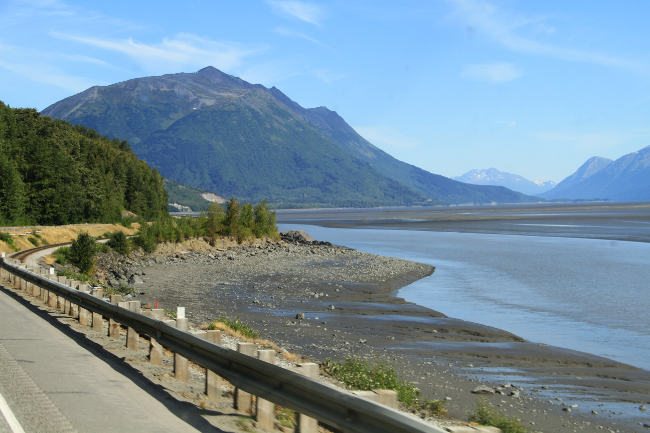
In accordance with his wishes no services will be held. His cremated remains will be scattered along Turnagain Arm over the Alaska Railroad tracks.