Countess Charles Eugene Carbonneau, accompanied by her travelling
companion and her sisters, is a guest at the Hotel Vancouver en route to her beautiful fruit ranch in the Yakima Valley.
The story of the countess' rise from poverty and obscurity to wealth and
position is one that outrivals many of the most interesting works of fiction. Born in a small town in Pennsylvania and early bereft of her parents, Belinda Mulrooney found herself under the necessity of providing for the sup- port of three younger sisters and herself. In the space of a few years she managed to send her sisters to the most exclusive schools in Europe and to amass a large fortune.
Mrs. Carbonneau, as she prefers to be called, struggled hopelessly along
for a few years in her Eastern home until the great news swept the world of the Northern gold strike. She immediately got the gold fever, sold her little home and belongings, placed her sisters with neighbors and started on the long road to what was then thought to be the Ultima Thule of the world. This was in the winter of 1897, when from every section of the world, from factory, shop, logging camp and goldfield, anaemic clerk and sturdy digger took the terrible trail to the Klondike, which collected its toll of thousands of lives.
Upon arriving at Seattle and after purchasing her outfit, Mrs. Carbonneau found herself penniless. She secured the position of stewardess on one of the boats, crowded with gold-stricken men. Arriving at Skagway she faced the terrors of the Chilcoot
pass alone, dragging one sled and having the other hauled by her faithful companion, the St. Bernard dog, Nero, known and loved along the trail and for many years after in Dawson
by every man in the Klondike district. Nero worked well on the cruel trail and when he arrived in Dawson retired to a life of ease and luxury, receiving food that many a miner in those days might have envied.
Mrs. Carbonneau was one of the first women to reach the Klondike, and indeed the first pioneer woman to successfully reach that Eldorado that winter by her own unaided exertions. Dawson reached, she pitched her tent on the only dry spot she could find on the waterfront facing the Yukon River. On this spot now stands the imposing building of the Dawson branch of the Canadian Bank of Commerce.
The crying need at that time was for prepared food to feed the thousands scattered along Front street and up the Klondike river. Mrs. Carbonneau immediately took advantage of this and established the first restaurant, if such it might be called, and securing the services of another woman, just arrived. Working night and day she was still unable to cope with the demand.
Built Dawson's First Hotel.
So she relinquished the little shack in a few weeks, and securing the cooperation of Alec McDonald, King of the Klondike, and other wealthy Yukoners, built the first hotel in Dawson, the Klondike Hotel on First avenue, which still stands as a first-class hostelry. The cost of the erection of this building was large, but so great
was the business done and the prices secured that in a few months she was able to pay off the loans and control the hotel, free and unencumbered.
While actively engaged in the work of conducting the hotel she established the first telephone system, consisting of a single wire from her hotel to the creeks. But, the line completed, she was unable to find an operator, and took up the position of telephone girl along with her other numerous dutles. The hotel was now in good running order and some little leisure awarded Mrs. Carbonneau's efforts. But she disliked leisure as much as the hobo despises work. She started for the creeks and created the townsite of Bonanza, commonly known as Grand Forks, about twelve miles from Dawson, which is still a thriving little settlement. It lies at the juncture of Bonanza and Eldorado creeks. Here she built the Grand Forks hotel which is still doing a flourishing business.
But gold was what she was primarily after. So in mucklucks and a man's parkey she mushed the creeks in search of desirable auriferous ground. She first staked fractional creek claim No. 3a Eldorado, and in one panning took out a thousand dollars in gold. This claim was destined to have a history. After being worked extensively the wiseacres thereabouts (and mining camps abound in this species of genus homo) claimed that they had discovered a second bedrock. The news spread rapidly and men dug deep under the
first bedrock to discover the mythical wonder of the substrata.
Without warning one day an enormous gusher sprung up, threatening the destruction of thousands of dollars' worth of property in the vicinity. In alarm the news was telephoned to the then Commissioner William Ogilvie in Dawson, who immediately convened the Yukon council, which body voted a large sum to cap the hole. Dan Matheson, now general manager of the Stewart River Gold Mining & Dredging Company, was commissioned to employ all the men avail\able to stop the work of havoc, and after toiling strenuously day and night succeeded in capping the mighty stream of water,
Mrs. Carbonneau's next mining venture was the staking of 41 above discovery on Bonanza creek. This claim produced an enormous amount of money and was only recently sold by Mrs. Carbonneau to Mr. A. N. C. Treadgold, the English mining engineer who promoted the Yukon Gold Fields, Limited, a Guggenheim enterprise.
Marries the "Count."
Mrs. Carbonneau, then Miss Mulrooney, was married in October of 1900 to Charles Eugene Carbonneau, a French promoter, and their honeymoon was spent on 3a Eldorado. Men in mining camps are prone to stick nicknames on all newcomers. The Frenchman was a man of distinguished bearing and this, combined with his nationality, caused the boys on the creeks to dub him "Count," and the name stuck.
"Never mind," the "Count" remarked philosophically, "some day I'll be a real one." And not many years later, owing to liberal donations to the Catholic Church, the Pope created him Count Carbonneau.
Mr. Carbonneau owned extensive interests on Gold Run creek. Dr. Alfred Wills, formerly a surgeon of the North West Mounted Police, owned the remaining interests. They united their properties under the name of the Gold Run Klondike Mining Company. But trouble arose between the partners. The company was reorganized by French capital and their interests sold.
Then Mrs. Carbonneau went to Europe to get her sisters, Nellie and Margaret, who were at school there, and returned with them to Glenside, Penn., for a six months' visit. While there Margaret attended the Pearce Business College of Philadelphia,
taking the banking course, which fitted her for her future career.
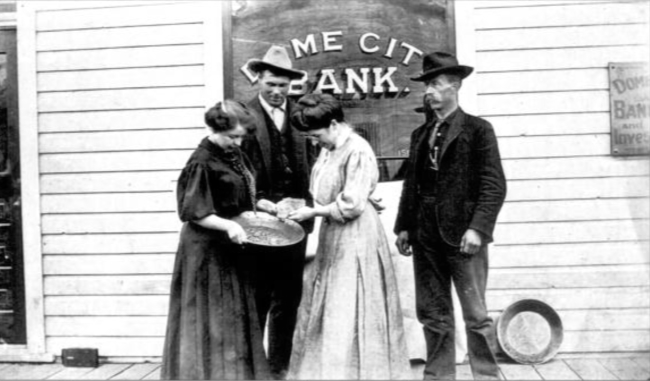
With her two sisters Mrs. Carbonneau proceeded to Seattle and organized the Dome City bank. Associated with her were James McElroy, a prominent Seattle attorney; Jesse Noble, who afterwards married Nellie Mulrooney, and some Seattle bankers. The management of the bank was left entirely in the hands of Jesse Noble, Mrs. Carbonneau and Miss Margaret Mulrooney. They proceeded in private conveyances over the Valdez trail to Fairbanks and established the first bank on the creeks, at the source of supplies. The other banks afterwards followed suit. A frame building was erected at Dome City, the family living upstairs. :
In the meantime Nellie, the other sister, was not idle. She was appointed postmistress and agent for the Alaska Express Company. But she shortly came to grief in both positions. A number of agents, armed to the teeth, visited Dome City to collect the gold from the agent.
"Hello, boys," said Miss Nellie, "won't you come upstairs and have a cup of tea?"
Such an invitation rarely came their way in those days. They accepted it
with alacrity, laid down their revolvers on the gold sacks and followed Miss Mulrooney to the living quarters, A few minutes afterwards Mrs. Carbonneau entered the office and found to her horror thousands of dollars worth of gold lying on the floor, on which were carefully deposited the huge revolvers of the agents upstairs. This ended Miss Mulrooney's first and only position as agent of the Alaska Express Company.
Her Bank and the Panic.
The population around Dome City consisted largely of Russian miners bearing long and unpronounceable names. When the Russians called for their mail Miss Mulrooney could not make their pronunciation of the names correspond with those on the
envelopes. She therefore adopted the simple and ingenious expedient of throwing the whole assortment of mail on the counter and telling them to help themselves. But the cruel postal authorities couldn't see it her way and this ended Miss Nellie Mulrooney's official career. Shortly afterwards she married Jessie Noble and thereafter busied herself with the joys and cares of domestic life.
Margaret, though only 19, took practical charge of the little bank and weathered it through many stormy days. Fire broke out in the building and Mrs. Carbonneau and her sister Nellie rushed out of the burning building, but Margaret would not budge until she had rushed downstairs in her bare feet and night attire to ascertain if the books were safely deposited in the vault.
The Fairbanks country was not immune from the dreadful financial panic which struck the country in 1907. The other banks there at that time were the Washington Alaska, the Fairbanks Banking Company and the First National Bank. They met and resolved to stop the payment of currency and to issue script until the crisis was over. But in vain did they try to persuade Mrs. Carbonneau to do likewise. Notwithstanding the heavy pressure brought to bear, she said that the boys who had money in her bank should get legal tender as long as the institution remained solvent. The Dome City Bank held a large amount of scrip of one of the other banks. A call was made for it for a large sum from the bank and Mrs. Carbonneau calmly offered its scrip in payment. The bank protested wildly, but Mrs. Carbonneau stated that if it did not accept she would publish broadcast that the bank had repudiated its own scrip. She won the day. So tight was the money market and so threatening the outlook that the two women were compelled to have armed guards protect the savings throughout the crisis.
In the fall of 1908 Mrs. Carbonneau sold out her interests to Jesse Noble
and came outside to settle in the Yakima Valley, where she purchased twenty acres of fruit lands. She has erected a beautiful home two and a half miles from the town of Yakima
and her property is self-supporting. The house is called Glenside, but the neighbors refuse to accept this designation and persist in calling it "Irish Castle."
After all these strenuous days one would think that Mrs. Carbonneau would be content to rest in dolce farniente, but she says that the inactivity is killing her and she will shortly take the long, cold trail again and see "what's doing" on the scene of her former strife and victory.