
|





|
|
Livingston Wernecke and pilot Chuck Gropstis die in crash, 1941
Arctic & Northern Aviation
Oakland Tribune - Friday, October 24, 1941
Air and sea resources of two nations were throw into the search today for a Berkeley mining man and his Oakland pilot, who were reported missing in their plane between Hyder, Alaska, and Alert Bay, British Columbia.
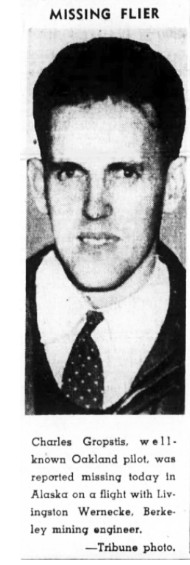 Missing are Livingston Wernecke, 2930 Avalon Avenue, Berkeley, mining engineer and manager of the Treadwell Yukon Corporation, Ltd., of San Francisco, which operates the Alaska-Juneau mine and other properties, and Charles Gropstis, his pilot, formerly of 1900 105th Avenue.
The two men left Oakland Airport a month ago for an aerial tour of the company's holdings in Alaska and British Columbia. Tuesday they took off from Hyder on the 200-mile flight to Alert Bay and fears for their safety spread when they failed to return the following day.
ON LEAVE FROM JOB
Gropstis was on leave from the Consolidated Aircraft Corporation at San Diego, and this was to have been his last flight in the north. At its conclusion he was to have headed for Oakland to see his family and then was to have continued on to San Diego.
The area in which the plane disappeared has been cloudy, with poor visibility, according to an Associated Press dispatch from Vancouver, B.C., and searchers were handicapped by these conditions.
The U.S. Coast Guard cutter Cyane entered the search today, starting out along the fliers' course, from Ketchikan. Joining in the search were British Columbia.
provincial police, units of the Canadian Navy, and planes of the Royal Canadian Air Force.
Wernecke is well known for his mining and geological work on the Pacific Coast. His wife, Mrs. Mabel Wernecke, is in Berkeley.
WIFE STILL HOPEFUL
Mrs. Wernecke refused to give up hope for her husband, pointing out that the plane was only two days overdue.
"My husband and his pilot are frequently delayed on these trips by weather conditions," she said, "and may be held over at some point where there are no communication facilities. This is especially true in the Fall season, when clouds and fogs may be expected. I do not think we need to worry yet."
Gropstis moved from his 105th Avenue home last Spring, settling in La Jolla, when he was employed by Consolidated in ferrying planes to the East Coast. He was on leave from the company to make the trip with Wernecke, whom he had piloted to Alaska on several previous occasions. He is an experienced Alaska flier.
His wife, Mrs. Marlea Gropstis, 28, has recently undergone a serious
operation and is living with friends in Alameda. She has not been apprised of the fact that her husband's plane is missing. There are two children, Sharlene, 5, and Marilyn, 3.
The Oregon Statesmen - Sunday, October 26, 1941

PRINCE RUPERT, BC, Oct. 25 - (AP) - Livingston Wernecke, Berkeley, Calif., mining man, and Pilot "Chuck" Gropstis, San Francisco flyer, are believed to have gone to their deaths last Tuesday when they attempted to land their pontoon-equipped plane on the narrow waters of Clam passage to aid two fellow Americans, whose Waco aircraft had crashed earlier.
The two in the Waco, Pilot Bud Bodding of Seattle, and Harry Sherman, Portland, escaped with head injuries.
Wrecks of both planes were found Saturday, ending a four-day search that extended the length of the British Columbia coast.
Radio reports pieced together here by Inspector Ernest Gammon of the British Columbia police indicate the Waco seaplane carrying Bodding and Sherman crashed in Clam passage, near Millbank sound, while headed north from Seattle to Alaska. Millbank sound is about half way between Vancouver and Prince Rupert.
The southbound plane carrying Wernecke and Gropsitis from Hyder, Alaska, to Alert Bay, BC, at the north end of Vancouver island, is believed to have spotted the) wrecked Waco and to have put down to give what help it could.
In landing, Wernecke's machine is believed to have struck the top of a tree. Both men were killed instantly.
Wrecks of both machines were within a quarter of a mile of each other in the narrow Passage.
Bodding and Sherman suffered head injuries, the western air command of the Royal Canadian air force at Victoria reported, and one of them had a broken wrist.
The Whitehorse Star - Friday, October 31, 1941
When Mr. Livingston Wernecke left the local airport southbound recently [October 17th] in his own Bellanca plane with his pilot, Charles Gropstis, at the controls it was little thought that they were both making their last airplane trip but such, unfortunately, it turned out to be. They were first reported missing [on October 21st] somewhere between Hyder, Alaska, and Alert Bay, B.C. A rain storm and poor visibility had been prevailing for most of the time the plane had been reported missing. Mrs. Wernecke was at Hyder at the time and she it was who first raised the alarm.
Planes of the Canadian Royal Air Force were sent in search of the missing plane as also was the U S. coast guard cutter "Cyane", despatched from Ketchikan at the instigation of Dr. E. Gruening, Governor of Alaska, and a Waco plane which was being flown north from Seattle by G. A. Bodding. Mr. P. R. Bradley, president of the Juneau Gold Mining Co., also wired from San Francisco appealing for a thorough search to be made for the two missing men.
At the inquest held in Prince Rupert before Coroner Watt the verdict of accidental death was given with no blame attaching to anyone. The chief witnesses were G. A. Bodding of Ketchkan, Alaska, and Harry Sherman of Dayton, Oregon, whose plane crashed on the same day in the same neighborhood. Bodding's plane was northbound and there was poor visibility. In the crash Sherman was rendered unconscious. When sufficiently recovered he and Bodding sighted Mr. Wernecke’s plane upside down among the wreckage drifting near shore with the two dead bodies inside.
Suffering from shock and exhaustion both Bodding and Sherman spent four days on the beach until finally rescued by police launch. Bodding gave it as his opinion that Mr. Wernecke and his pilot were looking for a place to land and in descending in a heavy fog hit a tree. The two bodes were taken to Prince Rupert on the U.S. coast guard
cutter Cyane and are being shipped to San Francisco for interment.
Throughout the Yukon this tragedy is deeply mourned. For quite a number of years Mr. Wernecke has worked laboriously in the mining industry in this Territory and it has been mainly through his instrumentality that the Mayo mining area has been developed to its present status. His untimely death is a severe blow to that camp. The
irony of it is, we are informed, that this was to have been the last trip which the late Mr. Wernecke and his pilot were to make as he had arranged to dispose of his Bellanca
plane on returning south.
His trusty pilot, Charles Gropstis, who leaves a widow and two children to mourn his loss, was admittedly one of the most experienced and efficient pilots who ever traversed the air-lanes of the north. Some time ago he was engaged in flying the
U. S. bombers, destined for England, from California to Montreal and we understood that upon arrival south he was to enter the U. S. government air service as an instructor.
To those who are left to mourn their loss we extend sincerest sympathy in their great bereavement on behalf and in the name of residents throughout the Yukon.
Loss to the Northland
A notable figure and economic factor in the affairs of the Northland was lost when Livingston Wernecke crashed to a tragic death in Millbank Sound last week. As geologist, mining engineer and business executive he was rated as one of the foremost of the mining world.
Identified with Alaska and Yukon since his youth, he was essentially a product of the North, devoting practically all of his busy span of life to its development and welfare. Taken from the midst of an active career, ripe with experience and at the head of many responsibilities, he was called when the industry and the region he served ill could spare him. The news of his passing came with a distinct shock to thousands who knew him and appreciated his extraordinary ability in his great field of service.
Long associated with large enterprises of the North, he participated in the Klondike gold rush, the building of the Copper River and Northwestern Railway, the development and operation of the Treadwell Alaska mine and - most notable of all - the opening of the Mayo silver-lead fields, which, through his genius more than any other became the largest and most outstanding producer of the kind in the North. His confidence and ability in that particular field saw it yield and give to the world millions of dollars of wealth through a period of over 20 years, and carrying on despite many handicaps to the day of his death. Due to his faith in the region and skillful guidance more than any other single individual the region has stood out as one of the great mining camps of the Northland.
It will be difficult to find a man to replace Livingston Wernecke in the role he played in progress of the Northland, but his works remain a monument to his name and an inspiration to all others in a similar field of endeavor.
|

|