
|





|
|
WB-50 weather plane crashes at Eielson, 1957
Arctic & Northern Aviation - Photos and History
The history of Eielson Air Force Base
Fatalities during USAF weather reconnaissance missions
 On January 17, 1957, Boeing WB-50D #48-093 of the 58th Reconnaissance Squadron (Weather), loaded with 10,000 gallons of fuel for a flight to the Aleutians and Bering Sea, crashed 2 minutes after takeoff from Eielson Air Force Base at Fairbanks, Alaska. All 12 men aboard the aircraft were killed:
- Captain Robert E. Eichelberger, 35, plane commander; wife and 4 children in Fairbanks.
- Captain William P. Spil, 38, weather observer; wife and 2 children in Fairbanks.
- Captain Harold W. Bales, 34, navigator; wife and 3 children in Fairbanks.
- 1st Lt. Ralph L. Sampson, 27, navigator; wife and one child in Fairbanks.
- 1st Lt. Robert E. McGough, 25, pilot; wife and one child in Fairbanks.
- 2nd Lt. Bobbie H. Spencer, 33, navigator; wife in Alaska.
- M. Sgt. Woodrow B. Russell, 40, flight engineer; wife and one child in Fairbanks.
- Airman 1/C John W. Cramer, 20, student crew chief; wife in Poughkeepsie, N. Y.
- Airman 1/C Donald W. Dodds, 20, dropsonde operator.
- Airman 2/C Robert C. Glenn, 19, radio operator.
- Airman 2/C Thomas F. Patterson, 18, crew chief.
- Airman 3/C Roger D. Sigmon, 20, radio operator.


A four-engined WB-50 Weather Reconnaissance plane
with 12 men aboard crashed and burst into flames shortly after its takeoff from Eielson Air Force Base at 6:45 this morning. Territorial Police reported there were no survivors.
The huge aircraft, loaded with 10,000 gallons of gasoline for a "Loon" weather check flight out over the Aleutian Islands and the Bering Sea, crashed about two minutes after its take-off at a point three miles north of the runway and about one mile from the Richardson highway.
The plane was blown to bits when its huge load of gasoline exploded on contact with the ground. The fire burned on a swath about 200 yards Jong and 50 yards wide which the flaming plane plowed as it hit the earth. A brilliant red flash shot up as the plane struck the earth, and this fire could be seen from both the field tower, and the Moose Creek Lodge on the Richardson Highway.
Normal Takeoff
The plane made a normal take-off on its 3,700-mile flight, and broke radio contact with the tower after takeoff, indicating that there was no emergency. The pilot radioed no hint of trouble previous to the crash. The 12 aboard had no chance to take to the parachutes, since the plane had probably not gained an altitude of more than 800 feet previous to the emergency.
Operates Lodge
Mrs. Jeanne Jones, who operates the Moose Creek lodge with her husband Thomas, said that those at the lodge at first thought the fire was a house burning.
"Then, we realized that we had just heard the weather flight pass overhead. It was the plane," she said. almost tearfully. She knows many of the people in the 58th Weather Squadron.
At the time of the crash, it was dark, light snow was falling, and the ceiling was down to 800 feet.
Eielson field fire trucks and ambulances quickly rushed to a point on the highway nearest the crash scene. Three snow weasels and other tracked vehicles plunged off the road into the snow toward the glowing remains of the plane. In their efforts to reach the aircraft, the Army and Air Force vehicles literally built a road through the wilderness to the crash.
Helicopter Dispatched
A helicopter from the 74th Air Rescue squadron at Ladd field also was dispatched to the scene. The helicopter flew low over the wreckage, shining a searchlight below. But there was no sign of survivors.
The tragedy took place in almost the same place where a weather squadron piane crashed several years ago.
The remains of the plane burned for approximately one hour after the crash. Finally, ground crewmen were abie to comb the wreckage, and found nine of the bodies. The search wes continuing.
Estimate Time
Base officiais estimate the time of the crash as about 6:48 a.m.
Names of the victims will be released tomorrow, after the next of kin have been notified. It is believed that a number of the men who perished had wives and children living in this area.
The last previous crash of one of the four-engined weather planes was last September along the Susitna river, north of Anchorage and far to the south of Fairbanks. Eleven men died in the wreckage. That crash came after a long period of safe flying on the regular weather runs to the Aleutians and to the North Pole.
The Air Force has made nearly 2,000 flights over the Aleutian-Bering sea circuit in the 10 years the weather operations have been conducted. More than 2,000 more have been made to the North Pole.


February 2, 1957, Fairbanks Daily News-Miner: "Informants said that plane had trouble getting off the ground because it was carrying a load of 170,000 pounds which, added to the ice that probably formed on the plane's wings that wet but freezing morning, made the plane extremely heavy.
It's also believed that one engine was feathered and perhaps reversed, thus tipping one wing and losing lift which might have kept the big aircraft from slamming to earth a few miles from the Eielson runway near the Richardson Highway.
After the crash, maximum loads for WB-50s were reduced to 150,000 pounds."
March 4, 1957, Fairbanks Daily News-Miner: "Lt. Col. Carl H. Morales, commander of the 58th Weather Sqdn. at Eleison, has called our attention to what he says are inaccuracies made in this column Feb. 20 about the crash of a WB50 in January.
The big weather plane, weighing 162,400 pounds with load, had no trouble getting off the ground and icing was negligible. The 162,400 pound weight was well within design limitations of the plane, a modified model of the B29.
The investigation board found no propellers reversed or feathered, that is in a neutral, non-drag position. Since the crash maximum take-off weight for the WB50s
has been restricted to 155,000 pounds.
The 58th's commander did not proffer any explanation for the crash. As we implied in the previous column, it probably happened from a combination of circumstances."
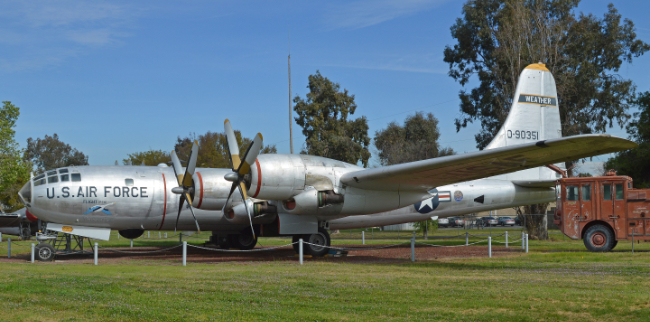
Boeing WB-50D Superfortress 0-90351 "Flight of the Phoenix," on display at the Castle Air Museum in Atwater, California. Photo shot on March 4, 2016, by Alan Wilson, used with permission.
|

|