
|





|
|
Pan American World Airways and Prince George, B.C.
1940 - 1941
Northern Aviation History
The history of Prince George Airport (Wikipedia)
Dateline: August 14, 2024.
The Vancouver Sun (Vancouver, B.C.), Tuesday, November 12, 1940

Canada and the United States have joined hands in Alaska and Yukon air transport.
Monday a great U.S. Army Bomber to be stationed at one of the new Alaskan air-bases, winged its way across central B.C. From Spokane the big ship jumped to Prince George where a magnificent natural air-field is being quickly improved.
Prince George, which is almost exactly the geographical centre of British Columbia, will also become the key point of a great north and south traffic in the air. Spokane to Prince George to White Horse to Fairbanks - these are the landing-places of the Alaska-Yukon traffic.
Hereafter American passenger planes will be routed through from Seattle to Fairbanks, via the inland plateau route across British Columbia, making stops
at Prince George and White Horse.
CO-OPERATION
New emergency landing-fields will be developed as quickly as weather permits. Pan-American is working hand in hand with Yukon Southern Air Transport Co. which has pioneered the route from Vancouver to White Horse.
Under the program, which involves the expenditure of about $100,000 on landing field, radio equipment and another unstated amount on at least six new fields on the Vancouver-Whitehorse route, Pan-American will have the use of every navigation facility available. Last Saturday, Joe Crosson, general manager of Pacific-Alaska Airways, subsidiary of Pan-American, arrived in Prince George in a giant Douglas transport plane with officials of the Civil Aeronautics Board of the United States and pilots who are being made familiar with the inland route.
THROUGH TRAFFIC
Mr. Crosson, veteran pilot, said PAA was assuming the full cost of installing new and more powerful radio equipment along the route, and that licences issued on Canadian territory would be carried by Yukon Southern Co. Of course, Canadian labour will be employed in the stations. The American company would not compete in any way with Yukon Southern, as PAA will not be allowed to pick up or disembark passengers in Canada.
Even PAA employees travelling from Seattle to Prince George will not be allowed to ride in
one of the company's planes, but must use the facilities of a Canadian company. Pan-American will confine itself to Seattle-Alaska traffic and Yukon Southern to the Vancouver-Whitehorse run, with both companies co-operating fully in the use of radio, landing fields, etc.
Prince George will be a main junction point for PAA, and construction of a modern administration building at that airport is planned at the expense of PAA.
Work has already started in increasing the power of the radio equipment at Prince George, where both long and short-wave frequencies are being installed. Present power of the short-wave apparatus, 60 watts. is being increased to 450 watts.
STEPS UP RADIO
The long-wave transmitter will be increased from 150 watts to 1200 watts and this will be one of the main direction-finding stations for navigation on the route.
Two 450-watt stations are to be installed at Fort Graham, about 300 miles north of Prince George, and at Dease Lake, for giving weather reports and direction finding and planes will also be able to "home" to these stations. Power is also being
increased at Fort St. John, Fort Nelson and Watson Lake. It is expected these will be 450-
watt stations.
It is hoped that range stations may shortly be installed north of Prince George and, though this is not official, it is stated Prince George may have a range station to enable beam flying.
Under the plan for landing fields at least six locations have been approved and work is already under way at some points. A field will be constructed in the
near future on the Conroy River, almost half way between Fort St. John and Fort Nelson. There will be another field in the Grand Canyon on the Liard River between Fort Nelson and Watson Lake, one at Wolfe Lake, between Watson Lake and Teslin Lake, and another at Teslin.
AIRPORT WORK
The field at Fort Nelson is open for use but further work will be necessary, while at Watson Lake, runways have been cleared, with some stumping yet to be done and grading of runways carried out.
A. D. McLean, superintendent of airways for Canada at Ottawa, and W. J. Lawson, district superintendent for Western Canada, based at Lethbridge, recently flew over the Yukon Southern route with Grant McConachie, president of the company, and
expressed complete satisfaction with locations and the amount of work done.
The whole scheme of things has apparently been under careful study of both Canadian and American authorities for some time, as U.S bombers have already gone north to Alaska over the B.C. route.
The Daily Province (Vancouver, B.C.), Wednesday, November 13, 1940

By CHARLES BISHOP.
OTTAWA, Nov. 13. - A permit has been issued to Pan-American Airways, noted U. S. firm, to stop at a point in British Columbia for emergency refuelling when flying conditions are such as to render unsafe the route from Juneau to Seattle.
"It is purely for emergency purposes," said Commander C. P. Edwards, head of the department of transport branch dealing with such matters.
"Pan-American planes can stop anywhere they want to, under the condition stated," he explained. "It may be at Prince George, where the Yukon Southern has a base.
"It does not mean that the Pan-American will be establishing a regular service in Canadian territory, but only that in case of bad flying conditions they can come inland to refuel."
PRINCE GEORGE, Nov. 13. - A party of 11 Pan-American Airways officials is expected here shortly to survey Prince George airport, where some $25,000 will be spent establishing a weather bureau and radio-beam station.
J. C. Morrison, in charge of operations here, said Pan-American would open a twice-weekly service between Seattle and Fairbanks on January 1. A fleet of 17-passenger planes will make use of local airport radio facilities.
The advance party landed here Saturday en route to Fairbanks, and is expected to stop off tomorrow on its way back to Seattle.
Three radio transmitters and receivers will be installed at the airfield and arrangements have been made to carry power to the field.
The Vancouver Sun (Vancouver, B.C.), Tuesday, January 14, 1941
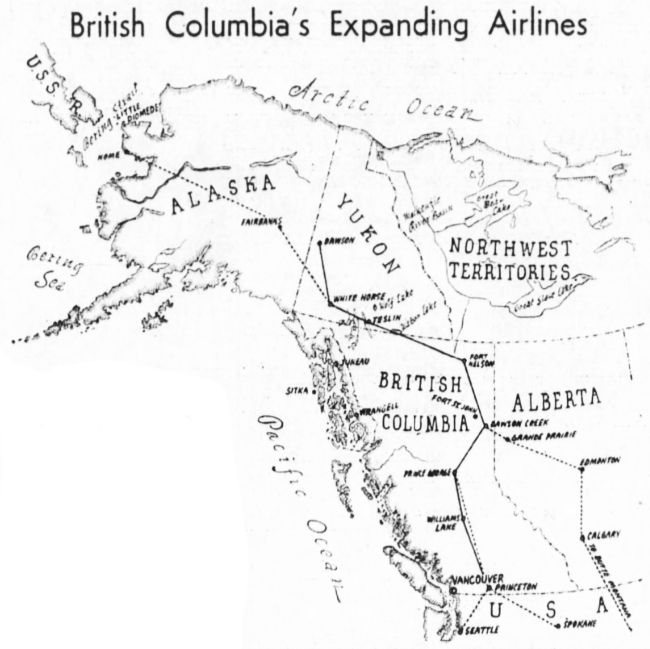
This comprehensive map shows the air lines leading through British Columbia, Alberta, Yukon and Alaska which have been so importantly thrust to the front by
recent developments.
The solid lines shown running out of Vancouver and Edmonton are the routes of Yukon Southern Air Transport to the Yukon. A little over two months ago, Pan American Airways officially abandoned the coast route from Seattle to Alaska in favor of the inland route, and the broken line represents the course taken by that company's plane to Fairbanks on the twice-weekly schedule. Another broken line from Spokane indicates the course of U. S. Army bombers and fighters travelling to Alaska bases. This course may also be used by Northwest Airlines on a service from Spokane to connect with Yukon Southern at Prince George, although it is not official.
The dotted line from Butte, Montana, indicates the flight of Western Air Express planes to Lethbridge, connecting with TCA, which travels on to Edmonton, where connection is made with Yukon Southern. This route will also more than likely be used by U. S. Army planes going to Alaska from Eastern American bases.
Present navigation aids on the Yukon Southern route with the exception of the run from Princeton to Vancouver on the TCA beam, consists of radio compass and direction finding equipment, but most modern range stations are now to be installed along the line at a cost of near half a million dollars. Prince George, now a great centre of aviation, will have beam equipment installed, as will either Dawson Creek or Fort St. John and Fort Nelson, Watson Lake, either Wolf Lake or Teslin Lake, and Whitehorse. This will enable flying under conditions not now possible, and night flying equipment is ready to be shipped to Whitehorse, which may herald the start of plans for night flying on the route.
There will be no beam equipment between Prince George and Princeton and the gap between the end of the south leg of the Prince George range and the top of the north leg of the Princeton range will be very small and direction finding equipment can be used.
There is already an excellent field at Prince George and there are fields at Dawson Creek and Fort St. John. The field at Fort Nelson is being used, but will be improved, a start has been made on the Watson Lake field and work is expected to be underway shortly at Teslin Lake and Wolf Lake.
The broken line running from Whitehorse to Fairbanks represents the route of Pacific Alaska Airways, subsidiary of Pan American. Pacific Alaska planes connect with Yukon Southern ships at Whitehorse. The line extending to Nome will possibly be the course
taken by planes on a service to the Orient after the war. At some points it is only a
few minutes' hop from American to Russian territory.
The Daily Province (Vancouver, B.C.), Friday, February 14, 1941
By MAX BOYD
Associated Press Staff Writer.
WASHINGTON, Feb, 14. - The problem of getting large numbers of American fighter planes to Alaska quickly in an emergency appeared on the way to a solution Thursday when the Canadian Government announced it would complete a $9,000,000 chain of flying fields between the United States and her northern territory this summer.
No agreement authorizing the United States to use the projected fields was announced, but it was assumed American planes would have that privilege if an invasion
were threatened. There was speculation in some quarters that the right to use Canadian
airports immediately after completion might become the consideration for British use of American army and navy equipment if Congress passes the lease-lend bill.
Principal value of the Canadian facilities to United States fighting forces would be to provide means of getting short-range fighter planes to Alaska immediately in an emergency.
Use of the closely-spaced fields would also increase the practicability of transporting troop reinforcements and supplies to the territory by air if they were
needed urgently, or if enemy warships interferred with ocean shipping.
OTTAWA, Feb. 14. - Two thirds of air-base expenditure will be on works within the interior of British Columbia and Alberta, and the remainder on Pacific Coast bases, G. C. Power, minister for air, announced Thursday.
The minister was reticent regarding details of the plans for the system of airports, but from well-informed sources it was learned the plan provided for construction of seven bases, from Edmonton to Whitehorse in the Yukon. At this terminus
the service would connect with Pan-American Airways, which operates along the coast from Seattle to Alaska.
The Cariboo Observer (Quesnel, B.C.), Saturday, February 15, 1941

G. E. Bassett, Seatlle, general manager of Pan-American Air Lines for
the route between Seattle and Alaska, passed through town last weekend en route to Prince George driving a new bus for use at the Prince George air field. From Prince George Mr. Bassett planned on taking one of the company's planes north on an inspection trip.
While here Mr. Bassett stated that Government regulations call for an
alternative field, and that the new Quesnel fleld, which has just been laid out and inspected by the Federal Government inspector, will probably be put into condition for this purpose.
Negotiations are being carried out at the present time between the Village Commissioners and J. G. Turgeon, Federal member for Cariboo, with regard to the construction of the field. When a local field was first mooted, various sites which would
combine facilities for both land and sea planes, were inspected, but all were considered too dangerous owing to bad air currents.
The new landing field on three mile flat is considered one of the best locations in the interior, being practically free from fog and a mile and a half long by a mile wide, and able when completed to handle the largest ship. Efforts are heing made to have construction start in the spring.
The Daily Province (Vancouver, B.C.), Thursday, March 6, 1941
PRINCE GEORGE, March 6. - (CP) - The Dominion Government plans to spend between $350,000 and $400,000 on a new airport at this central Interior town, and preliminary surveys of the proposed site already have been completed, it was reported here today.
The new field is to be ultra-modern with night-lighting, range-finding and facilities for beam flying, it was reported. It would be fully-equipped and have
concrete runways. Construction is expected to begin withia the next few weeks.
The new Prince George airport might be one of the main links of the projected skyway chain leading into the north country recently announced at Ottawa.
Pacific Alaska Airways, subsidiary of Pan-American Airways, sometimes use Prince George as a stop-over in the north country and have established hangars and equipment. Several times, the northern interior town has been used as a stop-over for United States military planes flying to and from Alaska.
The Vancouver Sun (Vancouver, B.C.), Saturday, March 8, 1941

Canada will give free access to United States airlines to fly their planes across Canada to Alaska, but they are not allowed to do any Canadian business.
Recently, the Northwest Airlines proposed to inaugurate a service, Minneapolis to Winnipeg to Edmonton to White Horse to Dawson and Fairbanks.
Yes, replied the Canadian government, but you must not pick up any Canadian traffic in Winnipeg, Edmonton and White Horse.
This is practically the same arrangement as was applied to Pan-American Airlines which operate from Seattle to Prince George to White Horse and
Fairbanks,
Only through Amercan traffic is to be handled over this service.
The inter-Canada business is left for development to Yukon Southern (affiliated with the C.P.R.) and any other purely Canadian companies.
Canada is planning to spend $7,000,000 in a chain of air-fields in British Columba and Alberta. Estmates for the Prince George airport run all the way from
half to three-quarters of a million dollars.
Prince George will be the key point.
It is located in the exact geographical centre of B.C. New fields are under construction today at Fort St. John and Fort Nelson.
There will be a vast commercial expansion in aviation all through the northwest this year.
The Daily Province (Vancouver, B.C.), Wednesday, November 13, 1941

The new Lockheed Lodestars are certainly living up to their reputation as the world's fastest commercial transport planes. On Thursday a TCA Lodestar, with a favorable wind, set a new record of 2 hours and 11 minutes for the 469-mile hop from Lethbridge to Vancouver. The plane was piloted by Captain Art Rankin, and Danny Driscoll was first officer.
Another Lodestar to set a record was Pan American's, travelling non-stop from Juneau, Alaska, to Seattle, via Prince George, in just under 4 hours and 20 minutes. It would not be surprising to see a few more Lodestars flying around Vancouver shortly.
* * *
Crown lands for airport sites in the federal government's new chain across northern British Columbia will be deeded free to Dominion authorities for the purpose, Hon. A. Wells Gray, Minister of Lands, said in Victoria today.
The Minister said federal officials have discussed with the province the areas needed for the new airports. While the surveyed sites have not been completed in some instances they will be turned over as they are. The Minister mentioned specifically sites at Prince George, Smithers and Watson Lake.
|

|
