



|
|
Cat train to the Fort Nelson airport site, 1941
Yukon Southern Air Transport
Arctic & Northern Aviation
Dateline: August 17, 2024.
The Vancouver Sun (Vancouver, B.C.), Friday, April 4, 1941

By JACK MEEK
Vancouver Sun Financial Editor
The story of the Trail of '98 over which thousands trekked into the Yukon for gold will always be told but none the less interesting, over the years to come, will be the tractor train which pushed its way through 400 miles of northern British Columbia fighting all the vagaries of nature to establish a road from Fort St. John, in the Peace River Block, to Fort Nelson, about 800 miles north of Vancouver.
Arrival of the first section of the tractor train on Monday at the site of the Fort Nelson airport, one of the group of fields being constructed under the Canadian-United States defense pact made history, not only from an engineering standpoint, but marked the approach of a new era in which that great country is to come into its own through a vast development, undreamed of, unthought of by even the most optimistic who have placed their faith in it, struggled to wrest a living from it and master it.
For 50 days, from the departure of the tractor train from Dawson Creek, until arrival at Fort Nelson this week, 28 men, who formed the crew of the first section
fought the merciless cold of the Northland, plowed through deep drifts of snow and braved sleepless nights, working 11½ hour shifts to get the road through before the ice went out of the rivers so that tons upon tons of materials could be transported north for the construction of the Fort Nelson airport. Twice, a mighty 17-ton bulldozer, which led the train, biting into the earth and making the road, broke through the ice of the Sikanni
and Muskwa Rivers.
City Man Drives Bulldozer
The writer flew from Vancouver to Fort Nelson with Yukon Southern Air Transport to meet the tractor train on the last lap of its journey and apart from the marvellous job done, the most striking feature was the nonchalance of the crew. They went about their work as though it were an everyday job, seemingly oblivious of the history they had made in pushing the road through under what at times were almost insurmountable difficulties.
Not the least of these was Glen Miniker, who, with three other men set out from Fort St. John on January 26 to survey the proposed route by dog team, arriving in
Fort Nelson on March 17. They fought their way through three feet and more of soft snow, breaking trail for the dogs all the way, blazing trees as they went for the tractor train to follow. They went a month at one time without seeing another person and on two occasions, a plane was sent out to check on their position.
Vancouver was represented on the expedition by Joe Holt, who formerly resided in this city and is now homesteading at Mortney, 16 miles north of Fort St. John. His parents, Mr. and Mrs. George Holt, live at 145 West Eleventh Avenue. Joe was one of the bulldozer drivers and was at the controls when the machine crashed through the ice on the Muskwa River, staying at his post as the bulldozer settled into the water with motor still running. The trip was a great experience for him, although he drove a bulldozer in
the construction of the road leading from Dawson Creek to the oil well being drilled by the government at Commotion Creek.
Eight Days Lost Making Repairs
The first train left Dawson Creek for Fort Nelson on February 9. This was the caboose made up of four sleds, containing a cook house, three bunk houses, office and radio room. The train was in constant touch by radio with Yukon Southe#n Air Transport stations along the line. A second train carried about 50 tons of materials, including fuel oil, portable sawmill, blacksmith shop and two diesel engines for a power plant.
Throughout the trip, the train averaged about 8 miles a day. Eight days were lost due to damage to tractors and mechanical troubles. At one point a large tree fell over the bulldozer, smashing the radiator and tying up the machine from 2 a.m. until 4 o'clock the next afternoon. Without the blacksmith shop, which was on the second train, it was necessary to travel back to Fort St. John with a smaller tractor to make repairs to the radiator.
J. H. Higgins, foreman, said it was the roughest ride he had ever had, the small tractor, equipped with rubber tires, travelling 20 miles an hour over the road
which had only been bulldozed.
A second trip had to be made to Fort St. John later when the tightening tracts on the bulldozer broke, This necessitated an all night ride.
Machine Sinks in Quicksand
The next event of importance was the bulldozer going through the ice on the Sikanni River. At this time of year much of the ice on the rivers is overflow and about 18 inches of the more than two-foot thickness was rotten ice. For a while, the crew thought the bulldozer would be a complete loss as it started to settle in quicksand. By the time ice was cut away to make a channel to pull the machine out, it had sunk three feet into the quicksand and only a small portion of the cabin was showing above the
five or six feet of water in which it rested. This resulted in an 18 hour delay.
The next ducking for the bulldozer was on the Muskwa River, about three miles from Fort Nelson and four miles from the airport site, which was its destination. The ice gave way when the bulldozer was some 30 feet from the river bank and the crew was forced to saw out huge chunks of ice before the machine could be pulled out by two other tractors, However, less than four hours later it was again busy making road on the last lap of its journey.
It was at the Muskwa River where Indians rushed to see the giant machine do its work. They waited on the river with their dog teams and could hear the bulldozer approaching. Suddenly it emerged from the bush on the river bank, pushing trees, boulders, dirt and snow ahead of it like a monster on a rampage. It came as such a surprise to the
Indians that many of them fled, screaming. They called it "Bad Devil" and at least 10 of them refused to come back. They had never seen such a thing before and were deathly afraid of it.
1000 Tons Freight Before Breakup
It is planned to take about 1000 tons of freight over the road to Fort Nelson before breakup. At present, trucks are running from Fort St. John over the road to
the Sikanni River and leaving freight there to be taken the rest of the way by tractor and sleds. Some 400 tons is now lying at the Sikanni River waiting to be hauled in.
It is a rush against time as the ice is not expected to hold out for more than another week or two, at least as far as transportation of heavy equipment is concerned, and if the job is not completed in time, the freight will either have to
he taken down numerous rivers by scow to Fort Nelson, or carried in by plane.
Whatever happens now, there is one man who is more than glad the trip is over, although he said he wouldn't hesitate to do it again, He is Ole Hovland, the cook, and he probably had the roughest time of all. Ole would be working over the cook stove
when the train would suddenly start moving, sending him plunging the length of the cookhouse to the back door. More than once, big metal coffee and tea pots hanging from the rafters would drop down on him with a sudden lurch of the train.
Many times during the trip men eating in the cookhouse would suddenly find their meal resting in their lap after the train had gone over a rough spot in the road, but the real hazard was cake making. Two or three lurches of the cookhouse found a
cake sadly sinking in the middle and Ole soon learned there was little use trying further.
Lodestars for Yukon Southern
Vancouver figures prominently in the whole scheme of northern airport development, for while the undertaking is primarily for defense, it will form part of the future route to the Orient, with this city and Edmonton being jumping off places.
The route over which the air bases are to be constructed was pioneered by Yukon Souther Air Transport, operating out of Vancouver and Edmonton to Whitehorse. Grant MeConachie, president of the company; Chief Pilot Captain Sheldon Luck; Captain Ted Field, operations manager, and others who developed the company from its bush flying days to the present mainline operation, are now realizing the fruits of their efforts.
The company started with open cockpit planes operating a fish-haul in Alberta. Always with an eye to the Yukon they built the company to a point where they received a mail contract for a once-weekly service to Whitehorse. This grew to two trips weekly, and the company's latest schedule lists three trips a week starting June 1.
Also, the company will take delivery of the first of two new Lockheed Lodestars either this afternoon or on Saturday. Mr. McConachie passed through Vancouver Wednesday to meet the planes in Portland.
Thus the world's fastest commercial transport planes will be operating out of Vancouver for the north, augmenting the fleet of three Barkley Grows and other aircraft already in use by the company. When the war is over and the great north circle route becomes the airlane to the Orient, great sleeper planes will fly overnight from
Alaska and the Yukon to Vancouver.
Airports for Largest Planes
The Government is leaving no stone unturned in making a thorough job of the airport scheme in the north. Work is to start soon on a new field at Prince George, also at Fort St. John and Watson Lake. It Is possible that a new field will be constructed at Williams Lake. All these tie into the defense scheme and the post war development to
come.
The Watson Lake field is a big undertaking. Fourteen scows and three boats are now being constructed in Vancouver at a cost of $100,000 to carry supplies and airport equipment into Watson Lake. They will be knocked down and shipped to Wrangell, Alaska, and from there up the Stikine River to Telegraph Creek. From Telegraph Creek they will be transported 72 miles by road to Dease Lake, then assembled and pulled up the Dease and Liard rivers to Lower Post, where a 25-mile road is being constructed to Watson Lake.
By next fall the north will have the same navigation aids enjoyed by TCA and the large air transport companies in the United States. There will be beam equipment at Prince George, Fort St. John, Fort Nelson, Watson Lake and Whitehorse, all on the Yukon Southern Air Transport route and runways to be put in will accommodate the largest aircraft. Runways will also be ready for winter use and will be hard-surfaced in the sum:
mer of 1942,
The north is really coming into its own.

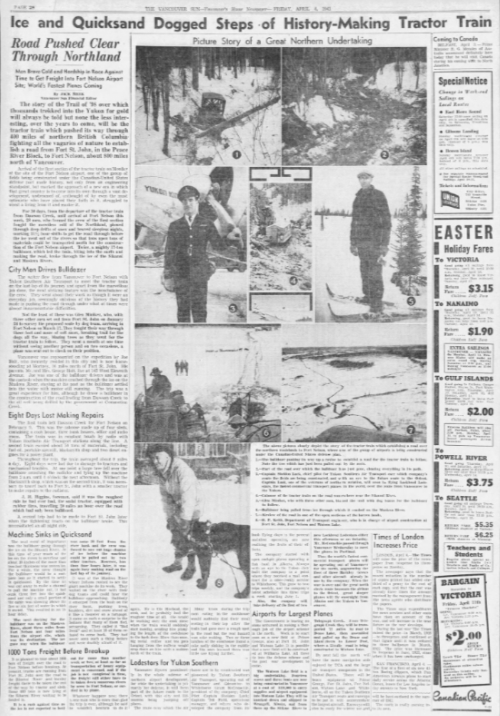
The pictures below clearly depict the story of the tractor train which established a road over the northern wastelands to Fort Nelson, where one of the group of airports is being constructed under the Canadian-United States defense plan.
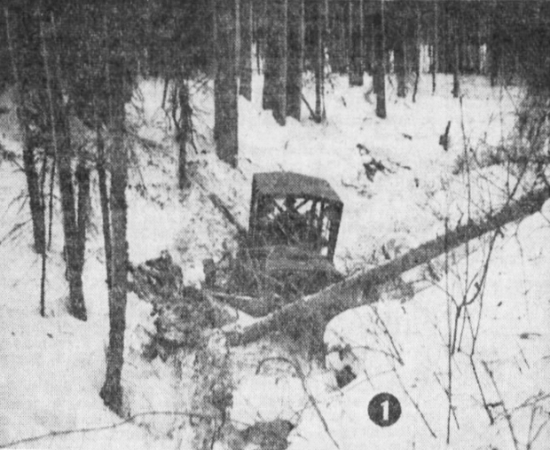
1.-The bulldozer pushing its way up a ravine to establish a road for the tractor train to follow. Note the tree which has just been pulled out by the roots.
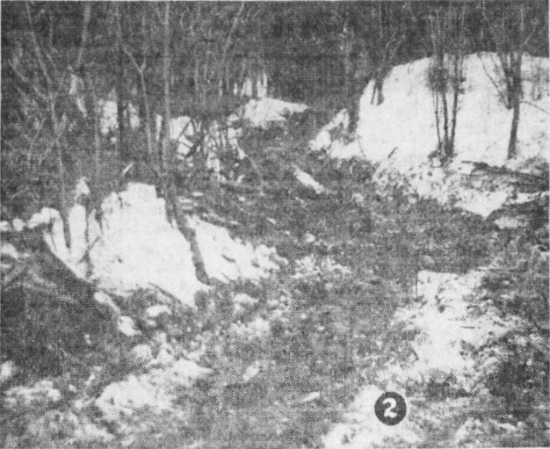
2.-Part of the road over which the bulldozer has just gone, clearing everything in its path.
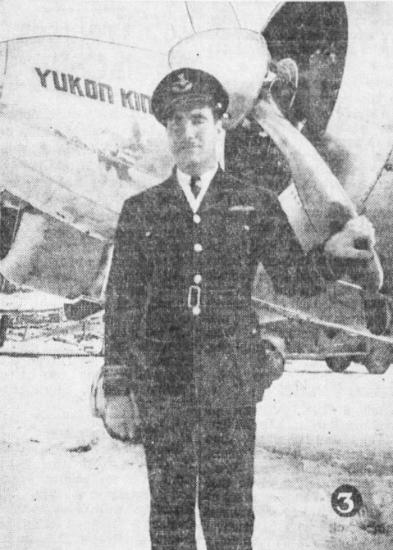
3.-Captain Sheldon Luck, chief pilot for Yukon Southern Air Transport over which company's route the fields are being constructed, and with an eye to the future route to the Orient. Captain Luck, one of the veterans of northern aviation, will soon be flying Lockheed Lodestars, the fastest commercial transport planes in the world, over the route from Vancouver to the Yukon.
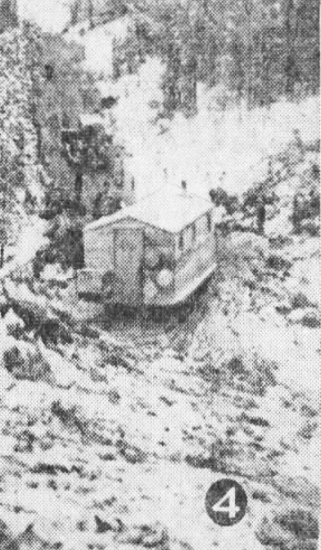
4.-Caboose of the tractor train on the road somewhere near the Sikanni River.
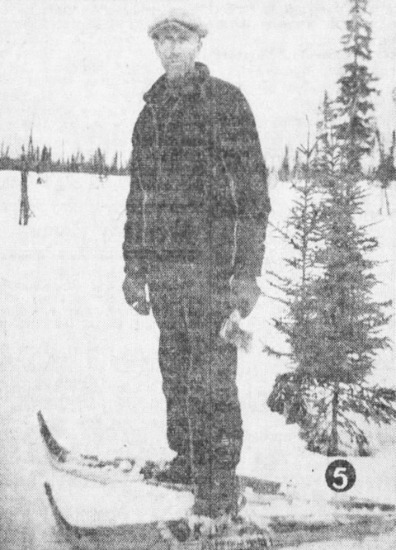
5.-Glen Miniker, who with three other men, blazed the trail with dog teams for the bulldozer to follow.
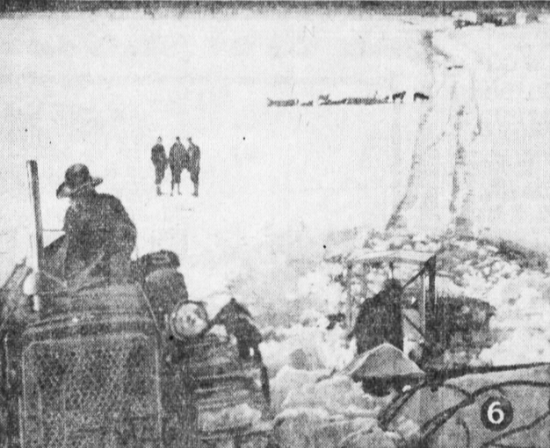
6.-Bulldozer being pulled from ice through which it crashed on the Muskwa River.
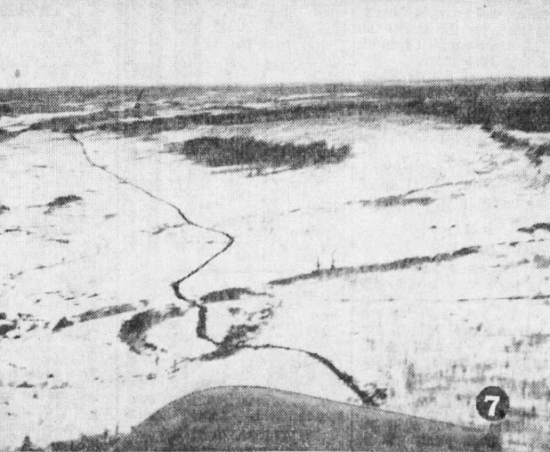
7.-Airview of the road in one of the open sections of the barren lands.
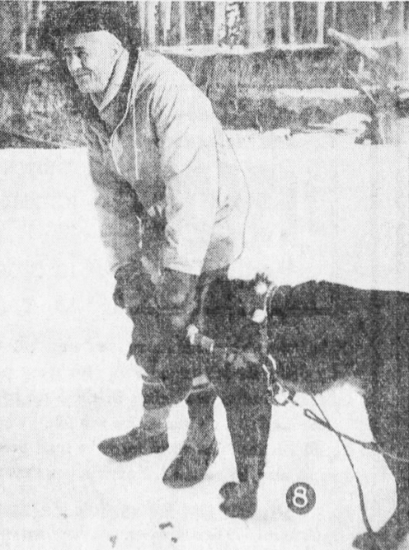
8.-H. P. Keith, Department of Transport engineer, who is in charge of airport construction at Fort St. John, Fort Nelson and Watson Lake.
Below, the original page layout.
|


