Carl Ben Eielson, Alaska Aviation Pioneer
Dateline: April 24, 2023
This chronology up to January 9, 1930, was published on Page 8 of The Fairbanks Daily News-Miner on Thursday, January 9, 1930. Additions to the chronology past that date were created from News-Miner files by the ExploreNorth editor. Details with complete newspaper articles can be seen at "The search for Carl Ben Eielson, 1929-1930".
Two months ago today, on November 9, 1929, a Hamilton monoplane set out from Teller for Cape North, Siberia, with Colonel Ben Eielson, executive vice-president and general manager of the Alaskan Airways, at the controls and Earl Borland accompanying him as mechanic.
Flying beside them in a Stinson biplane was Frank Dorbandt. When they came across Bering Sea a high fog bank was encountered. Dorbandt turned back to Teller. So far as any absolutely authentic information which bas been learned since then he was the last to see the Hamilton as Eielson continued to send the big air cruiser hurtling onward through the fog toward Siberia.
Since the disappearance of the airmen one of the most extensive searches in the history of the flying industry has been organized and the Aviation Corporation, of which the Alaskan Airways is a subsidiary, has announced that no expense will be spared in finding the fliers.
To make clear the events which have taken place a chronological account of the Siberian flight and the relief work that followed is given here:
Oct. 23, 1929. Ben Eielson announced in Fairbanks that his company had contracted with the Swenson Fur & Trading Corporation to bring 15 passengers and six tons of fur from the Nanuk to Alaska.
Oct. 25. A snow storm between Fairbanks and Ruby prevented Ben Eielson from leaving here.
Oct. 28. At 10:15 the Hamilton monoplane, carrying Eielson and Borland, left the local airport for Nome.
Oct. 30. Word was received at Nome that Pilot Frank Dorbandt had arrived at the Nanuk the previous day on the first ferrying trip between Alaska and Siberia. Eielson and Borland were at Nome.
Nov. 2. An Associated Press dispatch from Nome said Eielson, Borland and Dorbandt were overdue on the return flight from Cape North. It was believed that they
had run into a snow storm near Bering Strait and landed teo wait for better weather.
Nov. 3. No word was received from the fliers.
Nov. 5. The planes returned to Nome the previous day, having, as had been supposed, been forced down on the Siberian coast because of a storm. Dorbandt brought four passengers from the Nanuk and a load of fur and Eielson four passengers and fur. "Fine landings all along Siberian coast," said Eielson in a wire sent to Charles L. Thompson,
Alaskan Airways manager.
Nov. 9. The two planes took-off from Teller on the second flight. Dorbandt returned because of fog but Eielson and Borland kept on.
Nov. 16. The Nanuk reported Eielson and Borland had not arrived there.
Nov. 18. The local Airways office received a copy of the following wire sent by Olaf Swenson from the Nanuk: "Eight days ago just as it was getting dark with bad visibility Eielson circled around a native's house 60 miles from here but did not land. Another Russian trapper heard the plane about 50 miles from here. Cape Serge natives who have just arrived report there has been no visibility for the last few days. Think Eielson is somewhere along the lagoon east of here. If weather permits tomorrow will send dog team in an endeavor to locate him."
A relief expedition was Being organized by this date but the first of
a long series of accidents were already beginning. Dorbandt at Teller smashed the axle of his Stinson biplane and H. W. Barnhill put a New Standard out of service when a wing was damaged while he was attempting to take-off from the Anchorage field for Fairbanks. From
here he was to fly to Siberia. Manager Thompson was negotiating with Bill Graham, Nome flier, for the Stinson-Junior plane which is operated with Nome as a base.
Nov. 19. The Nanuk reported that word had reached Cape North that the Hamilton plane had been wrecked but this rumor was never confirmed.
Nov. 21. Swenson announced a dog team would be sent out from the Nanuk to the vicinity where the Hamilton was reported to have been seen. Dorbandt reached Nome to have repairs made to the Stinson's damaged axle.
Nov. 22. The Russian trader who last heard the plane's motor believed the ship was traveling inland and expressed the fear that it might have crashed into a mountain 10 miles from the coast. Three more dogteams were sent out from the Nanuk.
Nov. 23. Bad weather kept Pilots Young and Barnhill from leaving Fairbanks to join in the search.
Nov. 25. Barnhill and Young left Fairbanks but were held at Ruby by snow.
Nov. 26. At Nome Dorbandt awaited the arrival of the planes from Fairbanks to fly to Siberia.
Nov. 27. A native dog team driver who arrived at the Nanuk the previous day said he saw smoke in the foothills about 35 miles from the ship. Hope for Eielson and Borland was revived. Because Young and Barnhill were still at Ruby, Dorbandt took-off from Teller for Siberia alone. Good weather was the most pressing need, stated Manager Thompson as plans were being made to mobilize the entire Alaskan Airways personnel and fleet in the search.
Nov. 29. Dorbandt could not get sufficient speed out of his engine and had to return to Teller. Crosson arrived at Nome and Barnhill returned to Fairbanks with a plane which had been damaged at Ruby.
No. 30. Word was received that Joe Crosson had covered the entire distance between Fairbanks and Teller in a single day instead of stopping at Nome. Bad weather prevented the planes from leaving for Siberia. A dog team whose driver interviewed the Russian trapper returned to the Nanuk and it was said the trapper believed the Hamilton was flying offshore instead of inland.
Dec. 2. Bad weather continued. Matt Nieminen left for Teller but had to return to Fairbanks on encountering fog near Hot Springs.
Dec. 6. There had been no break in the weather in the interim. Nieminen was again forced back to Fairbanks on this date.
Dec. 7. Joe Crosson and Frank Dorbandt tried to leave Teller but both planes were damaged. Secretary of the Interior Ray Lyman Wilbur called upon the war department to aid.
Dec. 9. Pilots Barnhill and Moller arrived at Nome en route to Teller. Ed Young and Harold Gillam took-off from Fairbanks, Young having previously returned from Ruby. Noel Wien, first to make the Alaska-Siberia flight, expressed concern for the lost airmen.
Dec. 10. A heavy fog prevailed at Teller, while the weather was clear at Cape North. Young and Gillam arrived at Teller.
Dec. 11. Fog conditions continued.
Dec. 12. Weather still unfavorable.
Dec. 13. No breaks in weather yet. Nienminen and Alonzo Cope, mechanic, reached Nome, flying direct from Anchorage. Vilhjalmur Stefansson, famous explorer, urged that
further relief operations be set in motion as speedily as possible.
Dec. 14. The fliers were still held on the ground by bad Weather at Teller. Noel Wien volunteered his services to aid in finding Eielson and Borland but the Aviation Corporation from its New York offices explained all arrangements had been made. The coast guard cutter Chelan was detailed to bring three Fairchild planes owned by the Aviation Corporation to Seward. The Rutledge Airways, Ltd. of Calgary offered planes to Stefansson if he wished to organize an expedition.
Dec. 17. There was no break in the weather.
Dec. 18. Ed Young, Harold Gillam, H. W. Barnhill and Joe Crosson left Teller for Siberia. All were forced to turn back when they struck fog over Bering Strait.
Dec. 19. Crosson and Gillam took-off again and did not return to Teller during the day.
Dec. 21. Gillam reached Cape North after spending a night in the open. The Chelan left Seattle with the Canadian fliers and the Fairchild planes. Crosson arrived later the same day. Gillam made an hour and a half search flight. The Alaskan Airways hangars at Fairbanks were destroyed by fire, a Stinson plane brought from Nome the same day by Nieminen being destroyed.
Dec. 24. Secretary Wilbur and Senator Borah appealed to the Soviet government to aid in the search.
Dec. 26. The Canadian fliers and the Fairchild planes arrived. In the expedition were Capt. H. A. Oaks, Major Howard C. Deckard, T. M. "Pat" Reid, Wm. Broatch, Gifford
Swartman, Billi Hughes, C. T. F. Mews and Sam Macauley. The Soviet government gave assurances that an airplane expedition would be organized. Crosson and Gillam flew from the Nanuk but had no success.
Dec. 27. Work was speeded on the assembly of the Fairchild planes. Burning of the Nome radio station Christmas morning made transmission of news from Cape North slow.
Dec. 28. One of the Fairchilds was test flown by Pilots Reid and Swartman. The Russian government started organizing a three plane expedition. Wrangell Island was instructed to send out weather reports by radio daily.
Dec. 29. The captain of the Soviet steamer Stavropol reported that Eielson was believed to have been sighted by natives in the vicinity of Tchutkotsky Bay. Other reports said natives saw smoke in the vicinity of Vankarem, west of Koliutchinsky Bay, and Russian hunters sighted a plane a few miles west of there. The plane was said to have circled twice over the camp before disappearing toward the west.
Ivan Chuknovsky, one of the Russian filers who aided in the rescue of survivors of the Nobile expedition, prepared to leave for Cape North with Pilots Strabue, Alekseev and Sterligov.
Capt. Broatch, Canadian pilot, started back for the States on Sunday, Dec. 28. Those in charge of the Fairchild expedition announced two planes were ready to leave the following morning.
 Jan. 2, 1930. A Fairchild monoplane that was trying to get into the air for Nome, piloted by Gifford Swartman, was wrecked beyond repair.
Jan. 3. Another Fairchild was ordered from the States to replace the one wrecked the previous day. A dog musher arriving at Nome reported that a plane had been heard soaring over Pilgrim Springs at midnight on the day Eielson left Teller for Siberia, leading to the theory that the fliers may have turned back toward Teller in an effort to land safely. Bad weather prevented relief planes from leaving Fairbanks.
Jan. 4. Two Fairchilds, one piloted by Matt Nieminen and carrying in addition Major Deckard and Macauley and the other piloted by Reid and carrying Hutchinson and Hughes, left Fairbanks for Nome.
Jan. 6. The plane piloted by Reid was missing. He had become separated from Nieminen in a heavy snow storm near the coast and Nieminen turned back to Nulato, where he landed safely.
Jan. 7. Reid was not heard from and stormy weather prevented any search for him.
Jan. 8. The weather became worse and searching flights could not be made.
Jan. 9. Continued low visibility to the westward kept Nieminen and Dorbandt on the ground. The army admitted that it has no planes suitable for use in Alaska during the
winter. Two Fairchilds will be sent from Oklahoma to Fairbanks, it was announced.
Jan. 10. After several days of bad weather during which it was impossible for
airplanes to leave the ground, the search for Pilot Pat Reid and Jim Hutchinson and Bill Hughes got underway with the departure from Nulato of a Fairchild monoplane piloted by Matt Nieminen.
Jan. 13. Concentration of Alaskan Airways and Canadian fliers at Nome for a conference is the latest development in the Eielson-Borland search. Pilot Matt Nieminen has already arrived there with Major Howard Deckard and Sam Macauley and Pilot Reid, Jim Hutchinson and Bill Hughes are now scheduled to fly there from Unalakleet instead of returning to Fairbanks for repairs. Pilots Young and Dorbandt have heen ordered from Teller to Nome to participate in the conference.
Jan. 14. A woman near Cape Serdze, which is southwest of East Cape and between there and Koliuchin Bay, reports having sighted Eielson's plane about noon and heard it about three hours later. The date when this occurred was not mentioned, which leaves the
whole issue in confusion.
Jan. 14. Flying the Alaskan Airways red Swallow biplane, Pilot Gifford Swartman hopped off for Nome at 9:30 this morning to join the Eielson relief expedition. With him were C. F. Mews, mechanic, and Sergeant William Glasgow of the United States Signal Corps.
Jan. 16. The report that Eielson ard Borland were found near the Auguema river in Siberia was received by the Soviet government, although it has not been confirmed. Soviet authorities ordered a dog team expedition to the place, about 240 miles west of Cape North.
Jan. 16. Pilot Joe Crosson, directing the search for Ben Eielson and Earl Borland from Cape North, is not disposed to place much credence in the report coming from Moscow which said the fliers had landed on or near the Auguema river. Crosson says that the area has already been searched by plane and dog team without results. However, the exact location of the Auguema remains somewhat in doubt.
Jan. 18. That the airplane heard over Pilgrim Springs on the night of November 9 was not that carrying Ben Eielson and Earl Borland became almost a certainty yesterday when Pilot Ed Young searched the Sawtooth Range for the lost ship without finding any trace of it.
Jan. 20. Unless Ben Eielson and Earl Borland met disaster in a crash when they flew to Siberia in November no fear should be entertained for them on the score of lack of food, according to Pilot Frank Dorbandt, who listed what was in their 500 pounds of freight.
Jan. 22. Both Fairchild planes took-off for Teller at 9:45 a. m. yesterday. They were piloted by Ed Young and Pat Reid, the pilots belng accompanied by mechanics Hughes and Macauley. It is highly probable that if they find weather conditions good over Bering Strait they will continue on to Cape North, where they will immediately begin the search for Eielson.
Jan. 23. A wireless message from Governor Mineyeff of Wrangell Island to the Soviet Arctic Commission at Moscow said blinding snowstorms which began on the northern side of the Arctic Circle made it almost impossible to discover any trace of Eielson and Borland. The governor with a group of other Russians had set out by dog sled in search of the fliers.
Jan. 24. Poor visibility prevails and there are no new developments in the Eielson-Borland search. Victor Ross, piloting a Standard supply plane between Nome and Teller, arrived yesterday and said the Fairchild monoplanes were still held at Teller.
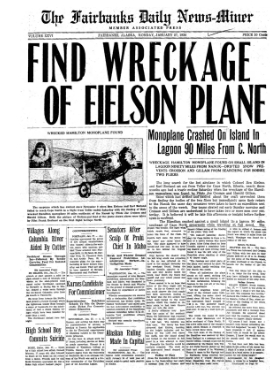 Jan. 27. The long search for the lost airplane in which Colonel Ben Eielson and Earl Borland set out from Teller for Cape North, Siberia, nearly three months ago had a tragic ending Saturday when the wreckage of the Hamilton monoplane was found by Pilots Joe Crosson and Harold Gillam.
Jan. 29. Ole Eielson began a jong journey to Alaska to claim the body of his son if and when it is found. He intends to bring the body back to the Hatton, North Dakota, cemetery for burial beside Ben's mother.
Jan. 30. The men who are looking for the bodies of Carl Ben Eielson and Earl Borland at the place where the Alaskan Airways Hamilton monoplane was wrecked have uncovered Borland's flying helmet, mittens and gloves.
Feb. 13. Russians are working hard and expect to find the bodies soon. They will
have all the wreckage dug out within three days. It is believed they will find the bodies near where the skip first hit, which must nave been several hundred feet from where the
cabin is now. They have cleared all snow from the cabin and engine and are going in the direction where the plane first struck. They are now out about 300 feet. They found Eielson's helmet and part of the cockpit.
Feb. 15. Bearing up under his loss with fortitude and consoling himself with the thought that his son carved out for himself a full career although his span of years was brief, Ole Etelsan: father of Carl Ben Eielson, arrived at Fairbanks last night to await the finding of his son's body.
Feb. 17. Buried deep under the snow, the body of Earl Borland, who perished with Carl Ben Eielson when their airplane crashed in Siberia on November 9, was found last Thursday.
Feb. 18. Ole Eielson last night became a full-fledged Pioneer of Alaska when
he was made an honorary member of Igloo No. 4. His famous son was also an honorary member.
Feb. 20. After a long search, the body of Colonel Ben Eielson was found in Siberia Tuesday. The bodies of Eielson and Earl Borland were to be taken to the Nanuk today and to Fairbanks as soon as possible.
Feb. 24. Foggy conditions between the Nanuk and Teller continue to delay the funeral cortege. Gillam expects to fly back with the Stearman plane but Crosson will probably leave the Waco behind. They will come with the first good weather. Services wili be held at the landing field upon arrival at Nome.
Feb. 25. In the city which they adopted as their home there will be accorded
to Carl Ben Eielson and Earl Borland a final farewell. Funeral services are to be held
here for the fallen aviators shortly before their bodies are taken to the States for burial.
Feb. 27. American and Russian flags stood at half mast at the motorship Nanuk on February 25 as Commander Maifric Slipnev, representing the Soviet government, formally gave the bodies of Eielson and Borland into the custody of American pilots for transportation to Alaska.
Feb. 28. Unfavorable weather conditions along the line of flight have made it impossible for Pilots Joe Crosson and Ed Young and the Russian fliers to leave Cape North with the bodies of Ben Eielson and Earl Borland.
Mar. 3. Unlimited visibility was reported today at Teller, giving rise to the belief that a similar condition might prevail at Cape North. If such is the case the fliers have probably left there with the bodies of Ben Eielson and Earl Borland. It is believed that if they are able to cross Bering Strait they will continue on to Nome today and fly to Fairbanks tomorrow.
Mar. 4. Ed Young flying the Fairchild arrived at Teller at 3:55 p. m. Monday, carrying the bodies of Colonel Eielson and Earl Borland. An escort plane piloted by Commander Slipnev arrived 30 minutes later.
Mar. 7. With the landing from a leaden-gray sky this afternoon of the plane bearing the bodies of Eielson and Borland, and of the two escort planes which followed in close formation, the work of the relief expeditions ended.
Mar. 8. On March 13 the bodies will start on their last long journey. At Seattle the two who were together in the last hours of life and have been so since in death will separate. There Earl Borland will be laid to his final rest while the body of Ben Eielson will be taken to Hatton, North Dakota, where he is to be buried beside his mother. A guard of honor from North Dakota will accompany the body from Seattle to Hatton.
Mar. 12. The long hours of vain hope are over, and also the tedious days of awaiting. The time for farewell has come. Today Fairbanks stands bared and bowed before its dead. Tomorrow all that is mortal of Carl Ben Eielson and Earl Borland will speed
southward on a last journey.
Mar. 17. The steamer Alaska sailed at 11:15 yesterday morning for Seattle with the bodies of Eielson and Borland. It is due in Seattle Saturday morning.
Mar. 19. Ten planes will form an aerial squadron and escort the steamer Alaska to her pier when she arrives this weekend with the bodies of Eielson and Borland. Elaborate ceremonies have been planned.
Mar. 21. The Fairbanks Commercial Club's endeavor to have Copper Mountain in the Kantishna district named Mount Eielson has met with quick response. Senator Nye of North Dakota plans to have the name changed by Congressional act on the day of Colonel Eielson's funeral.
Mar. 24. Interment in the new Seattle Mausoleum marked the end of a long journey from North Cape for Earl Borland. The body of Carl Benjamin Eielson is speeding eastward today in a special coach over the Great Northern for Hatton, North Dakota, where the famous flier will be buried at his boyhood home next Wednesday.
Mar. 26. Beneath overcast skies, with a cold wind hurling snow out of the north, Carl Ben Eielson was buried this afternoon. All night long former buddies of the American Legion stood guard over the casket at the mortuary. After brief, simple services at the church where Eielson worshipped as a boy he was buried beside his mother, brother and sister in the Hatton cemetery.







