Forty years ago yesterday the Canadian Pacific Railway bought out the Canadian Pacifie Navigation Company from Captain John Irving and his Victoria friends. That was the nucleus of the great coastal fleet of Canadian Pacific steamers of today. But the original ships, including the Islander, Yosemite and Princess Louise are all gone. }
Today, interesting reports are abroad that the Canadian Pacific is going into the airplane business on a big scale between Vancouver, Dawson and Alaska. C.P.R. ships are the finest on the coast, and the idea appears to be that passengers can be transported to Yukon and Alaska by C.P.R. planes or by C.P.R. steamship when present plans are worked out. Already the C.P.R. is in the air business in the Mackenzie Valley. Big plans are in hand for air traffic between Vancouver and the Orient.
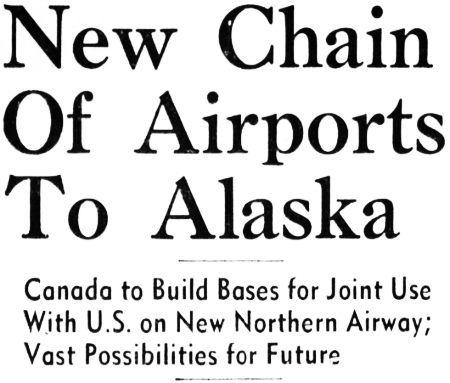
OTTAWA, Jan. 11. - Plans for a series of air bases extending from Edmonton across northern Alberta, northern British Columbia and the Yukon to connect with bases in Alaska are likely to be announced soon by the Dominion government, it was stated in officials circles here today.
The bases will be built at Canadian expense by the Transport Department, but will be available for United States use in case that country wishes to send planes to
Alaska.
The project, it was understood, is one of the recommendations of the United States-Canada Defense Board.
The bases will be capable of accommodating the largest machines in the Canadian and U. S. air forces.
VITAL IMPORTANCE
American sources here today said the vital importance of the new move from their standpoint was that it will provide safe year-round air highway to Alaska for
fast pursuit planes in large squadrons.
While the existing commercial route already is being flown winter and summer, pursuit planes have short range and, therefore, better facilities are needed to insure adequate landing space and radio guidance.
The new routes will be east and north of the Rockies and, although in unoccupied country for much of the way, available data shows the weather on the route is fairly favorable for operations.
Half a million dollars will be spent by the government of Canada in the next few months on air bases and radio equipment throughout northern British Columbia, Alberta and the Yukon as part of a vast scheme in co-operation with the United States to connect with bases in Alaska.
This information comes from unimpeachable sources and further reveals the complete co-operation between the Canadian and American governments on aviation matters pertaining not only to defense but to the enormous development of commercial transport that will take place with the end of the war.
The United States has already set aside more than $3,000,000 for development of at least 50 airports and commercial landing fields in Alaska in connection
with the defense plan, and the work to be done in the Canadian northwest will form a definite link with this.
SIX RANGE STATIONS
Two months ago The Vancouver Sun told of the hand-in-hand policy of the two governments when Pan-American Airways abandoned the coastal route to Alaska in favor of the inland plateau across B.C., making stops at Prince George and Whitehorse.
Since that time U.S. army bombers and fighter planes have regularly been travelling to Alaska bases over the B.C. route, and Pan-American has maintained twice-weekly schedules to Fairbanks from Seattle via Prince George and Whitehorse.
Now, plans are being laid in Ottawa for the establishment of from four to six new range stations in Northern British Columbia with one in the Yukon. They will cost in the neighborhood of $80,000 apiece, and northern fliers will have the same beam and
radio equipment with which to operate as are used by TCA and all American commercial air
transport companies.
VANCOUVER TO MONTREAL
It is expected the first range station will be installed at Prince George, which is now the key point of north and south air travel through British Columbia.
Two months ago when the agreement between Yukon Southern Air Transport, which company
pioneered the inland route, and Pan-American was completed, power of the shortwave station
at Prince George was increased from 60 watts to 450 watts and the long-wave transmitter boosted from 150 to 1200 volts. All this will now be in addition to the new range equipment.
JOINT USE OF FIELDS
A range station will also be put in either at Fort St. John or Dawson Creek, in the Peace River country, at Fort Nelson, Watson Lake, either Teslin or
Wolf Lake, and at Whitehorse. It is possible another station will be installed at Grande Prairie, in Alberta, for U.S. planes flying from eastern bases. All these stations are on the Yukon Southern Air Transport routes both from Vancouver and Edmonton to Whitehorse and Pan-American and U.S. Army planes will have full use of them.
The new range station equipment is not expected to be put in south of Prince George for the convenience of Yukon Southern Co.'s planes flying in and out of
Vancouver from the north, or for American planes, as there will be a short gap between the end of the south leg of the Prince George range and the time the north leg of the Princeton range is picked up, from where planes swing west into Vancouver on the TCA beam.
The system of co-operation in the use of radio facilities will also apply to landing fields. The government has appropriated funds for the development of landing fields and for improvement of various sites where Yukon Southern Co.'s planes are already landing.
Of course, first-class facilities are already available at Prince George, where there is one of the finest natural alrport sites in the Dominion. There are
fields at Fort St. John and Dawson Creek and the field at Fort Nelson is already in use, but will be vastly improved. A field is also under construction at Watson Lake, a site has been located at Teslin Lake on the Yukon border, and it is possible a field will be put in at Wolfe Lake, near Teslin.
SERVICE TO ASIA
Dan McLean, superintendent of airways for Canada, viewed all these sites three months ago with William Lawson, inspector of alrways for the western division. They approved the sites selected by Yukon Southern and it is believed Ottawa took immediate action in appropriating funds for an immediate start on the work. It is expected that
main runways at each of the fields will be completed by the end of this year. At many
points tractors and other equipment will have to be flown in for the work.
The present program is largely to facilitate defense plans in the north, and while commercial transport companies will benefit hy the improvements it is known that a scheme is belng developed for use of the northern route after the war in connection with international services that would have seemed like a dream a few years ago.
Already they are talking of trans-Atlantic passenger and mail services with the use of land planes instead of flying boats and it is altogether possible that an all red route around the world may be established with planes flying through British Columbia, the Yukon and Alaska, the latter being the jumping off place for the Orient. At
some points in Alaska the distance between American and Russian territory is no farther
than from this city to Vancouver Island.
C.P.R. IN PICTURE
All these things have been talked about even before the war and there can be no doubt they will be put into effect in peace time. It is possible an arrangement
may be made whereby Pan-American will somehow share in the deal.
Lending great significance is the entrance of the Canadian Pacific Railway in the Canadian aviation picture. C.P.R. has bought out MacKenzie Air Service, in Alberta, and feelers are out for other companies, including one well-known organization
operating to the west coast. It would not be surprising to see the C.P.R. become one of the greatest air transportation companies within a few years and rumors are already around that the company has eyes on an operation from Canada to the Orient, as part of a proposed all-red route.
There seems no doubt that the great northland, British Columbia and Vancouver are destined to play a role in the future of aviation undreamed of by even the most optimistic.
Competent observers who have studied weather in the north find that flying conditions at night are far superior to those of the day time. Thus, with such great things in the offing, we may yet see sleeper planes flying to Vancouver over night from, say, Alaska, in the course of a trip from the Orient. Night flying apparatus is all ready to be shipped to Whitehorse and this may be the first stage in the great changes to come.