|





|
|
The crash of Canadian Pacific Air Lines Lockheed 14, 1942
The story of Airplane Creek, BC
Dateline: December 25, 2024.
On December 20, 1942, Canadian Pacific Air Lines Lockheed 14-H2 Super Electra CF-CPD (msn 1504) crashed on Mount William Knight, killing 13 persons (3 crew and 10 passengers) instantly. The flight had originated in Whitehorse, and after a stop at Prince George, was en route to Vancouver when it disappeared.
No clues were found during 500 hours of aerial searches and extensive ground searches, both hampered by bad weather, and in early January the search ended.
With snow at high elevations melting, the search was resumed on about June 20th, 1943, and the wreckage was found by a search plane on August 9th. On August 16th the first ground party reached the wreck and found pieces of the aircraft and its occupants spread over a wide area on both sides of a ridge at 7,000 feet elevation.
A coroner's jury in September found that the crash was "an accident, the causes of which are unknown." The passengers' remains were buried at the crash site in early October.
Killed in the crash were:
Reginald H. Battye
James J. Coyle
Laetitia A. Herron
William G. Holland (co-pilot)
Robert W. Kehr
Ernest W. Kubicek (pilot)
William N. Scharfe
Rudolph A. Schroeder
Arthur L. Smith
Hugh Stewart
Winowna M. Stouse
Bernard J. Stouse
Edna Young (stewardess)
In 2020, Chilliwack History Perspectives posted a very detailed history of the crash, with 10 photos.
The material that follows consists of the most significant of the newspaper reports published. The articles chosen have been reproduced in their entirety, with no editing.
Monday, December 21, 1942.
The Vancouver Sun
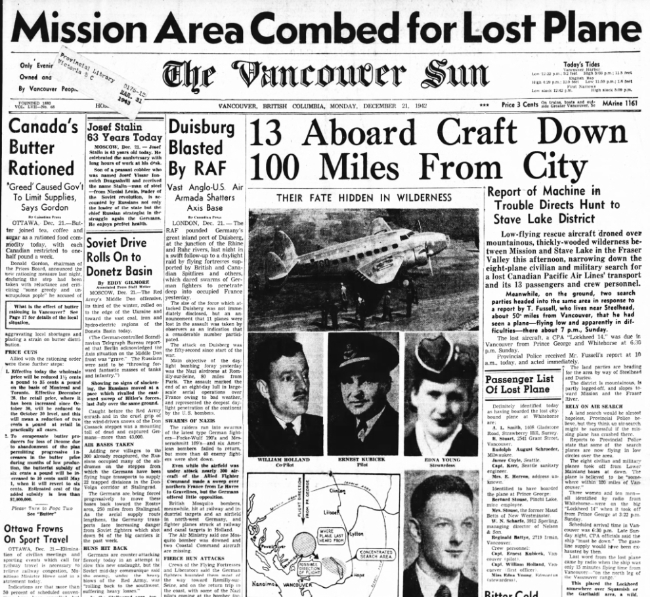
Low-flying rescue aircraft droned over mountainous, thickly-wooded wilderness between Mission and Stave Lake in the Fraser Valley this afternoon, narrowing down the eight-plane civilian and military search for a lost Canadian Pacific Air Lines' transport and its 13 passengers and crew personnel.
Meanwhile, on the ground, two search parties headed into the same area in response to a report by T. Fussell, who lives near Steelhead, about 50 miles from Vancouver, that he had seen a plane - flying low and apparently in difficulties - there about 7 p.m., Sunday.
The lost aircraft, a CPA "Lockheed 14," was due in Vancouver from Prince George and Whitehorse at 6:30 p.m. Sunday. Provincial Police received Mr. Fussell's report at 10 a.m., today, and acted immediately. The land parties are heading for the area by way of Steelhead and Durieu. The district is mountainous, is partly logged-off, and slopes toward Mission and the Fraser River.
RELY ON AIR SEARCH
A land search would be almost hopeless, Provincial Police believe, but they think an air-search might be successful if the missing plane has crashed there. Reports to Provincial Police state that some of the search planes are now flying in low
circles over the area. The eight civilian and military planes took off from Lower
Mainland bases at dawn. The plane is believed to be "somewhere within 100 miles of Vancouver."
Three women and ten men - all identified by radio from Whitehorse - were on the big "Lockheed 14" when it took off from Prince George at 3:22 p.m. Sunday.
Scheduled arrival time in Vancouver was 6:30 p.m. Late Sunday night, CPA officials said the ship "must be down." The gasoline supply would have been exhausted by then.
Last word from the lost plane came by radio when the ship was only 15 minutes flying time from Vancouver "on the north leg of the Vancouver range." This placed the Lockheed somewhere over Squamish or the Garibaldi area, a wild, mountainous area. It was believed the plane might be found somewhere in an easterly direction from that area.
Now the search has narrowed to an area between Mission and Stave Lake.
THOSE ABOARD
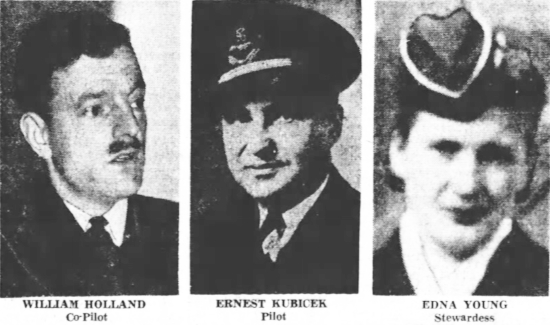
The three missing crew personnel are:
Capt. Ernest Kubicek, Vancouver (pilot) - well-known northern
flier.
Capt. William Holland, Vancouver, (first officer) - experienced bush pilot who just completed two years with the RAF bomber ferry command.
Miss Edna Young, Edmonton (stewardess).
Belief that the plane was in the Harrison Lake area stemmed from a last report which indicated the Lockheed was "somewhere over Squamish and heading east towards Hope for an eastern letdown procedure."
Pilot Kubicek reported by radio that visibility was "just fair." He reported ro difficulty and notified CPA that he was transferring his radio over to the
control tower for landing instructions. Procedure is that the control tower then calls the plane back. This procedure was followed, but the Lockheed 14's radio remained silent.
One conjecture is that something may have happened while the radio was being transferred over to the control tower.
TRIPS CANCELLED
CPA, Trans-Canada Air Lines and the Royal Canadian Air Force are co-operating in today's widespread air search. CPA has cancelled its Vancouver-Whitehorse and Vancouver-Victoria flights today to provide two more planes for the job.
The search area - now being combed by land and sea planes - extends east to the summit of the Cascades, west to the coast, north to the 50th parallel and south to the international border.
CAREFUL SEARCH
RCAF planes are patrolling up-coast to north of Powell River, and inland to level with Mt. Garibaldi. The weather is "poor" for such a search.
Hopes were raised at an early hour today, when a report from Chilliwack said that flares had been sighted south of the Fraser River during the night. A search party was sent out, but nothing was found to indicate that the lost plane had crashed in that area.
HAVE FOOD IF SAFE
Stewardess Young ig a trained nurse, and the CPA transport planes carry emergency rations which she is trained to cook over an open fire if necessary. If the plane is down and the passengers and crew escaped death in the crash, they will be able to exist for some time.
Two seaplanes taking part in the search plan to visit logging camps on Harrison Lake to check reports that the plane was seen and heard in that area Sunday evening.
There is little hope that the plane found an emergency landing in the Fraser Valley. CPA officials point out that they would report immediately if such a landing was accomplished.
Both the pilot and co-pilot of the missing plane are northern bush fliers of long experience and proven skill.
Capt. Kubicek has been flying in this area for about 10 years. He learned to fly in Calgary, but since then has spent most of his time in northern areas of Alberta, British Columbia and the Yukon. He was one of the original "Big Three," consisting of Grant McConachie, now executive head of CPA in Western Canada, and Ted Field. He spent 1938 and 1940 flying with the British Yukon, subsidiary of White Pass and Yukon Route, between Skagway and Alaska, and Whitehorse and Dawson City. After inauguration of the Edmonton-Whitehorse mail run in July, 1937, Capt. Kubicek piloted the second mail flight to Whitehorse.
BACK FROM EUROPE
Captain Bill Holland recently returned to northern flying after two years with the Bomber Ferry Command. He is one of the best known pilots here and throughout Canada. This flight was a re-familiarization one for Capt. Holland, and he was first officer and co-pilot. He flew for years in the Yukon and Northern B. C., before joining the air force. He was with Ginger Coote Airways on the Zeballos service.
W. N. Scharfe, reported missing on the lost plane, is well known as managing director of Nelson & Sons, a Vancouver brokerage house. He was a former partner in Fell & Scharfe, who handled a number of big realty deals for the government. Mr. Scharfe is well known in golfing dircles, too. Last Wednesday he told members at
Shaughnessy that he intended to fly to Prince George that day, but had been unable to get a place on the plane.
NAME ON LIST
His wife told The Vancouver Sun today that her husband was at Prince George.
Reginald H. Battye, 31, is an electrical journeyman employed by Hume & Rumble at Prince George. His mother told The Sun today that he had booked passage by air from Prince George and was to have left there on December 23.
The Mr. and Mrs. Stouse listed as coming from Prince George are believed to be Mr. Bernard Stouse, a miner at Pinchi Lake, and his wife, the former Maud Betts of New Westminster. Mr. Stouse has a brother in Vancouver, John Stouse, 640 Clinton, and his mother resides at 1424 Gravely. He was a private in the Canadian Army in the present war
but was discharged more than a year ago.
Wednesday, December 23, 1942.
The Chilliwack Progress

Search for the Canadian Pacific Airways Lockheed plane which, with 10 passengers and three crew members, has been missing since dusk Sunday on a flight from Prince George to Vancouver continued here today by both air and land.
Patrols are concentrating today on three areas: the west side of Elk mountain ridge, the upper reaches of the Chilliwack river and the Liumchin district.
Three CPA planes based here will carry out special area searches while RCAF aircraft will continue general reconnaissance work. Concentration of the search in
the Chilliwack district is based on the reports of people who heard an aircraft circling the district after 5:30 p.m. Sunday. Well over one hundred such reports have been received.
Sergeant W. J. Thomson and H. Hollick-Kenyon, CPA official di-
recting the company's search operations, have been tracking down reports of smoke signals, flares and sounds of crashes without result.
From 12 miles up the Chilliwack river Ed Bell, well known packer and farmer, reported yesterday that an aircraft had flown so low over his home Sunday night at 6 p.m. that the noise of the motors rattled the windows of the house. The plane was not
visible.
Among today's plans is a proposal that a CPA aircraft based here fly into Chilliwack lake to contact a settler there in an effort to determine if the missing airliner was heard there.
Searchers have been hampered by the lack of material evidence and by a constant stream of reports and rumors.
During the early part of Monday the hunt was concentrated on the Fraser river between Hope and Chilliwack. Tuesday the scene shifted to the Chilliwack River-Liumchin area. While leaders of the search believe that reports indicate the missing Lockheed has crashed in this district, they admit the machine may be anywhere between here and Princeton.
Local hunters and woodsmen are providing valuable aid to game wardens, police, RCAF and CPA officials. From daylight to dusk they have been using their knowledge of the rugged country to advantage, both on the ground and in the air.
A. Ryder of Ryder Lake, reported this morning that he had heard a plane over that district between 5:30 and 6 p.m. Sunday. The aircraft's motors were missing and
suddenly went off, he said. Mr. Ryder was positive that the plane was in difficulties and that when the motors went off, the pilot would attempt to find a safe landing spot.
Thursday, December 24, 1942.
The Vancouver Sun

By DON MASON
Vancouver Sun Staff Reporter
CHILLIWACK, Dec, 24. - The joy of Christmas Eve is tempered for neighborly folk in this Fraser Valley country today by growing fear that the 13 men and and women lost four days aboard a missing Canadian Pacific Airlines Vancouver-bound plane will not be found alive, if they are found at all. The search by land and air carries on with unabating energy, but even the searchers' first high hopes are flagging now. They don't intend to give up, however, until all hope is gone, and that means they'll carry on
until well after Christmas Day.
Sixteen RCAF and civilian planes found nothing at all in an all-day wide-spread hunt Wednesday. Scouting parties who trekked all over the north slope of Elk Mountain reported back empty-handed when night fell.
Today the air search goes on again - with special attention to a mountain slope 12 or 14 miles the other side of the international border, southeast of Lynden, Wash.
U. S. REPORT TRACED
South to Mt. Baker and north of the Fraser River up to Chilliwack Lake will be the concentrated area of search by planes. Scout parties will go out on foot, but not in the same numbers as Wednesday, because they have no new leads to work on.
H. Hollick-Kenyon, CPAL official who is directing the air and ground search out of Chilliwack, crossed the border to Lynden, Wash., last night, to check a report that a Dutch farmer had seen a fire burn brightly on a mountain slope there last Sunday night. That's the mountain a special plane will fly over today.
REWARD OFFERED
Veteran sportsman flier Earl Brett of Chilliwack joined the air hunt in his small private plane on Wednesday. He knows the country like a book and he combed mountains south of Chilliwack and all round Cultus Lake.
Canadian Pacific Air Lines has offered a $500 reward for information leading to finding of the lost plane and its 13 passengers.
The concentrated and systematic air search by extra RCAF planes on Wednesday was without result, except to eliminate a considerable area from the hunt.
At Hamilton, Ont., today, William James Holland, son of Capt. Bill Holland, co-pilot of the missing aircraft, said: "If dad is dead in the British Columbia mountains, he died in the place he loved best, doing the thing he loved best."
The Vancouver Sun

By JACK MEEK
There was drama in the skies above Vancouver and Southern British Columbia last night.
Late yesterday, as the sun was sinking in the west, a large Lockheed "14" aircraft of Canadian Pacific Air Lines, exactly the same as the ill-fated craft missing with 13 persons aboard, took off from Vancouver airport to re-enact what possibly happened to the plane which has been the object of Western Canada's greatest aerial search.
With Grant McConachie, general manager of CPAL, western division, piloting the craft, Ted West, co-pilot, and Walter Gilbert, superintendent, Vancouver division, we left Vancouver just after 5 o'clock and headed for the Squamish and Garibaldi areas, where the missing plane was last heard from Sunday.
Taking off a few minutes after us were three Royal Canadian Air Force planes and a TCA plane, all searching for a trace of plane, all searching for trace of the plane or a signal that might give some clue to the fate of the passengers.
PROBABLE COURSE
We swung right over the heart of the business section of Vancouver, steadily gaining altitude, and reached about 11,000 feet over Squamish, which is approximately the level at which Captains Kubicek and Holland would have been flying at the time they reported on the radio their intention of landing and then disappeared without another word.
We held at between 10,000 and 11,000 feet for the next 10 minutes, heading in a northerly direction, and then swinging east by south as might have been the
case with the lost plane, if, as thought, the pilots turned quickly toward the Fraser Valley to locate the Fraser River when trouble developed such as loss of radio beam signals which would occur with an electrical power failure.
WOULD SEEK RIVER
It seems evident, as the writer explained in a story from Chilliwack on Tuesday, that electrical failure was the cause of the trouble as residents of the Fraser
Valley saw the craft break out of clouds without navigation lights and it is agreed by everyone knowing flying conditions here that the natural thing for the pilots to do, with loss of radio navigation facilities, would be to try to locate the Fraser River and follow it into Vancouver.
It is almost a certainty that with an icing condition at the time the plane disappeared, plus a heavy rain and wind estimated at up to 50 miles an hour that the
pilots would not attempt a let-down in the mountainous country around Squamish without aid of a radio.
PERIL OF ICE
As we turned toward the east we looked directly over Vancouver and to the United States. Mount Baker rose up beautifully, while below us, a few miles ahead,, and as far as the eye could see to the north, mountains stood deathly silent with a faint red hue on their snow-covered and glacier sides, reflecting a sunset that for a brief few minutes
turned them into a scenic wonderland.
Right at this moment, as the Fraser Valley started to come into view, I could feel myself in the position of Holland and Kubicek, both of whom I have flown with many times. I could feel them tensely battling the elements, watching for the dreaded ice building on the leading edge of the wings and hoping that they might be able to get out away from it. I can see them now following a compass course to where they thought te Fraser River lay and praying that they could let down through the clouds and break into the open without building up such a load of ice that it would be near impossible to keep their big, silvery skyliner in the air.
TWO POSSIBILITIES
Soon the mountainous country was giving way to the smooth, lush Fraser Valley district, in the vicinity of which the secret of the whereabouts of the craft may
be found. Two things stood out in my mind as I looked down on the Fraser River:
1. That if the plane had made a safe landing on more or less level ground, it would have been seen the very morning following its aisappearance.
2. That if it landed in the mountainous area surrounding the valley, there is little chance that anyone came out alive, for such a speedy aircraft striking a solid object would have broken into a thousand pieces.
After passing over the narrow neck of the Fraser Valley above Chilliwack, we came above the Cascade Mountain range. Here we followed valleys opening on to the Fraser Valley which might have been used by the pilots to seek a way to safety. All finished in dead ends.
LAKES SEARCHED
As we went farther into the Cascades I could see that another theory fayoring the idea that the plafe might have landed on a frozen lake in the mountains could not hold, up as very few of the lakes are yet frozen in. Chilliwack Lake, which is at the 4000-foot level, is open, as were many other smaller lakes.
Pushing forward on our trip on which we covered 6000 or 7000 square miles of country, we passed over the international boundary at 6 o'clock near Chilliwack Lake. The boundary could be plainly seen cut for miles through the mountains.
After crossing the border, we headed back west, watching for signs of lights, particularly the red glow of a camp fire. We flew parallel to the boundary for
some minutes, very close to Mount Baker, then circled back east and north to the Princeton area.
NO SIGN OF PLANE
All the time below us there were steep mountains rising to razor edge peaks. Some of them were covered with glaciers centuries old, Others had bare strips down their sides, evidence of slides which carried everything before them.
We had proceeded some 25 or 30 miles into the State af Washington which was considered the limit to which the ill-fated plane would-have travelled. At one time we swung sharply to the north where lights were seen but they were found to be on the Hope-Princeton road.
On the way back to Vancouver we followed the radio range from Princeton and crossed over this city at between 12,000 and 13,000 feet. The night was clear and beautiful with ideal flying conditions. There was certainly no sign of life in the vast area that we covered.
One point which must be brought out is the thoroughness of the search. It can be said that everything, humanly possible is being done. Grant McConachie told me the search will be continued as long as there is the faintest hope of finding the plane.
Friday, December 25, 1942.
One would think that the crash would be well covered in the city the flight originated from, but that wasn't the case. On Friday, December 25th, this was the report in The Whitehorse Star: "A C. P. A. plane bound for Vancouver was reported missing this week. Many conflicting reports have been made concerning the same but up to the time of going to press this morning (Thursday) no definite information is available." That, as you have seen above, simply wasn't true.
Wednesday, December 30, 1942.
The Chilliwack Progress
Weather conditions slowed the search for the missing Canadian Pacific Airlines plane and its 13 passengers this morning as the hunt went into its tenth day.
Since Sunday, searchers have been concentrating their efforts on
the region around Columbia Valley and the watershed of Watt creek, in which a thin film of oil was reported. The discovery was made by Bill Thompson, well known Columbia Valley settler. Monday and Tuesday searchers plowed through snow along the creek bed in an effort to trace the source of the oil but their hunt was fruitless.
The aerial search for the missing Lockheed has also been curtailed. During the week police, CPA officials and RCAF, assisted by volunteers, continued to explore the region of the Chilliwack river including Chilliwack lake, as well
as the district around Spuzzum and Kawkawa lake, near Hope.
Wednesday, June 16, 1943.
The Chilliwack Progress

Search for the Canadian Pacific Lockheed Lodestar aircraft and 13 passengers and crew missing since last December will be resumed shortly, officials of the company indicate.
Search for the plane was concentrated in this area immediately after it was lost and both company and RCAF aircraft scoured hills surrounding the valley for days in a futile effort to find the big airliner.
Now that snow is disappearing from the mountains, the search will be resumed.
Wednesday, July 28, 1943.
The Chilliwack Progress

Although rumors to the effect that the missing Canadian Pacific Airlines Lockheed Lodestar passenger plane missing since December 20 has been found, renewal of the aerial search has so far failed to reveal any trace of the aircraft.
Tuesday afternoon reports were being widely circulated to the effect that the aircraft and its 13 passengers had been found not far from the military camps.
The aerial search was resumed in this area Sunday, when a CPA seaplane arrived at Cultus Lake. Tow Lawrie and Ed Murphy, two of the company's skilled pilots, are
working four-hour shifts during daylight in an effort to find the ill-starred aircraft. The search has covered practically the entire country from west of Chilliwack to Princeton, including the Harrison lake area. Tuesday the search was concentrated in the area of Mount Cheam.
The presence of snow on the mountains until recently delayed the start of the search.
Tuesday, August 10, 1943.
The Vancouver Sun
Sun glistening on a piece of metal, imbedded in snow, and spotted by Capt. Don Patry, in a search plane, brought to a dramatic end the search for the CPA airliner missing with 13 aboard since last December 20.
The metal - the tail section of the missing plane - was uncovered by the melting snow in an area that had been thoroughly scanned from the air at the time the aircraft disappeared.
From descriptions of the wreckage given The Sun by those who viewed the craft from the search plane it was evident that all on board were killed outright when the big silver airliner, its pilot having apparently lost his bearings, plunged into the mountain. Wreckage was scattered for hundreds of feet over the mountainside but the plane did not burn, indicating that the pilot had time and presence of mind to shut off the engine switches before the crash.
Unlucky Thirteen Aboard
Those on board the plane were:
A. L. Smith, 1408 Gladstone Road, Strawberry Hill, Surrey.
H. Stuart, 2541 Grant Street, Vancouver.
Rudolph August Schroeder, Milwaukee.
James Coyle, Seattle.
Capt. W. R. Kerr, Seattle sanitary engineer.
Mrs. E. Herron.
Mr. and Mrs. Bernard Strouse, Pinchi Lake.
W. N. Scharfe, 5912 Sperling, managing director of Nelson & Son.
Reginald Battye, Burnaby.
Crew personnel:
Capt. Ernest Kubicek, Vancouver (pilot).
Capt. William Holland, Vancouver (first officer).
Miss Edna Young, Edmonton (stewardess).
Two Men to Stay as Guard
Provincial police, CPA Lines, officials and pilots sat in conference today, studying the task of sending in ground parties to the wreckage.
They determined that four experienced woodsmen would set out for the scene of the wreck from Ford Creek, only four air miles south. Once they have blazed a trail through the heavy timber and trekked over the snow to the wreckage two will come out, leaving the others at the scene.
Later, the main ground party, including G. W. McConnochie, general manager of CPA Western Lines; E. R. R. Field, British Columbia superintendent: police
officers and representative of the Dominion department of transport, will go over the marked route. The party, it is expected, will traverse 15 miles through rough mountainous country to reach the wrecked aircraft.
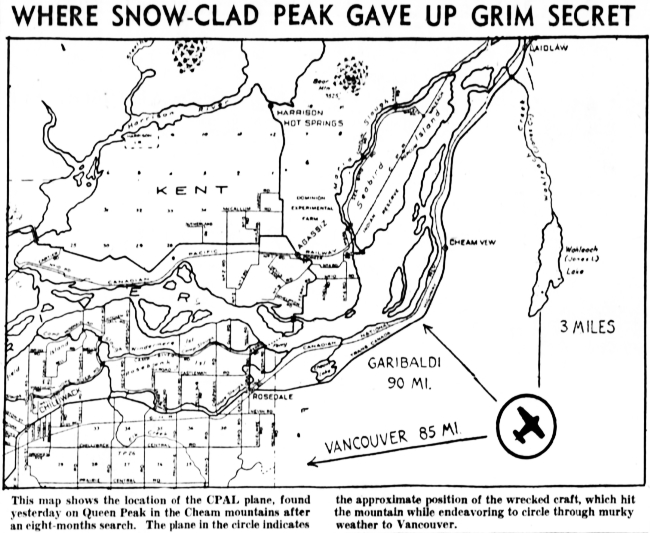
Today company officials pinned hopes on the airship's log to explain to them the mystery of how the craft lost its beam in the Squamish area and crashed within 15 minutes' flying time of Vancouver and only two miles from another radio beam.
Yesterday afternoon, Sergeant W. J. Thompson, of the Chilliwack Provincial Police, and Game Warden A. J. Butler, also of Chilliwack, flew over the area to determine the best route to follow to reach the craft.
It is planned to salvage everything from the wreckage that can be moved from the area, including personal articles of passengers, mail, express and other valuables which the ill-fated plane was carrying from points in Alaska, the Yukon and Northern British Columbia to Vancouver.
Pack horses could be used only part of the way, which would mean that the task of the parties going in would be made all the more difficult.
Grant McConachie, general manager, CPA, western lines, was in Winnipeg when informed of the finding of the plane and immediately boarded a plane for Vancouver, arriving here late last night.
HOW PILOT FOUND IT
Parts of the plane were scattered for hundreds of feet along the mountainside, said Captain Patry, senior pilot of CPA here, who viewed the wreckage later
from the air. "I was coming around the peak just about at noon when I noticed a square object on the side of the mountain," said Captain Patry. "It turned out to be the tail end of the plane. Further on I could see the two propellers of the plane stuck in the side of the cliff as though someone had placed them there."
Strangely enough, the propellers showed little damage and were situated about 200 feet ahead of the main body of wreckage. It is evident that after the plane struck it bounced over or around a large bluff and the fuselage came to rest in a sort of pocket on the side of the hill in very deep snow.
BLACK OBJECTS
The fuselage appeared to be lying on its right side but with so much snow it was impossible to tell from the search plane whether the part of the fuselage sighted was intact and contained any of the bodies of the passengers or if it was just a large strip of metal. Above the fuselage lay a torn wing and airplane elevators and near them were dark patches that may have been suitcases, clothing or bodies.
Captain Patry tried to get close enough to have a better look at
the wreckage but with unsettled, bumpy air conditions the closest he could approach was 500 to 1000 feet. However, he was able to identify the plane through the registration marking "CPD" on the fuselage. The first two registration letters - CF - could not be seen.
Capt. Patry, who found the missing airliner on the treeless peak, was brought here from Edmonton to lead the search when it was renewed a few weeks ago
as the snow began to melt.
On his discovery of the wreckage, CPAL authorities immediately reported the news to relatives of the 13 victims of the crash.
Later Patry flew an official party to the scene to ascertain the best way for a ground party to reach the scene. On the plane were Sgt. Thompson, Game Warden Butler and E. R. R. Field, superintendent in British Columbia for CPAL.
It is expected that the investigation of the three members of the Civil Aviation Branch, Department of Transport, which began last December when the plane was lost and adjourned until the plane was found, will be re-opened as soon as the report of the search party is received.
NIGHT OF DRAMA
Capt. Patry said it is impossible to tell how fast the plane was travelling when it hit the mountain peak. With a full passenger list, the aircraft would weigh about 17,000 pounds and would not have to be going very fast to scatter wreckage all over the peak.
The crash of the Lockheed Lodestar en route from Prince George to Vancouver was preceded by a dramatic exchange of radio calls between Sea Island Airport and the plane on the dark, rainy night of December 20. The machine, second section of the daily flight, was flying south on the Sidney beam that intersects the Vancouver north beam
near Squamish.
At 5:30 p.m. Pilot Kubicek of the plane reported to CP authorities at the city airport by radio that he was flying at 10,000 feet and estimated his position as over Squamish. He gave his landing time as 5:45 p.m. and asked to be switched over to the airport control tower for landing instructions. The switch was made, but the control tower was unable to pick up the doomed aircraft.
A dramatic point about the discovery of the craft was the fact that it lay in an open area. Captain Patry said his altimeter indicated 7000 feet at the point
where the plane struck and this was about 100 feet from the top of the mountain. Search planes had been over this area hundreds of times but with heavy snows that started the day after the plane crashed, the broken and torn parts would have been completely covered, hiding them from view of searchers. It is estimated that the snowfall in this particular area last winter was as much as 20 or 30 feet.
Both Patry and Field, whose experience in flying is equalled by few in this section of the country and in the north, agree that it is difficult to tell exactly
which direction the plane was flying at the time it struck.
PLANE HEARD AT TIME
The plane came to rest on the southeast side of the mountain about eight to nine miles southeast of Agassiz. This fact confirms reports by Fraser Valley residents that a plane was flying around the area apparently lost on that fateful December Sunday night. It also confirms the belief of CPA officials that when the plane was last heard from by radio about 10 to 15 mirutes flying time out of Vancouver, Ernest Kubicek, the pilot, turned east from the Garibaldi area and struck out in the direction of the Fraser Valley for one of two reasons:
1. Development of some trouble aboard the craft which prompted the pilot to seek the flat Fraser Valley area so that he could go lower and orient him- self, and possibly follow the Fraser River to the Vancouver airport, or
2. Swing from Garibaldi in an easterly direction tb pick the east leg of the Vancouver radio range for an approach to the city.
HEAVY WEATHER
Possibly the plane was a little farther east than the pilot thought and in letting down to a lower altitude over what he thought was the Fraser Valley area, he struck the peak in the Cheam range, which borders the valley on the south.
At the time the plane last reported it was in a strong wind said to be blowing up to 50 miles an hour and there was a heavy rain. With that condition prevailing on the coast, it is possible snow was falling over the Cheam Range and with the darkness,
the pilot would have been letting down "blind."
Had the plane been but 100 feet higher it would have cleared the mountain and in any direction it might have been flying, would have passed into lower terrain. If the plane had been on its course at the time it hit it would have been only 15 minutes' flying time from Vancouver.

E. R. R. Field, superintendent of the Vancouver division, Canadian Pacific Air Lines, said today that CPA planes had flown 50,000 air miles in search of the
lost plane, found yesterday on the Cheam Range. This is the equivalent of approximately 500 hours' flying time spent on the search.
In the period from the start of the search in December until early March, some 250,000 square miles had beeen covered. Search for the plane was the greatest in the history of Western Canada and thousands of miles were also covered by RCAF planes, exclusive of the flying by CPA craft.
CPA brought a special plane from Quebec in the spring to join the search and it was from this craft that the wreck was sighted. The Quebec plane was fitted with special gasoline tanks to enable it to fly long distances on the search.
Wednesday, August 11, 1943.
The Vancouver Sun

By ARTHUR MAYSE
Vancouver Sun Staff Writer
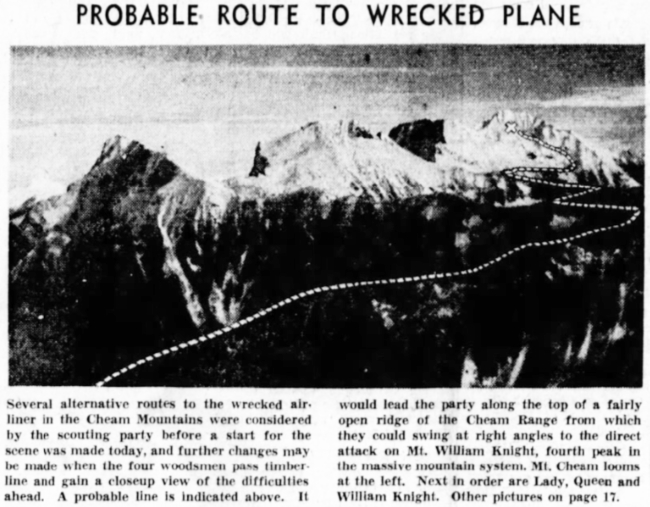
CHILLIWACK, Aug. 11. - With a trailwise veteran of the Pacific Coast Militia Rangers for their guide, three Lower Mainland game wardens are today working their way from west to east along the flanks of the Cheam Range, their goal a snowfield under the 7000-foot pinnacle of Mount William Knight which hides the last chapter in the grimmest air tragedy Western Canada has ever known.
There, on December 20 last, a huge Lockheed passenger plane of Canadian Pacific Airlines ripped itself in shreds and battered the life out of three women and ten men as a lost pilot sent it roaring through overcast into the peak.
With luck, the light-packing four who took to the hills at dawn today may rope and claw their way to the scene of the crash by late afternoon. With more luck, they may be able to return to B.C. Police headquarters at Chilliwack sometime before Thursday morning with the data they set out to recover. A less optimistic estimate is that the trip may take three days.
"It takes a good man to get up Cheam itself and back in a day," one oldtimer observed to The Vancouver Sun as the party was making its preparations. Mt. William Knight, least accessible summit of the range, is three peaks removed from
Cheam.
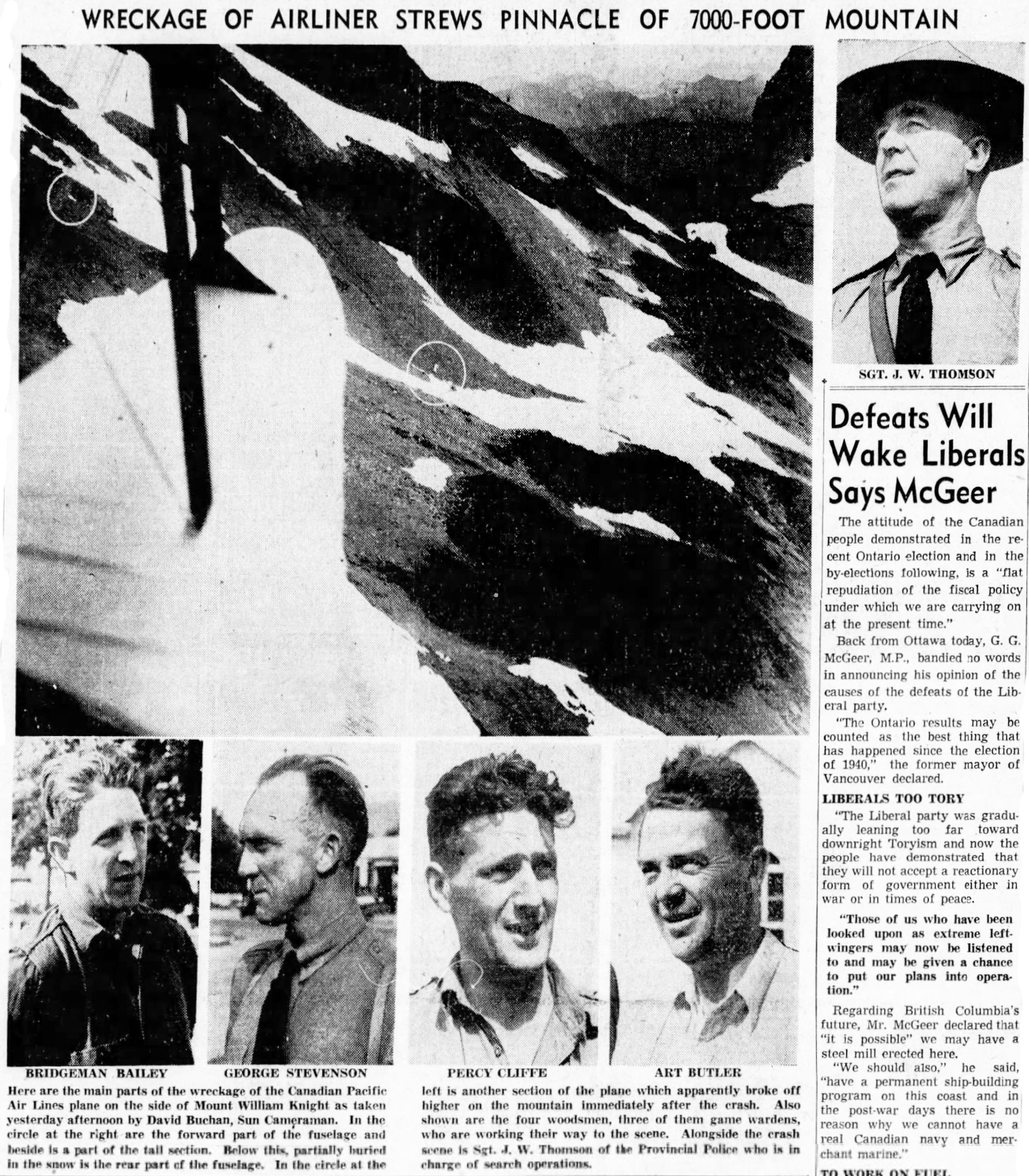
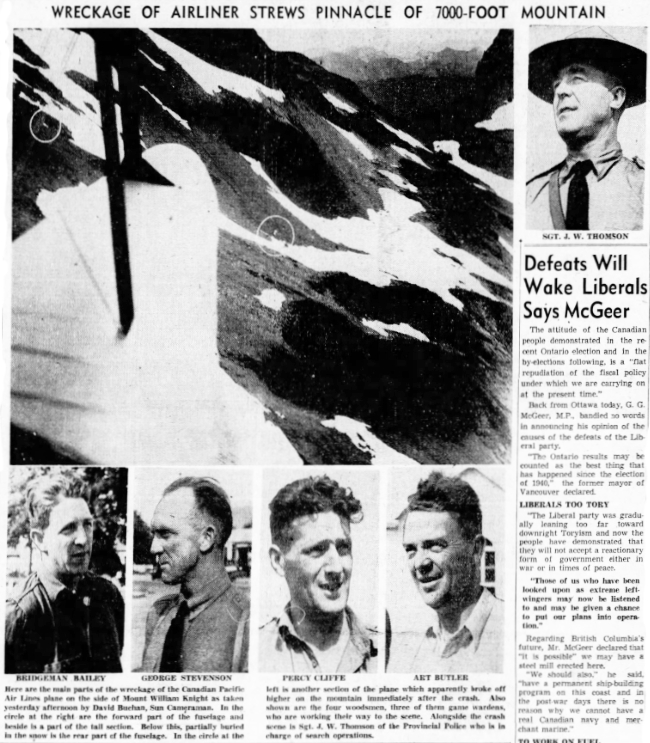
In the group sent to scout a route for later expeditions which will attempt to recover the bodies of the victims and salvage the plane's log and valuable instruments, are Wardens Art Butler of Chilliwack, Percy Cliffe of Mission, and George C. Stevenson, who was summoned from North Vancouver. The guide is Bridgeman Bailey of Ryder Lake.
LOGGING TRAILS HELP
They were accompanied to the jumping-off point by Sgt. J. W. Thomson, in charge of Chilliwack provincial police detachment, who organized the trip. Plans were changed from hour to hour Tuesday, as the expert hillmen checked and rejected several alternative routes. Al though the mountain is about nine miles in an air line from Agassiz it is difficult of approach.
Finally settled upon was a route which climbed by truck-logging grades high into the timber of the Cheam south slope. It was proposed by Earl Brett, lumberman and keen pilot, who flew low over the area during the afternoon.
The party loaded packboards into a logging truck at Brett's
operation near Rosedale when the first light came.
OFF INTO FOOTHILLS
Before the morning was far advanced, they were climbing on foot toward the fairly open summit of a 3000-foot ridge into which flow the massive, snow-streaked buttresses of the Cheam Range. They expect to find the going good until they have paralleled the line of peaks to the point where Mt. William Knight gathers itself for its 2000-foot final surge into the clouds.
After that? Here's how grey-haired, easy-smiling Sgt. Thomson put it to
The Sun: "Even the mountain goats don't go up there. They get discouraged."
Wardens and guide haven't the slightest doubt they will succeed,
however. Packs are pared to the barest essentials, and they carry a 100-foot alpine rope, which they expect to use in the steep pitches below the snow-pocket.
DIFFERENT ROAD BACK
Photographs from the air show that fragments of the plane lie exposed by melting snow on a slope of shale scree. They indicate too that the ship ticked the
ragged crest of the peak, shedding its pronellors on the north side and cartwheeling over the top to smash itself to pieces on the snow-sheathed rock.
Last word this morning was that the climbers may come out by another route, which would take them along the easy hogback of Bald Mountain and drop them into the Chilliwack River watershed, They would then hike over the Chilliwack Lake trail to make contact with civilization at Vern Currance's ranch on the old Mt. Baker Road.
In broad outline, the plan is to reach the wreckage of the airliner by the shortest route, make identification of the 13 victims and prepare them for later removal, collect any records of the flight, then, on the way out, blaze a line which salvage parties can follow.
DIFFICULT SALVAGE
Arrangements for salvage are still vague, and will be based on what the scouting party learns. Opinions are that it may be necessary to slash out a pack horse trail to a point as near the rock pitches as possible.
Choice for a guide fixed almost automatically on Bridgeman Bailey. A rifleman in the Rangers, he was born within sight of the Cheam group and has spent more of his years in the wilderness than among men. He has no illusions about the trip. "There will be a hell of a lot of rope work," he told The Sun. "We're going in as light as we can, a blanket apiece and four days' grub. We'll take rice, bacon, tea, salt."
While Bailey does much of his guiding for hunting parties in the Cariboo, he knows the Cheam Range as well as any man. He has never climbed the last rise of Mt. William Knight - named for a Chilliwack district pioneer - but has studied it often from
below.
A few mountaineers have penetrated to Mt. William Knight, but the country beyond the logging roads remains primeval hinterland. In it are grizzly and black bear, deer and goat.
Sgt. Thomson accompanied the climbers to the end of the truck road.
By DAVE BUCHAN
One look at the wreckage of the ill-fated Canadian Pacific Air Lines plane strewn over the top and side of Mount William Knight in the Cheam Range would convince anyone that the end for the 10 passengers and crew of three was mercifully sudden.
Yesterday afternoon I flew over the scene of the crash in the same plane and with the same pilot that located the wreckage on Monday. Aboard the plane with Pilot Don Patry and myself were Grant McConachie, general manager of CPA western lines, and Norman Terry, district inspector of civil aviation for the Department of Transport.
AS IF PLACED BY HAND
The scene which met our eyes on approaching the mountain would surprise even the most imaginative person. Less than 100 feet from the peak were two three-bladed propellers ground into the side of the cliff. This is apparently where the plane struck with terrific force, but the propellers appeared as though some one had carefully placed them in position as a mark to guide searchers to the remainder of the wreckage which lay several hundred feet beyond.
A few feet behind the propellers was scattered further wreckage, among which appeared to be an engine cowling. From this point it appeared that the plane had bounced crazily over a hump and then dropped sharply into a ravine, scattering baggage and
other articles en route.
PIECES EVERYWHERE
On the edge of a drift of deep snow, which might easily have been a glacier, I could see the forward end of the fuselage and nearby, torn from the rest of the
plane, but yet still having its original shape, was part of a tail section.
A few feet below that was the back end of the fuselage on which the identification letters of the plane could be easily seen. This section was lying in snow and the underside may have been deeply buried.
The forward part of the fuselage, which bore the brunt of the first crash against the mountain side, was twisted and torn open as though some giant had been locked inside and hammered his way out.
From the position of the propellers on the southeast face of the mountain, it is apparent that the plane was travelling north, or northwest at the time of the crash.
I may have been awed by the sheer peaks pointing to the sky and the closeness of our search-plane to the peaks, but there is little doubt in my mind that the rescue party going to the scene of the wreck is in for a tough climb.
Click on the image below to enlarge it in a new window.
Tuesday, August 17, 1943.
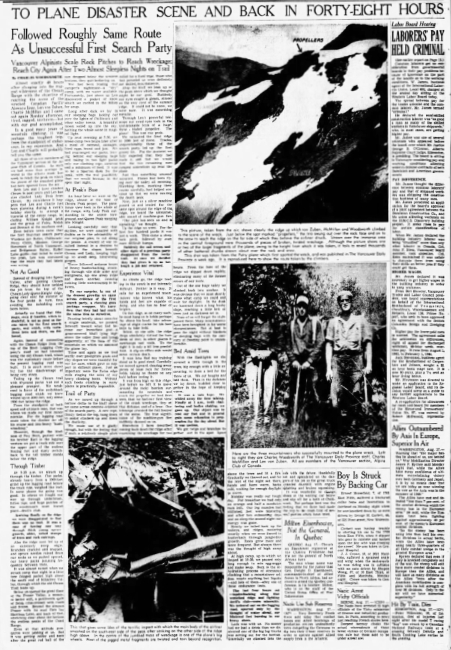
This is by far the most extensive coverage of the crash - we have reproduced a small part of it. The photo reproduction is unfortunately very poor.
The Vancouver Daily Province
Three men have reached the wrecked Canadian Pacific airliner.
Today they are back in Vancouver with pictorial proff of their spectacular dash across rugged Cheam Range ridges and up the precipitous peak where lies the horror that is the wreck and its 13 victims.
The Vancouver Daily Province party - consisting of Alpine Club members Len von Zuben, Charlie McMillan and Charles Woodsworth - left here Saturday and returned Monday. Today they and their pictures tell the first eye-witness stories of what there is to see atop the mountain peak that has already balked one official search party.
A second official party is bound for the scene today. It established a base camp at the mouth of Ford Creek, Monday, and is pushing on.
This is the log of the mountaineers' successful trip:
SATURDAY
Left Vancouver 11:20 a.m.
Drove to Brett Logging Co. road, left car.
Started up road on foot, 3:25 p.m.
Rode upper stretch with Roy Brett.
Left end of road for ridge, 5:30 p.m.
Camped on ridge, south end - Killarney Valley, 9:20 p.m.
SUNDAY
Up, 5:30 a.m.
Broke camp, 7:40 a.m.
Reached bluff for attempt on final ridge, 2:30 p.m.
Reached wreck, 4 p.m.
Left wreck, 6 p.m.
Back to bluff, 6:45 p.m.
Bivouacked in trees, well on return trip, 9:30 p.m.
MONDAY
Broke camp, 6 a.m.
Back to base camp, 10:30 a.m.
Down, 3:30 p.m.
Back to Vancouver, 8 p.m.

By CHARLES J. WOODSWORTH.
(Daily Province Editorial Staff.)
The bodies of the 13 victims of the crash of the Canadian Pacific airliner will probably never be brought down from that unidentified Cheam range peak which ended their flight and their lives on December 20 last. As the first party to reach the steep scene of the disaster we are convinced of this fact.
It was one of two tragic convictions we brought back from our mission to this death peak. The other was that, had the pilot of the machine been able to raise its nose perhaps ten feet as he flew through fog and clouds towards Vancouver, the crash would not have happened. As it was, one of his propellers hit on one side of a peak lying
southward from the 7000-foot Mount William Knight Massive. The other propeller carried over the edge and plummeted with the rest of the machine into a carnage of destruction. We found the airliner and its human freight spread in a million pieces over a vast area of snow and rubble.
PARTY SHOCKED AND HORRIFIED
That is one reason why the bodies can never be brought down. Literally and brutally, we saw no bodies - only parts of some of them. This is hard to report, but it must be said.
As the three of us stood on the ridge dividing the propeller debris and the far-flung remains of the once-luxurious airliner, we ourselves were inexpressably shocked and horrified. Perhaps even stronger was the feeling that those aboard her had missed safety by such a narrow margin.
Death for all had been mercifully sudden. There was no sign of an explosion or of fire. None of the victims knew of the horror that came afterwards - a horror that we saw at first hand but which should be no more than hinted at. As we were preparing to reach the ridge we heard machine gun fire from a plane above us, but we did not learn until we reached the other side at what the plane crew was aiming.
Pilots of the planes which are closely circling the scene are machine-gunning bears. But obviously the gun fire is not effective.
But even were it not for these factors, it would in our opinion still be impossible to bring bodies from the peak.
SCATTERED OVER BIG AREA
The only apparent route lies up a difficult and dangerous ridge, so sharp and steep it can be scaled only by skilled mountaineers with proper equipment. To carry a body down over this is out of the question.
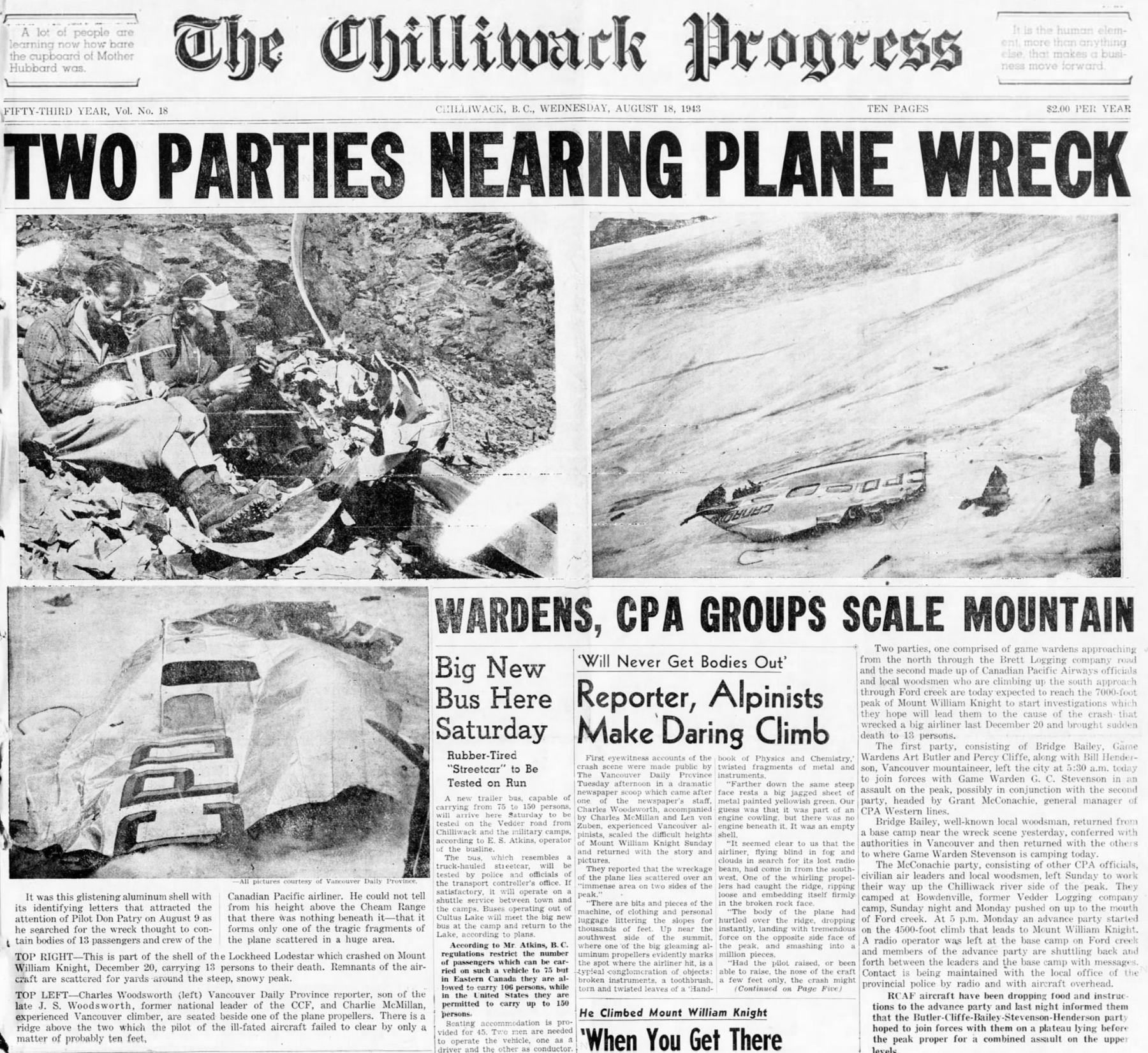
What applies to bringing out bodies goes also for announced plans to salvage the shattered hulk of the once-magnificent airliner. A more complete scene of disaster it would be difficult to imagine. The wreckage of the plane, torn and twisted, lies scattered over an immense area on two sides of the peak. There are bits and pieces of the machine, of clothing and personal luggage littering the slopes for thousands of feet. Up near the south-west side of the summit, where one of the big gleaming aluminum propellers evidently marks the spot where the airliner hit, is a typical conglomeration of objects; broken instruments, a toothbrush, torn and twisted leaves of a "Handbook of Physics and Chemistry," twisted fragments of metal and instruments.
Farther down the same steep face rests a big jagged sheet of metal painted yellowish green. Our guess was that it was part of an engine cowling, but there was no engine beneath it. It was an empty shell.
SMASHED INTO MILLION PIECES
It seemed clear to us that the airliner, flying blind in fog and clouds in search for its lost radio beam, had come in from the southwest. One of the whirling propellers had caught the ridge, ripping loose and embedding itself firmly in the broken rock face. The body of the plane had huriled over the ridge, dropping instantly, landing with tremendous force on the opposite side face of the peak, and smashing into a million pieces.
Had the pilot raised, or been able to raise, the nose of the craft a few feet only, the crash might have been avoided. How close he came to clearing the summit ridge is shown by the fact that the other propeller rests on the southwest, or opposite, face. It is possible that the machine was tilted somewhat as the pilot circled, so that only one set of the whirling blades caught the peak.
On the southeast side, where the main part of the machine was hurled after it struck, the confusion is multiplied a thousand times. The 300 orb 400 feet of the broad but very steep upper slope is of broken rock, dropping to a lower snowfield where the biggest chunks of wreckage lie, jutting in fantastic forms from the snow.
All over the entire slope are countless broken fragments. There are torn dresses and coats, a pair of man's pants, smashed fountain pens, valises and club bags burst wide open. Some of the objects, crushed and shredded, have remained in them. Others have been added to the indescribable litter.
In a smashed club bag was a worn leather wallet. Hotel bills and business letters identified it as the property of Captain William Holland, first officer of the ill-fated airliner. In one compartment of the wallet, seams burst, were water-faded family groups and snaps of planes which no doubt Holland piloted. In the club bag also were the flyer's leather gloves, pipe, and a pair of socks, with the price tag still attached.
A woman's leather handbag contained the national registration card, driver's license and ration card of Mrs. Bernard Spouse, another victim of the wreck. Also in the bag was a small sum of money. None of these things were together. They were scattered unnaturally hundreds of feet from each other as if a tornado had struck them.
There are not a few books and magazines, Many of them have been blown apart. I picked up a copy of Susan Ertz' "No Hearts to Break," in relatively good repair. Across the faded buckboard cover in large firm hand was the name "Elsie Davis."
On the climb up, as we neared the top of the ridge, we had been preparing ourselves for forbidding sights. A 15-power telescope had given us a vivid closeup of the bear on the mountain top. But to witness mangled remains at close hand was something else. The first piece was a foot - just a foot which ended at the ankle.
BOOTS TORN FROM BODIES
From then on, when fragments appeared which told of a violence to human beings, we warned each other quietly, to lessen the shock. Often it was difficult to decide without close inspection. The ripped upholstery of chair arms, with the frayed and sodden stuffing bursting forth, might be something else.
One thing that surprised us was the number of empty boots and shoes scattered about the mountain side. No doubt many of them were carried in valises as personal luggage. But we were reminded of the phenomenon, familiar in automobile and train
wrecks, in which bodies of victims are hurled by the impact clear of their shoes, no matter how tightly laced.
When we first reached the scene of the disaster we decided instantly to climb to the summit ridge where the propeller rested before proceeding down the slope to the main wreckage. This for two reasons. Firstly, we were already high up, and with little time to spare wished to save ourselves a long uphill climb from the lower snow slope.
BEAR STOOD ON GUARD
In the second place, there was a bear. Big, black, menacing - he seemed to stand guard over the shattered remnants of the wreck in the snow hollow below. None of us had any wish to arouse the powerful creature to fury. We were unarmed, and a bear's ways are notoriously unpredictable. As long as we remained far above he paid no attention to us. It is doubtful it was aware of our presence. When we had finished examining the fragments above, the bear was still there. At our first shouts he looked up. Coming down we opened a barrage of shouts. He moved off, stood uncertainly. Encouraged, we came lower,
shouting constantly. Slowly he left the snow for a nearby rock ridge. But from there he refused to budge. Standing on all fours, he stood facing us.
Our hearts sank. We were anxious to get down the snow to the main wreckage. But we knew to get below the bear in the big snow pocket to the left would be suicidal in case he attacked. There would be no way out, and an ice axe is no protection against an enraged bear.
HURLED ROCKS AT INTRUDER
From a scant 200 yards up on the rock ridge I sent rocks whizzing at that malevolent black giant, hoping he would not suddenly charge uphill. Some of my rocks crashed in front of his nose but he refused to budge.
Wanting to get what pictures I could before the light failed, I set off across the snow slope, while Charlie McMillan stood guard, keeping close watch on the bear. Len von Zuben was also snapping wreckage.
Suddenly, and for no visible reason, the bear moved off slowly over the ridge. Apparently he was bored. He disappeared. But we had no idea how near he was behind the rocks and decided it was too risky to approach anywhere near a body which was not far away from him. The way was clear for us to go down to the vast chunks of shattered metal flung headlong in all directions about the snow slope below.
Charlie McMillan was hesitant for a moment. The air of death and disaster was heavy about the slope. A moment before he had touched with his axe what he thought was a cupped piece of metal in the snow. To his dismay he realized it was the upper part of a skull. It upset him a little. "I don't think I'll go down," he announced quietly. But a moment later he had recovered his composure and joined us.
SNOW SLOPE IN SHADOWS
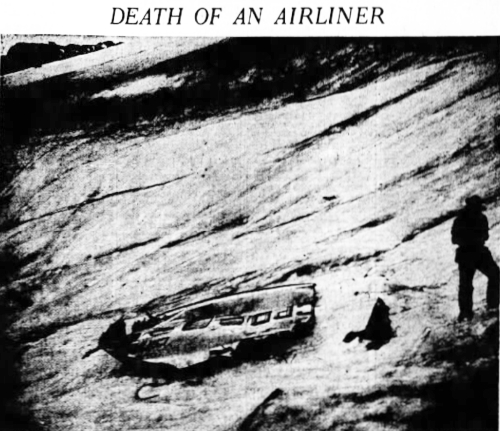
The late afternoon sun had @ropped behind the fatal peak, leaving the littered snow slope in shadow. The failing light added to the sinister character of the fantastic scene. It was as if a madman with a sledge hammer had struck loose with a barrage of furious blows. Here was a side of the main cabin, with the lettering CPD, frayed, smashed in. A few feet away was a pile of scrap - a junkman's dream - with twisted bars and pipes crushed inextricably about a huge rubber tire.
Uphill a bit was a massive block, presumably part of an engine, but so badly battered to be unrecognizable to the average eye.
In the big snow trough nearby. a jagged metal strip hung limply from a twisted part of the fuselage, On it was the unfinished lettering, "CANADI."
The whole jumbled mess, could it be brought out, would bring only so much by weight in the scrap market. Only the aircraft expert could determine to what part of the machine many of the broken fragments belonged, and even he would be confused.
We had spent two hours examining the wreckage and taking pictures. It was now 6 p.m. It would not be safe to wait longer. We must get off the peak, and well off it, before dark.
"LET'S GET OUT - AND FAST"
Suddenly we felt tired. The excitement of discovery was gone and strain and fatigue were beginning to tell. "Let's get out of this," Len said. "And fast." It was at the mountaineer's customary plodding deliberate walk, however, that we kicked steps in the snow upward to the rock leading to the ridge. "Take it carefully," we reminded each other. "This is the time when accidents happen - on the return trip, when you're tired."
Carefully but without wasting time, we lowered ourselves down the ridge, walking erect where possible, but more often crouched, or hunchigg forward astride the sharp rock edge. Carefully we chose handholds and footholds on the steep pitches.
We came off the rock onto the gentler grass slope at the base and out onto the flat plateau with a fast little stream of water from the snow slopes above running through it. The tension was over. With one accord we turned to one another and shook hands.
We had made it.
Wednesday, August 18, 1943.
Click on the image below to enlarge it in a new window.
Wednesday, August 25, 1943.
The Chilliwack Progress

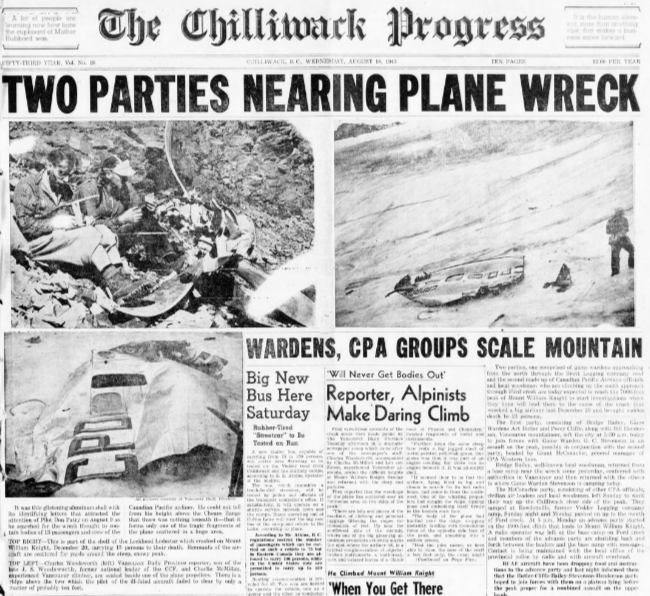
With results of investigations of both federal air inspection officials and B. C. Police in from the Mount William Knight airliner wreck, next step in the drama of the disaster is expected to be the opening of a formal inquest in Chilliwack, probably in September.
First tne two official parties to reach the actual scene of the wreck was comprised of Game Warden Art Butler, Game Warden Percy Cite, Game Warden Stevenson and Bridge Bailey, Ryder Lake woodsman. Butler, Cliffe and Bailey, accompanied by Bill Henderson, Vancouver alpinist, left here early Wednesday morning and by the B. B and B jogging company route joined Stevenson and for the second time made the assault on
Mount William Knight. With the aid of Henderson, a skilled mountaineer, they made the climb Thursday after spending the night at their base, only 1000 feet below the summit.
Game Warden Butler declared that the description of the wreck scene given by The Daily Province, whose search party was the first to climb the mountain, was "very
true." The litter of the wreck was strewn over a wide area. After collecting data which
would lead to the identification of the passengers, insofar as that was possible, the wardens returned to their base camp. They arrived in Chilliwack Friday night.
The men went up the mountain in cotton shirts, took no food, sleeping bags or sweaters with them. There was rain or fog during the entire trip.
By pre-arrangement, an RCAF bomber stationed at Roy Brett's airfield was to drop food and clothing to the party. Neither food nor clothing ever arrived. The bomber apparently was unable to penetrate the dense mist and clouds which shrouded the craggy peak. The party shivered in the cold, never spent a dry moment. The men lived largely on rice and raisins, they said.
While the game wardens saw tents which they believed were those of the McConachie party which was approaching the peak from Ford river, they didn't actually see any members of that group.

"We were soaked to the hide whenever we went outside a tent. It was either raining or clouded most of the time, and every bit of underbrush was full of water." Howard Compeau, one of the Chilliwack men who accompanied the CPA party to the scene of the airliner wreck on Mount William Knight, sums up his story of a gruelling week in those two sentences. "I wouldn't have missed the trip for anything," he adds.
"Rain was the most uncomfortable part of the trip," George Strevens, another member of the group, declares. "None of us had a dry stitch of clothing on from
Monday to Sunday. But I'm glad I went on the trip just the same."
Stung by hornets, legs bruised and swollen, members of the party admit they had a tough week. "The creek willow was really terrible," is the way Strevens puts
it. "So were the devils club and snags."
RETURN SUNDAY
Chilliwack members of the CPA party returned to the city Sunday, just one week after they left in company with officials of the airlines and the government to reach
the wreck peak.
It was Friday before Grant McConachie, general manager of CPA western lines, and Ted Field, manager of the Vancouver division, reached the wreck. The following day Constable Jack Bell, Compeau, John Kossikar and T. M. Shields, district inspector, Civil Aviation, Department of Transport, climbed the peak and Mr. Shields made an official investigation covering causes of the crash.
Scene of the crash is one subject on which Howard Compeau does not talk much. The Vancouver Daily Province pictures and story gave a vivid report of it, he says.
DIED INSTANTLY
"If I can judge at all, everyone died instantly," he states. There is no evidence to the contrary. The wrecked plane itself looks as if it had been smashed to bits in a twinkling."
Other members of the party were Jim Hamilton, Peter Hansen, an Alpinist, and Norman Terry, also of the aircraft inspection branch. The group left on Sunday, August
15, making their first camp at Bowdenville. Monday they pushed on up to the junction of Chilliwack river and Ford creek, where they established their main base camp and installed their radio equipment. John Kossikar, the axeman of the party, felled a tree across the stream at this point and the party crossed on it. Their 12 pack and saddle horses had to be left here.
Then a start was made brushing a trail up Ford creek to what the party termed "Airplane creek," a stream which runs from the base of Mount William Knight into Ford creek. "It was hard going,” Compeau says. "We did plenty of real bush whacking."
By Tuesday night the party was ready to establish its advance base camp site up Airplane creek. Ted Field and Compeau had pushed ahead to the camp site, which had
been prearranged, and that same evening an RCAF aircraft dropped supplies to them. The rest of the party became separated from them and on Wednesday they spent most of their time trying to locate the larger group.
Another plane came over Wednesday. It was a bad day, raining and cloudy by turns. Field and Compeau had the supplies, and the others were going on short rations.
That night they rejoined forces, and Thursday the whole party came back to the advance base camp.
LOTS OF FOOTING
Three small streams run into Airplane creek, and to get to the base of the mountain the party had to go back down the creek and then up what they called "number two creek."
"The way we went up it was not an alpinist's job," Compeau says. "It was a stiff grade all the way but there was lots of footing in the timber. Then you hit heather slopes and it was slippery but not dangerous."
When Compeau, Constable Bell and their party reached the peak they came up on a ridge and then waited for clouds to roll off the scene of the wreck. It lay almost
northwest of them, across a little basin and up onto a small ledge. "It wasn't more than half a mile from where we came up," Compeau says.
Their examination of the wreck was somewhat hurried, Mr. Shields devoting himself to investigating crash causes while Constable Bell took charge of the search for
means of identifying victims. There are plenty of black bears on the mountain. "They didn't bother us," Compeau says briefly.
Though there was no particular evidence of other parties having been there, the game wardens who reached the peak prior to the CPA party had done a major
portion of the work of identification. The clear mountain air has maintained articles such as blankets, instruments, clothing and shoes in an excellent state of preservation and it was not difficult to establish to whom they had belonged.
CPA party members are inclined to think they had a much tougher battle through the woods than did the game wardens and the Daily Province party, but believe the final assault was made in an easier spot.
"We never saw them, anyway," Howard Compeau says, "I don't think they got quite as far around behind the final ledge as we did. I couldn't be sure how tough a climb
they had on the last stretch but it looked a little better from our side."
The party was back to its advance base camp Saturday night. McConachie, Field, Terry and Hansen had already left for civilization to report the findings of the
first two, and on Sunday the remainder of the party came out.
SUPPLIES FLOWN IN
Getting supplies by airplane sometimes resulted in a laugh or two. They came in metal containers about 18 inches in diameter and about three feet deep, being
suspended from parachutes. Sometimes the chutes failed to open, and then anything could happen. "One container had a lot of butter in it," Compeau laughed, "and it was on the bottom. The chute opened too late, and it really hit hard. We were scraping butter off everything in the shipment." Some canned peaches burst in one shipment, and the boys all gathered round the container and polished them off right away. A four-pound can of jam was another casualty. "It really got spilled," Howard says. "I don't think we got more than a spoonful of it."
Messages dropped by the planes got lost on a couple of occasions. Word of the successful climb of The Daily Province party did not reach them till Thursday, and they were also without information that the game wardens had made the peak until late in the week.
CAME DOWN LOW
"The pilots who flew the supply planes deserve real credit, despite the fact that they did not always hit a bullseye. It wasn't much of a clearing we were asking them to shoot at," Compeau says. "They came down so low you could almost see into the plane. They really tried hard."
Back home Sunday night the Chilliwack members of the party are about their jobs again this week, some more than a little stiff and sore from a week of slashing
and climbing of the hardest kind.
Sunday's descent from the advance base camp to the gravel slide on the Vedder, where a police car picked up and whisked them back into Chilliwack, was made in
12 hours.
Monday, September 20, 1943.
The Vancouver Daily Province

(Special to The Dally Province.)
CHILLIWACK, Sept. 20, - Ernest Kubicek, pilot at the controls of the Canadian Pacifie airliner which crashed near Mount Cheam on December 20 last, killing 13 persons, in all probability was battling conditions of heavy cloud, zero visibility, a 70-mile-an-hour gale and sleet or snow.
This picture of the weather at about 6 p.m. on the day of the tragedy was given by David Strachan, department of transport meteorologist stationed at the Vancouver airport, to a coroners' inquest which opened here today. Mr. Strachan said that at 5:30
p.m. in the Chilliwack district the ceiling was about 1000 feet with a visibility of eight miles. From 1000 to 6000 feet, however, the clouds were likely to have been either ragged or solid, with solid overcast prevailing from 6000 to 17,000 feet.
FREEZING LEVEL.
"Freezing level that evening was about 4000 to 5000 feet," the witness told the six-man jury. "One can't be sure, but it is almost certain a plane would encounter icing in such conditions. An aircraft could maintain altitude quite safely, at a higher level, but icing conditions would be moderate to severe up over the ridges in the Chilliwack area."
Replying to a question by A. H. J. Swencisky, Vancouver, representing the families of Mr. and Mrs. Stouse, Pinchi Lake, two of the crash victims, Mr. Scott said all pilots had navigation charts and knew the exact heights of the mountains in the district over which they were flying.
Evidence that it was raining heavily and that there was a moderate storm in the area at the time was given by W. R. F. Richmand of Chilliwack, a voluntary weather observer for the Dominion department of transport.
According to Walter E. Gilbert, Edmonton, superintendent of B.C. district of the Airline company at the time of the accident, Ernest Kubicek, pilot, had flown the route continuously since April, 1942, until the crash. He had made more than 100 round
trips in that time.
"William Holland, first officer, was in my opinion, one of the finest pilots ever turned out in Canada," Mr. Gilbert said. Formerly with the ferry command, he had flown the route previously with another organization, and had completed half a dozen trips as first officer.
Coroner C, N, Tingle, of Chilliwack, is presiding at the inquest. E. Stuart Davidson and Allan Guinet, both of Chilliwack, are representing the crown. Representing the company are J. E. McMullen, K.C., of Vancouver and J. A. Wright.
Wednesday, September 22, 1943.
The Vancouver Daily Province

(Special to The Dally Province.)
CHILLIWACK, Sept, 22. - The 13 persons killed in the crash of a Canadian Pacific airliner in the Cheam Range on December 20 last died as a result of an accident, the causes of which are unknown, a coroner's jury here decided Tuesday.
The six-man jury brought in a recommendation that full entries on all developments during a trip be made in the flight log book, including loss of radio contact.
The verdict followed a two-day investigation into the crash during which Coroner C. N. Tingle of Chilliwack heard evidence from officials of Canadian Pacific Airways, provincia] police and members of The Vancouver Daily Province party which visited the scene of the wreck.
Wednesday, October 13, 1943.
The Chilliwack Progress

To obtain further evidence as to the identity of 13 passengers and crew members of the Lockheed Lodestar transport which crashed on the summit of Mount William Knight December 20, CPA officials spent the best part of last week at the scene of the wreck.
Taking John Kosikar as their guide, the party included E. R. R. Field, CPA superintendent; "Scotty" Bailey, a company pilot from Edmonton, and Peter Henson, Vancouver. They spent three nights and two days camped on the top of Mount William Knight within three-quarters of an hour's walk from the scene of the wreck. Going in by way of the Chilliwack river and Ford creek, the party left Ed Bell's ranch at 11:20. a.m. October 2, and returned to Chilliwack Friday afternoon at 2 o'clock.
They buried ten bodies, nine of which they identified by papers, registration cards, purses and liquor permits. The tenth body was not identified. One man was identified by a telegram and other articles in his pocket, a woman by clothing and a pin.
A cross fashioned of mountain stones was placed on each grave.
In some cases snowdrifts had melted as much as 30 feet, revealing further details of the wreck. One body was found lying on top of a drift.
GRANITE PLAQUE
A granite plaque about 14 by 20 inches and one inch thick, weighing 22 pounds, was placed on the cairn built by a previous party. The plaque bore the following
inscription:
"To the memory of Reginald H. Battye, James J. Coyle, Laetitia A. Herron, William G. Holland, Robert W. Kehr, Ernest W. Kubicek, William N. Scharfe, Rudolph A. Schroeder, Arthur L. Smith, Hugh Stewart, Winowna M. Stouse, Bernard J. Stouse, Edna Young, who lost their lives when aircraft CF-CPO crashed on this mountain, December 20th, 1942. Erected by Canadian Pacific Air Lines Ltd."
It was Kosikar's seventh trip to the ill-fated aircraft and this time, he packed in 72 pounds, included in which was the 22-pound plaque.
Camped beside a stream of water, the men experienced good weather for their entire trip with the exception of Monday afternoon when at 2:30 it clouded over, and
there was a heavy rain shower for three-quarters of an hour.
Peter Henson shot a bear and a goat on the trip. The men were agreeably surprised to find that bears were not visiting the scene of the wreck. "This is the time of the year," said the guide, "that bears feed on huckleberries, and there are plenty of them now."
CPA officials carried 60-pound packs. Food and supplies taken in proved sufficient for the trip, although a company plane circled over them every day, except Mon-
day, ready to drop supplies if needed. Supplies had also been stored at a base camp at the foot of the summit.
|

|