




|
|
Air North Alaska, 1951-1984
Arctic & Northern Aviation
Dateline: February 16, 2023. Last update: March 5, 2023.
In February 2023, I received a message that included a recent photo (source not known) of a derelict DC-3/C-47 sitting along the Chena River at Fairbanks.

Although tail number N95460 has "Air North" on it, the first thing I noticed was that the script is a little bit different than the Yukon's Air North was in its early years. The airframe dossier at AerialVisuals.ca shows its to be a C-47A-90-DL, construction number 20190. That aircraft is not on the list we compiled of DC-3s/C-47s that Air North Yukon owned.
I posted queries about the aircraft on two Facebook groups - my Yukon History & Abandoned Places, and History of Alaska Commercial Aviation. A member of the Alaska aviation group soon replied that it had been moved from Metro Field (MTF) to Chena Marina a couple of years ago, and I was able to find an aerial photo of it on Google Earth.

The first good lead of which direction to go from there came from Yukon History member Dan Tonner, who commented "Carol Scott, our Air North agent in Fairbanks years ago, used to refer to us as Air North Canada. There was an Air North in Fairbanks years ago. Different company, same great name!" Knowing that there were indeed two different companies made the newspaper archives search much easier and I was able to compile this history.
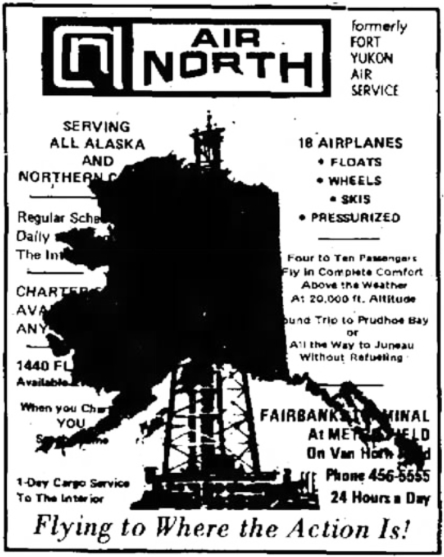
Air North began as Fort Yukon Flying Service, founded in Fort Yukon in 1951. The company moved to Metro Field in 1968, the first company to base at that field. In the fall of 1968, they were involved in the first big push to the North Slope, carrying men and supplies to the Prudhoe Bay area.
In 1969, Fort Yukon Flying Service got the U.S. mail contract for Fort
Yukon, Chalkyilsik, Venetie, Arctic Village, Birch Village, Beaver, Stevens Village, Rampart, Tanana, Circle Hot Springs, Central, Circle City, Eagle, Boundary and Chicken.
In July 1973 the firm received a Canadian license, and began operating throughout the Yukon and Northwest Territories.To reflect their new international scope of operations, President Tommy Olson and Vice President and Director of Operations Ron Klemm, along with Marvin Jones, secretary and director of maintenance, came up with a new name, Air North.
On December 18, 1973, the Fairbanks Daily News-Miner published a photo of Air North's new pressurized North American Rockwell Turbo Commander, bringing their fleet to 17 aircraft. The Rockwell is the only pressurized twin-engine aircraft available for charter in Interior Alaska, and can fly non-stop from Fairbanks to Juneau at 25,000 feet.
On April 10, 1974, a notice in the News-Miner stated that Air North was now managing Metro Field, and due to increased commercial activity, all other flying will be prohibited between 8:00 a.m. and 7:00 p.m. as of May 1st.
Fairbanks Daily News-Miner, January 16, 1975:
Fairbanks Daily News-Miner, February 3, 1975:
A Fairbanks man, Les Bradley, escaped injury here Friday when he made an emergency landing in a twin-engine Aerocommander owned by Air North of Fairbanks.
The aircrafl which was enroute to the North Slope with cargo sustained minor damage in the belly landing.
A combination of team effort by Eielson personnel and pilot skill averted a potentially tragic situation, an Air Force spokesman said. Eielson operations received first word of the airborne emergency at about 10 p.m. when the pilot radioed that the hydraulic system on his aircraft had gone out and he was unable to lower his landing gear.
Preparations were begun for him to make a gear up landing on a snow covered inactive taxiway. Because it was unlighted, Eielson personnel placed portable
lighting units along the 6,000-foot-long taxiway.
Fire trucks, an ambulance and other rescue equipment were on hand for the landing.
Meanwhile, in the dark skies over the Tanana Valley, another Air North pilot from Fairbanks, Ron Clemm, flying a second Aerocommmander, attempled to lock the landing gear of the disabled craft by lightly nudging them with his wingtip. This delicate inflight maneuver was made all the more difficult by the darkness.
Although Clemm was able to get the gear into the proper position, it would not stay locked. Bradley then began preparation for a gear up landing.
At about 10:45, after reducing his fuel load and exhausting every effort to lower the gear, Bradley brought the disabled craft in for a perfect landing. The
aircraft skidded on its belly for 2,000 feet before stopping.
Small scratches on the plane were the only evidence of the drama that occurred.
On April 24, 1975, the Fairbanks Daily News-Miner published a photo of four 10-passenger Rockwell Turbo Commanders flying in formation. They were the flagships of a fleet of 20 aircraft then operated by Air North. The company had bases at both Metro Field and Fort Yukon, with a staff of 38, all Alaskans.
Fairbanks Daily News-Miner, August 15, 1975:

Fairbanks pilot David M. Tucker his been named the Alaskan Flight Instructor of the Year by the Federal Aviation Administration (FAA).
Tucker is an instructor pilot for Air North at Metro Field. His more than 20 years af flight instruction experience earned him the award "for outstanding contributions to air safety through good flight instruction practices."
Tucker has more than 13,000 flying hours, including 5,000 hours of flight instruction, and the FAA says during the last 24 months he has successfully
trained more than 40 students and conducted more than 200 flight checks.
His experience includes instrument flying, gliders and helicopters. Tucker was one of the first pilots to hold an instrument flight rating for helicopters.
He holds FAA certificates as an air transport pilot, flight instructor, ground instructor, navigator, flight engineer, dispatcher, airframe and powerplant mechanic, control tower operator and parachute rigger.
Tucker is rated in more than 20 aircraft, and is authorized to give
ratings in private licenses, commercial licenses, instrument flight and multi-engine land and sea operations.
Fairbanks Daily News-Miner, August 16, 1975:
A Cessna 180 operated by Air North remained down in the Brooks Range today following either a forced landing or mishap Thursday. None of the three persons on board the plane at the time of the incident was injured and all have been evacuated, sources said.
Details of the incident were sketchy as Air North employes declined comment and State Troopers and the Federal Aviation Administration said they had little information available. Air North presiden Tom Olson was fying and unavailable for comment this morning.
Fairbanks Daily News-Miner, September 20, 1975:
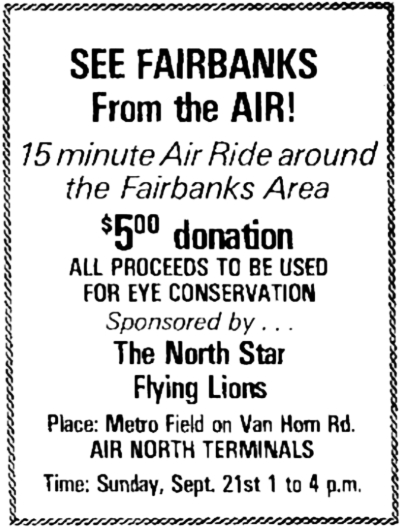
The North Star Flying Lions will hold their first airshow in Alaska Sunday between 1 p.m. and 4 p.m. at Metro Field on Van Horn Road.
Tommy Kushida of Northland Aviation will fly his 150-Citabria on two major passes and Ron Klem of Ait North will fly a World War 11 T-6 Advanced Trainer that
he restored himself.
Admission to the airshow is free and both Northland Aviation and Air North will offer 15-minute sightseeing trips over Fairbanks, the University of Alaska, and the Pipe Storage Yard. All proceeds will go to the North Star Flying Lions Fund to Purchase a portable operating microscope with accessories for eye surgery.
The microscope will cost about $2,000. To help with the fundraising project, the club also will start its annual Rose-Bowl raffle at the show.
Further information is available by calling Tommy Olson at 456-5555 or Tom Kushida at 452-2918.
Fairbanks Daily News-Miner, November 19, 1975:
Air North has filed a proposed rate increase for passenger fares and air cargo shipments to be effective Jan. 5.
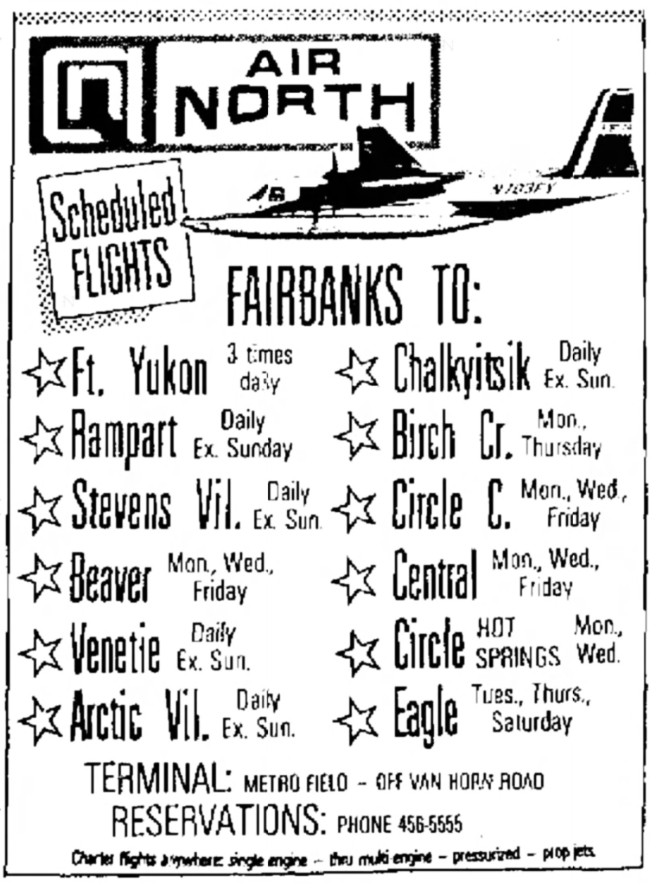
The rate increases cover the scheduled operations of Air North to Rampart, Stevens Vilage, Beaver, Birch Creek, Fort Yukon, Venetie, Arctic Village, Chalkyitsik, Circle City, Central, Circle Hot Springs, Coal Creek
and Eagle.
The increase sought would raise the shipping price for cargo from one to four cents a pound and one-way passenger fares from $2.17 to $5.89 depending on the destination.
Anyone wishing to protest the increases is asked to make their complaint to the Alaska Transportation Commission at least 15 days prior to the effective date of the new fares.
The company says the proposed increases are the first since July 1973 and are necessary because of increased wages, fuel prices, the increased cost of doing business and parts and engine overhaul costs.
Fairbanks Daily News-Miner, December 19, 1975: Truck fire spreads. Flames originating from a truck fire caused an estimated $10,000 damage to an Air North hangar on Metro Field about 7 this morning. Fire departments from Ft. Wainwright, the airport and the university responded to the fire.
Fairbanks Daily News-Miner, March 19, 1976:
Fairbanks Daily News-Miner, May 28, 1976:
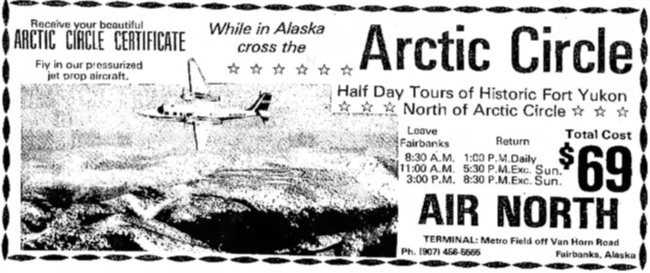
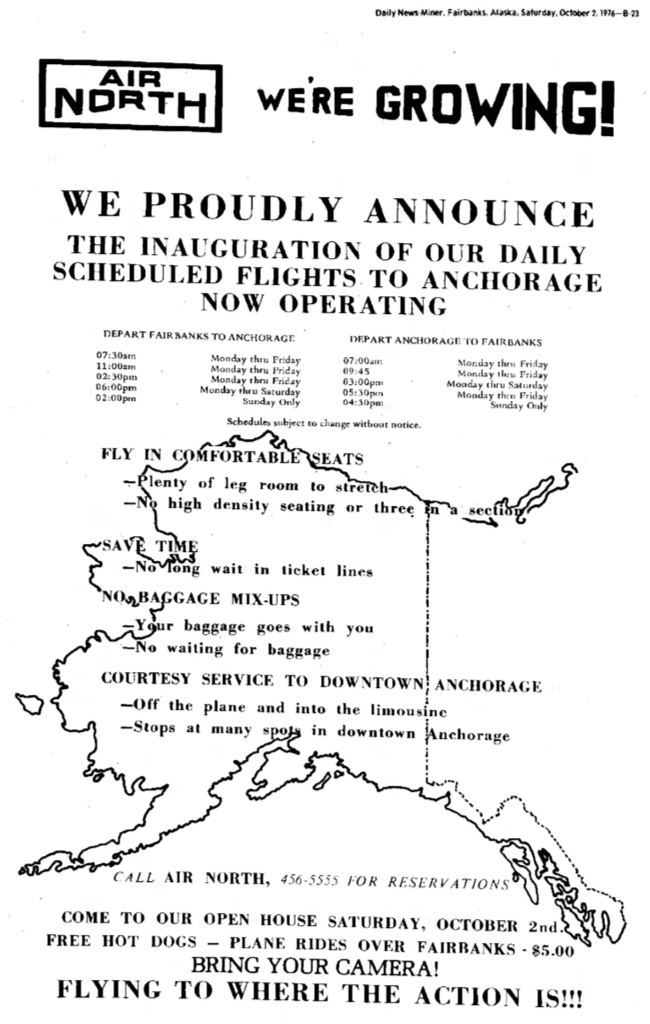
On September 27, 1976, the Fairbanks Daily News-Miner and The Sentinel (Sitka) both reported that Air North had received a licence to operate in Washington State. They had planned to start that operation on October 4, but moved it up to September 27 to take advantage of a strike against Alaska Airlines by the Association of Flight Attendants.
Fairbanks Daily News-Miner, October 2, 1976:
Fairbanks Daily News-Miner, October 23, 1976: Note that the ad is now for "Alyeska Air Service, DBA Air North".
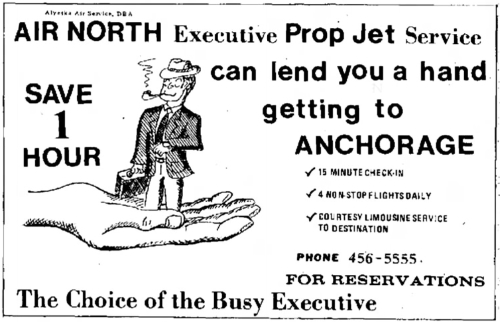
Fairbanks Daily News-Miner, November 3, 1976:
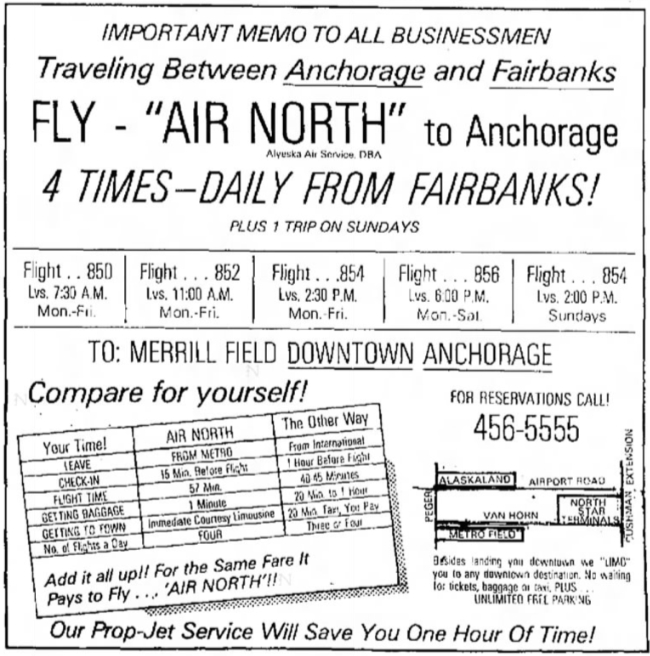
Fairbanks Daily News-Miner, November 19, 1976:

In a report from Stevens Village in the Fairbanks Daily News-Miner on December 23, 1976: "The village would not have a telephone services if it wasn't for the State of Alaska through the Governor's Office of Telecommunications, NC Company of Fairbanks, and Air North who did a real good job of bringing to our village all the fuel in 55 galion barrels. Plus hauling the 250 gallon fuel tank and the 10 KW generator."
The Fairbanks Daily News-Miner reported on December 24, 1976, on the annual Christmas outreach program of radio station KJNP ("King Jesus North Pole"). Gifts are collected, repaired if necessary, and wrapped. "Getting the packages to the villages
requires the cooperallon of local airlines, which are at their peak with freight hauls because of the Christmas rush. However, there are those such as Air North which take the gifts on a 'space available, no charge basis', even though it does create problems."
February 1, 1977 - Another Air North is founded, in the Yukon Territory. Co-owner Joe Sparling told the story in the company's 24-page 40th Anniversary history: "On February 1, 1977 Tom ('Ace') Wood and I purchased the assets of Globe Air for $50,000 from its owner Ed Phillips (also known as 'Fast Eddie'). Our purchased assets included a well-used Cessna 206, C-GLIZ, a Cessna 150 C-GCOO, and a small office trailer. We assumed the leases on three Cessna 172s, C-GASK, C-GWYU, and C-GWKA. My equity in the company was my 1963 Cessna 172, CF-NFA and Tom's equity was a 1958 Piper Apache, CF-MTF plus an interest in some Vancouver real estate.
We had to decide what to call our new venture and, as neither Tom nor I was very creative, the best we could come up with was 'Air North'. Because we had to incorporate Federally, this name was challenged by Northward Airlines and Nordair and perhaps a couple of others. Being stubborn as well we got our name by tagging on what we did so we were officially incorporated as 'Air North Charters & Training Ltd.', a name which we soon outgrew, but worked for us as we did business as 'Air North'."
On March 12, 1977, a lengthy article reported on the problems that have arisen since August 1976 when the customs official in Fort Yukon left. Air North used to fly a 7-seat Cessna between the communities each Wednesday and always had a full load. With no customs official to clear people and cargo, those flights had to stop.
Fairbanks Daily News-Miner, April 1, 1977:
A Native corporation on Cook Inlet has filed a lawsult against an Anchorage-based air service seeking to halt the firm from flying over the Native lands.
Tyonek Native Corp. filed suit in Superior Court in Anchorage against
Alyeska Air Service, a subsidiary of Fairbanks-based Air North, claiming the air service has trespassed upon its air space and prevented it from "reasonable enjoyment" of the surface of the land.
Alyeska Air Service has been flying supplies and mail to an airstrip on land the Tyonek Native Corp. leased to Kodiak Lumber Mills, under contracts with the mill and the U.S. Postal Service. The lawsuit claims that Alyeska Air Service has "encroached and trespassed upon the air space of the plaintiff, in landing and departing from an improperiy located alrstrip on the lands leased lo KLM," that the Native corporation "has incurred interference with the reasonable enjoyment of the surface of the land," and that the flights "have resulted in virtual dispossession of the plaintiff's right to use and enjoy the property under which the airspace has been invaded."
Tyonek is asking the court to enjoin Alyeska Air Service from "continuing to invade" its airspace, to grant $25,000 in punitive damages, and to grant
general damages as it may determine.
Tom Olson, president of Air North, said he plans to counter sue the Native corporation for damages caused by the suit. Olson said the timber company cancelled its contract with Alyeska Air after the suit was filed, and he said he has notified the Postal Service that he can no longer fulfill the mail contract until it is settled.
Olson called the suit "ridiculous" and said "every person who flies into Anchorage flies over the same ground we do." He said if property owners could control the air space over their land, nearly every air strip in Alaska could be shut down. "You'd have to close Merrill Field (in Anchorage), because you have to fly over some homes," he
said.
The village af Tyonek is on Trading Bay on the west side of Cook Inlet.
On October 12, 1977, it was reported that the Tyonek Native Corp. had asked the court to dismiss their original suit.
Fairbanks Daily News-Miner, April 2, 1977: The Eagle General Store is for sale. "Includes living quarters, store area. Chevron Service Station. Chewron Airport dealership. Eagle sport shop (guns, ammo and sale of hunting and fishing licenses. 185 air miles from Fairbanks, served three times each week by Air North or can be driven to by the Taylor Highway. Selling for $149,000.00."
Fairbanks Daily News-Miner, June 13, 1977:
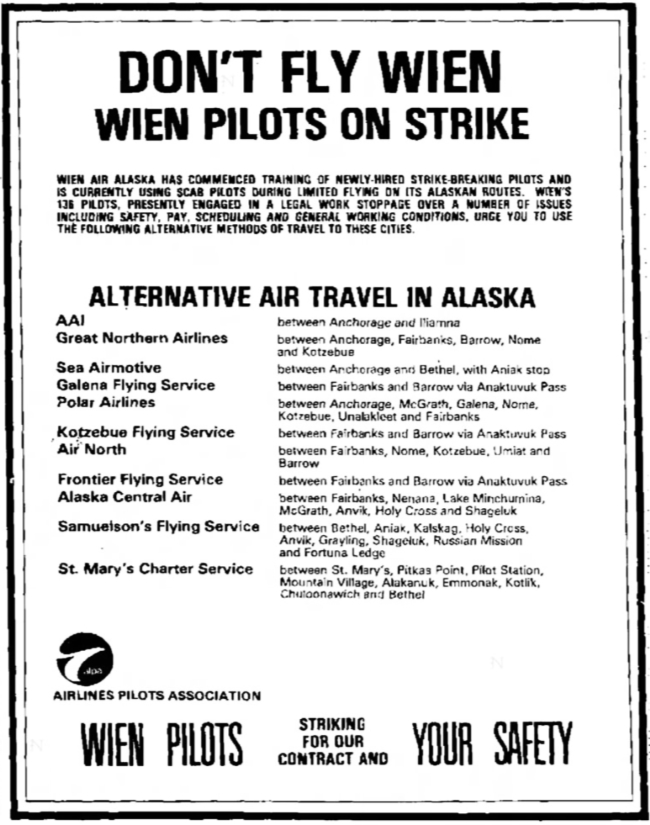
Fairbanks Daily News-Miner, July 29, 1977:

The last issue of the Fairbanks Daily News-Miner that is online is October 31, 1977. Thus ends our primary source of Air North news.
The Whitehorse Star, March 12, 1982: Trans North Turbo Air could be flying to Juneau as early as April 1, but Fairbanks-based Air North has applied to take over the U.S. rights to the Juneau-Whitehorse route after being relinquished by Wien Air Alaska. Arden Meyer, assistant general manager of Trans North, says there is not enough traffic for both airlines. Trans North is also in negotiations to take over the Whitehorse-Fairbanks route from CP Air, which has not flown it in many years.
The Whitehorse Star, April 21, 1982: Trans North Turbo Air may lose the Fairbanks-Whitehorse-Juneau air route to strong Alaskan competition. Trans North is close to getting the final permit it needs to fly the Whitehorse-Juneau route but general manager Al Kapty fears it could be months before it gets the Whitehorse-Fairbanks route,
which he said will provide enough business for only one carrier. CP Air has
the rights to the Fairbanks-Whitehorse route. Though they haven't run the route for years, they will not give it up, but are willing to contract it out. A Fairbanks company, Air North, is only days away from getting final permission to fly the complete route.
Air North president Tom Olson said his company is ready to fly two 44- passenger F-27 turboprop aircraft on a daily basis, with at least three roundtrip flights per week during the winter.
Sitka Sentinel, April 28, 1982: Wien Air Alaska may have left Juneau, but two smaller airlines are rushing to replace some of the lost flights. Trans North Air of Whitehorse and Air North of Fairbanks are planning to fill part of the void, with flights starting in May.
The Whitehorse Star, May 6, 1982: Trans North Turbo Air will begin regular air service to Juneau on Friday, May 14. There will be two flights weekly for the first two
weeks, on Friday and Sunday, then the summer schedule starts and flights will run every day except Saturday. The fare is $90 one way.
The Whitehorse Star, June 14, 1982: Despite paperwork delays an then last minute
problems getting counter space in both Juneau and Whitehorse airports, Air North Alaska's
Fairbanks-Whitehorse-Juneau air service has finally started. They had planned to start the service, which uses a 48-passenger stretched F-27 turboprop aircraft May 17th. The one-way fare is $177 (U.S.) from here to Fairbanks and $68 (U.S.) for the Whitehorse-Juneau leg. Trans North Turbo Air currently charges $75 (U.S.) at today's exchange for the Whitehorse-Juneau route but has applied to drop the rate to $70 (U.S.) in the next
few weeks.
The Whitehorse Star, September 28, 1982: Air North Alaska is cutting back its daily flights from Whitehorse to Juneau and Fairbanks to three times a week starting Oct. 1 due to the normal winter drop in volume on the route. The previous carrier, Wien Air Alaska, which used large jets on the route, was in the habit of suspending all service in winter. Fairbanks-based Air North uses smaller F-27 turboprop aircraft. Flights will run
Monday, Wednesday and Friday, following the established routine of leaving Fairbanks early in the morning, flying to Whitehorse then Juneau, and returning by the same route in the afternoon.
Those three fights per week were soon cancelled.
The Whitehorse Star, February 11, 1983: Air North Alaska (Yukon Air Service Inc., d.b.a. Air North) has applied for rights to begin scheduled flights from Fairbanks to Old Crow, and Fairbanks and Dawson. Trans North Turbo Air is opposing the applications, as they would cut into their Old Crow and Dawson schedules, which are "fragile" routes.
On March 25th, Air North amended their application to a seasonal operation (June 1 - September 15) between Fairbanks and Dawson.
The Whitehorse Star, June 6, 1983: Air North Alaska has re-started their Fairbanks-Whitehorse-Juneau seervice but is now using refurbished DC-3s, of which they own four.
The Whitehorse Star, June 20, 1983:
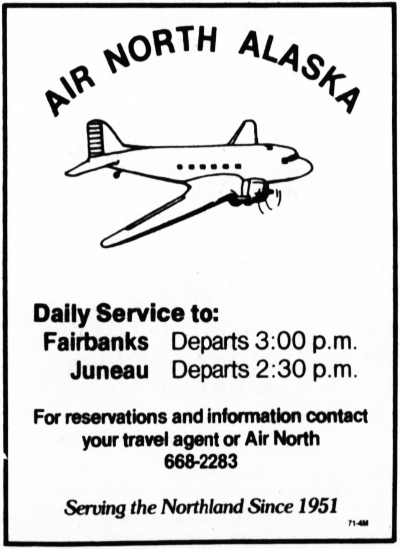
Daily Sitka Sentinel, June 27, 1983: a report on the crash of the aircraft that started this search:
Plane Engine Burns
An Air North DC-3 enroute from Fort Yukon to Fairbanks with 19 persons aboard landed safely Friday night after one of its two engines caught fire 63 miles south of Fort Yukon.
James Titus, a supervisor at the Fairbanks International Airport tower, said the propeller-driven aircraft put down without incident at Metro Field, a small-plane landing facility adjacent to Fairbanks International.
A passenger on the flight, 30-year-old Dale Atkinson of Ketchikan, said the left engine of the aircraft caught fire about 20 minutes after the plane left Fort Yukon.
"In about five minutes, flames were coming over the engine and over the
wing," Atkinson said.
He said the pilot shut the engine down, and the fire burned itself out before the plane landed.
See March 25, 1985, for a summary of the NTSB report on the crash.
The Whitehorse Star, May 2, 1984: Air North Alaska plans to start regular service from Fairbanks to Dawson City, Old Crow and Inuvik after June 1. Ticket agent Tracey Pitts said from Fairbanks that either a Navajo Chieftain or an Islander 402, both nine-seaters, will be used. Starting May 27, for the third straight summer, it will resume
daily flights from Fairbanks to Whitehorse.
The Whitehorse Star, June 26, 1984:
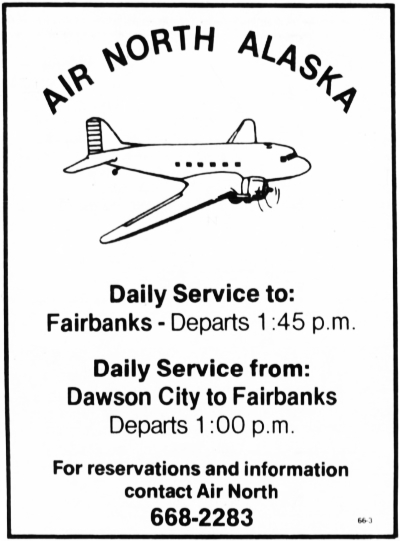
Daily Sitka Sentinel, August 13, 1984:
Valdez Airlines and Air North, two Alaska regional commuter airlines, have been bought for an undisclosed price by an Anchorage-based holding company that plans to merge them into a single airline, a holding company spokesman said Friday.
The companies were bought by Liberty Air Inc., said Jerry Eastep, a
former MarkAir vice president who will head the new airline. Eastep, Garry White, former president of MarkAir, Fred Frink, former owner of Alaska Alarm and developer of an Anchorage condominium project, and Wayne Kelley, founder of Dallas-based Sun Air, own Liberty Air.
Valdez Airlines and the Fairbanks-based Air North are to be merged by Sept. 15 and the resulting airline will have a new name, Eastep said.
"We feel there's a real opportunity now," because of deregulation of the airline industry, he said.
The purchase of Valdez Airlines included four twin-engine, 19-passenger turbo-prop aircraft, plus facilities and equipment in six southcentra] Alaska cities. It serves Kenai, Homer, Kodiak, Valdez, Cordova and Anchorage.
Air North has 11 aircraft and provides year-round commuter flights to interior Alaska cities.
Daily Sitka Sentinel, September 7, 1984:
Anchorage Airlines
Files for Bankruptcy
The new owners of two Alaskan commuter airlines have filed for bankruptcy, a month after buying the financially troubled airlines.
Liberty Air of Anchorage, which took over Air North of Fairbanks and Valdez Air early last month, sought protection Tuesday under Chapter 11 of federal
bankruptcy laws.
"It's one of those things you get into where you've got to buy some time," Jerry Eastep, the company's president, said Wednesday in a telephone interview from his Anchorage office. "You've got to get the creditors off your back."
If a federal court approves the Chapter 11 request, the company will get a federal court order protecting it from creditors' lawsuits. Chapter 11 is designed to give a company time to put its finances in order. The ultimate reorganization plan must be accepted by a majority of the company's more than 300 creditors.
Both airlines will continue normal flight schedules and no employees have been laid off because of the bankruptcy, Eastep said.
Eastep said he and his partners knew when they bought the two airlines that bankruptcy might lie ahead. "There was no question they were having trouble, or we wouldn't have been able to take them over." Eastep said.
He said Liberty hopes to come out of bankruptcy in 90 to 120 days and
resume normal operations.
Eastep's partners in the venture include Garry White and Wayne Kelley.
Eastep and White are former executives of MarkAir, which was formerly the all-cargo Alaska International Air.
"AIA did it and it worked for them, and it's working for Continental,"
Eastep said of the bankruptcy filing. AIA spent some time in Chapter 11 shortly before the Alaska Pipeline was started, and then recovered. Continental Airlines now is coming out of a Chapter 11 filing.
Daily Sitka Sentinel, September 27, 1984:
Some former Air North workers in Fairbanks plan to meet Saturday to explore the possibility of forming their own airline.
Dispatcher Larry Rowlett said seven of the 10 pilots and others who worked as mechanics and freight handlers and in office jobs are discussing the possibility of a new airline.
On Friday, Liberty Air Inc. shut down all operations and its owners said they would not oppose a petition to force the company into involuntary bankruptcy and liquidation. Liberty Air this summer acquired and merged Air North and Valdez Airlines, then filed under Chapter 11 bankruptcy to reorganize its finances.
"We're talking about opening right back up, the same thing we were doing
and hopefully a little bit better," Rowlett said. About $1 million capital would be needed to pay airplane and hangar leases, wages and fuel, Rowlett estimated.
Some of the workers now out of jobs have indicated they would consider a second home mortgage to raise the money, he said. Another possibility to raise capital might be public sale of stock, he said.
The Whitehorse Star, September 28, 1984:

An Alaskan airline that linked Whitehorse and Fairbanks has ceased operations in face of creditors' demands that it be declared bankrupt.
Liberty Air Inc., a merger last month of Air North Alaska and Valdez Air after both companies were purchased by a group of four people, ceased all operations Friday with next to no notice to its employees, and indicated it would not oppose the demands in an Anchorage court that it be declared bankrupt.
The last Air North flight between Whitehorse and Fairbanks was on Friday, the last day any Alaskan community got Air North-Liberty Air service. Air North had advertised daily service to Whitehorse this summer. Several companies in the highly competitive Alaskan market say they are interested in taking on the Whitehorse route.
They said they would continue to follow Air North's pattern of having flights in the summers only.
The regular Princess Tours business between Dawson and Fairbanks went to a charter outfit this summer, Pacific Alaskan airlines, because Princess wasn't happy with the scheduled DC-3 service provided by Air North-Liberty Air. Rather than using the aging aircraft, Pacific Alaskan used 47-seat pressurized stretch F-27 turboprop aircraft.
Daily Sitka Sentinel, December 10, 1984:
The founders of Valdez Airlines have sued their former partners for allegedly conspiring to push the company into bankruptcy in order to take over the airline.
In a 29-page complaint filed in Anchorage Superior Court, Jeffery
Haddock and Ronald Watson said four fellow board members "deceptively induced" them into selling the airline, and "for reasons of greed and self-interest" let the company go bankrupt.
They are seeking at least $10 million in punitive damages and repayment of their back debts, among other damages.
Haddock and Watson formed the airline in 1979, flying one plane between
Valdez and Anchorage. By last summer, the airline served six cities and employed 80 workers.
The four defendants were partners in Liberty Air, which bought Valdez
Airlines last August and planned to merge it with Fairbanks-based Air North.
Daily Sitka Sentinel, March 25, 1985:
Improper actions by the flight crew of an Air North DC-3 in 1983 contributed to an emergency aboard the plane when one of its engines caught fire, the National Transportation Safety Board has concluded.
The twin-engine plane on June 23, 1983, was carrying 19 people from Fort Yukon to Metro Field, a private airport in south Fairbanks, when the fire broke out in its left engine.
As the plane descended near Lime Peak, the fire went out and the plane
landed uneventfully at the field.
But the NTSB noted that passengers complained there was a long delay
between the fire's outbreak and corrective action by the crew. The agency's report also cited poor communication between the cockpit and thecabin, and a lack of emergency
equipment on hand at Metro Field.
The NTSB said causes of the incident included loose fuel line fittings, improper emergency procedures and poor supervision by the pilot and poor coordination by the copilot.
Air North was taken over by another firm that went bankrupt.
|


