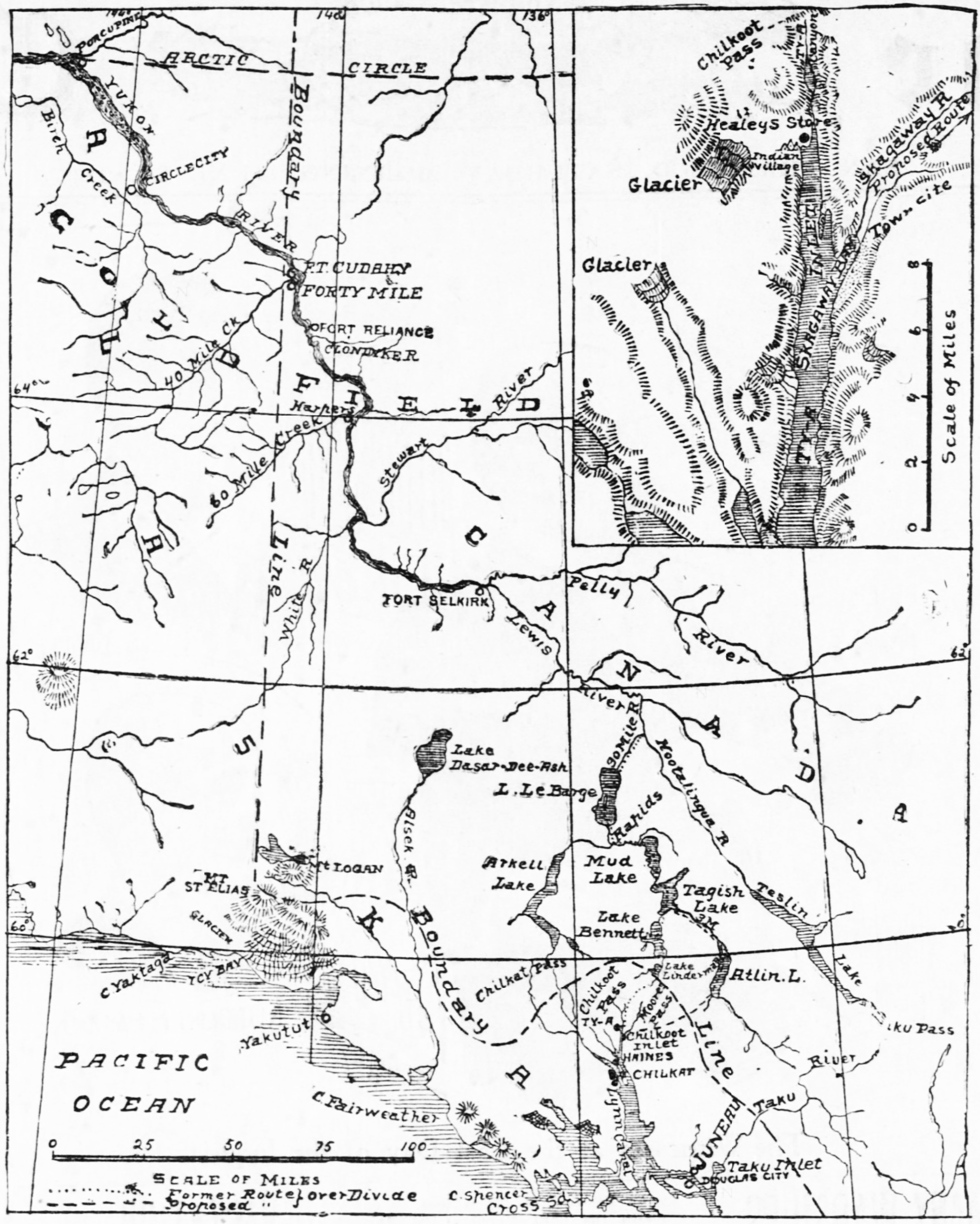
The dispatch published in The Call a few days since stating a company had been formed to build a railroad into the Yukon gold fields has aroused considerable interest. At present there are two ways of getting into the Yukon country. The first and easiest, but longest and most expensive, is by sea to St. Michaels Island, near the mouth of the river, 2800 miles from San Francisco, and thence by steamer up to Circle City, 2300 miles, and beyond. As the river is not open until the early part or middle of June this route entails a loss of a good part of the very short working season, and is not much followed. By the other way one must pass an overiand journey of nearly 500 miles from tidewater to the mining district. There are several of these overland routes. One starts just below Juneau and goes up Taku River over the divide to the head of Teslin Lake, and thence by boat built on the ground, down the lake and the Hootalinqua River to the Lewis, and thence into the Yukon. This is the longest of the overland routes, but is the easiest after reaching Teslin Lake. It was proposed some time since to build a railroad from Taku Inlet to Teslin Lake, and application was made to the Canadian Parliament for a charter. The project was dropped, however, owing doubtless to the expensive engineering incident to the route.
One of the other routes overland, that from Ty-a (or Dyea), at the head of tidewater navigation, eights miles above Juneau, over Chilkoot Pass to Lake Linderman, the headwaters of Lewis River, is the one most used, fully 90 per cont of all the travel in and out choosing that road. The start is made from Juneau as a base in.March, so as to get over the pass before the snow melts and have a boat built ready for the melting of the ice on the lakes and rivers beyond. The summit of the pass, fifteen miles from Ty-a, is 3500 feet above the sea. The passage up is very arduous and parties are frequently detained by snowstorms for ten days or two weeks at a time, adding this much to the six or eight weeks necessary for the trip to Forty-mile Post. To lessen the disadvantages of this, the most troublesome part of the route, Juneau parties have established a pack-train of horses to carry baggage over the summit, a hotel and restaurant at Sheep Camp near there and a sawmill and boat-building shop on Lake Linderman. But with all these helps a month or six weeks of working weather is lost. A bill was presented to Congress providing for a charter for a railroad over this pass from Ty-a to Lake Linderman, but it will hardly be built. The new route promises to cut the time from Juneau to Forty-mile Post in half or even less.
It will start from Skagaway Bay, a good harbor on the east side of Ty-a Inlet, some five miles below that place. On the shores of this bay is one of the few sites eligible for a business town on all these coasts. Into the bay flows the Skagaway River, whose waters rise high up toward the summit of a pass over the divide to the headwaters of Atlin Lake. This pass is about the lowest on the whole chain and the approaches to it are easy compared to the Chilkoot and others. A good road can be made up the river valley and over the divide down to the lake for a comparatively small amount of money. With a saw-mill and boat-building plant at the lake and a railroad around the rapids below the journey to the Lower Yukon will only be a matter of days instead of weeks.
A steamer of less than 150 tons, with strong machinery, can run up Lewis and Thirty-mile rivers to the head of Lake Le Barge, and it is probable that the parties interested in this route will put on two or more steamers in the near future. A subsidy for carrying the mails will probably be cranted by the Canadian Parliament.