
Home Page | The ExploreNorth Blog | About ExploreNorth | Contact Us | Search
Which ship took the first Klondike gold Outside?
Klondike Gold Rush
Dateline: January 8, 2026.
The conventional wisdom says the steamships Excelsior and Portland brought out the first Klondike gold in July 1897. But a historian whose research I respect suggested a few days ago in a comment on the Yukon History & Abandoned Places group at Facebook that it may have been the Lakme, in October 1896.
We have transcribed four newspaper articles from 1896 and 1897 below that provide clues. The first three were published on October 7, 1896, the day following the Lakme's arrival at Seattle with over 150 gold miners from Alaska. Only the second one mentions gold from "Cloendyke creeks." The third and by far the most detailed only describes Circle City gold. It's the fourth article, published in July 1897, that provides the detail that could validate the Lakme, as the river steamer Portus B. Weare made a stop at an Indian village which was probably at the mouth of what we now call the Klondike River, days after the initial discovery of Klondike gold. It may have stopped there on the way back downriver, picking up men with whatever gold they had gathered in the previous few weeks, but that is not specified.
The lengthy third and fourth articles provide a great deal of information that we hope will interest anyone with an interest in Klondike history.
Was the Lakme the first ship to take Klondike gold Outside? While we are intrigued and feel that it's possible, the information seen so far is too vague and even contradictory to prove it. Part of the problem is that exaggerations, lies and outright frauds were very common in newspapers of the time.
The Morning Oregonian (Portland, Oregon) - Wednesday, October 7, 1896

Seattle, Oct. 6. - The first large crowd of Yukon miners and prospectors to arrive here came in tonight on the steam schooner Lakme. There were 155 of them, and all had gold dust, ranging in value from $100 to several thousand dollars. The majority will only stop here tonight and will then leave for San Francisco. The more fortunate ones are putting up at the best hotels, and nothing is too good for them. The more unfortunate have hunted the cheap houses. The views taken of the prospects of the Yukon as a mining region vary in proportion to the success of the miner. Those who hit it hard say it is a
good country, while the unfortunates solemnly warn intending prospectors.
"Wages are $10 a day," said one of the latter, "but one cannot work for more than 50 days at the outside. The mines are now shut down for the winter."
The Lakme left St. Michael's September 23, receiving most of her passengers from the river steamer P. B. Weare, which came down from Circle City. Among the
Lakme's passengers were 35 carpenters that had been building the river steamer John J. Healey. As the Lakme came in the Sound the returned miners cheered repeatedly each passing vessel.
The San Francisco Call (San Francisco, California) - Wednesday, October 7, 1896

Seattle, Wash., Oct. 6. - Nine horny-handed miners from the Yukon walked
into the Hotel Butler to-night, registered and deposited 125 pounds of gold dust with the clerk for safe-keeping. They were of the steam schooner Lakme's passengers, numbering, all told, 150. The Lakme arrived in port this evening, thirteen days out from St. Michaels. The passengers, all of whom are from the Yukon, came down the river to St. Michaels on the North American Transportation and Trading Company's steamer P. B. Weare.
Fifty of these miners were successful in their efforts at gold-hunting, securing from $3000 to $15,000 each; in fact, a conservative estimate places the Lakme's
cargo of gold dust at $250,000. Nearly all was taken from Mastodon, Deadwood, and and Cloendyke creeks, around Circle City.
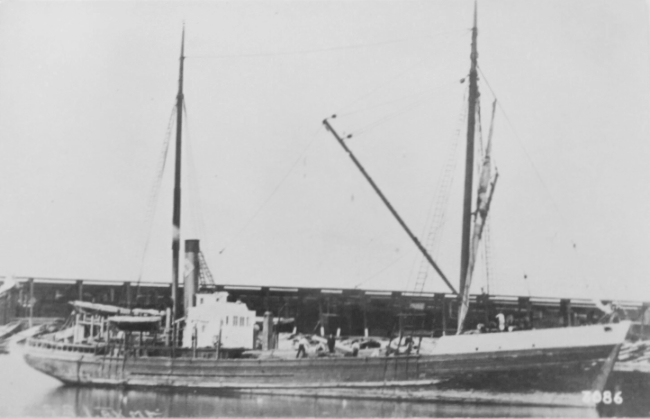
The independent coastal steamer Lakme.
The Seattle Post-Intelligencer (Seattle, Washington) - Wednesday, October 7, 1896

Men with ragged beards and ragged clothes were on ihe streets last night, and in their general make-up were the indescribable indications of the returned Alaska prospector. But these were miners, not prospectors, the distinction being that these men had money and were from the Yukon, not from Cook inlet. It wasa veritable transplanting of population.
One hundred and fifty-five came in on the long expected steam schooner Lakme last night at 8 o'clock, and with that number were thousands of dollars worth of gold dust. The largest amount brought out is credited to L. Laflamme, who had about $10,000. The Anderson brothers, of this city, had also good sacks amounting to probably $3,500. Charles J. Larson and Albert Williams were among those with piles going imto the thousands. Even the poor ones in the crowd had $100.
Four of them were met on the street and asked for news. They were L. A. Biskell, Jas. McLaughlin, Charles Beede and Mr. Gettings. The first named acted as spokesman. "I don't want to advise any one about going into that country." he said. "If he has money, all right - if not, all wrong. In the first place, it's a hard proposition to reach Circle City, and then the fun only just begins. You have to go sixty-five miles to reach the mining regions, and must make the whole distance with your face covered by a veil. If not, the mosquitoes would chew you up. They are the curse of the country. Whenever you step to take a drink or blow your nose they get in under the veil, and then you wish you were safe at home. And marshes! You are in it knee deep all the way from Circle City to the mines.
"As to the mines, they are good if you happen to own one. If not, you must depend on labor by the day. This is paid at the rate of $10 a day, but one can only work fifty days at the outside, and about $500 is a year's pay. All the mines were being closed down when we left. Prospecting is all done in the winter, and those who remain will be engaged in that work. The P. B. Weare, carrying those who came out, left Circle City September 6, just a month ago tomorrow."
The Lakme came in about 8 o'clock last night. As she steamed down the Sound the passengers cheered every passing vessel again and again, and when the lights of the city came in sight they shouted themselves hoarse. Just such a cheering crowd as this was carried from Seattle last summer by the Lakme on her first voyage to Cook inlet.
St. Michaels was left September 23 and the passage was made in thirteen days. The Lakme left Unalaska September 23. The steamer Bertha was there with eighty-five passengers for San Francisco, and intended to leave the day following. No freight was carried by the Lakme, enabling her to accommodate the 155 passengers without crowding. The fare from Circle City was $150 far first class, $100 for second class and $75 for steerage.
Among the passengers were thirty-five men who went up on the steam schooner Portland to put together the new river steamer John J. Healy. The vessel is now
completed and on her first trials has shown up well.
Two women were aboard the Lakme. One was Mrs. M. E. Maynard. Her husband has been in the country four years and will go up the Yukon this year to prospect. His original intention had been to start a trading post, but things did not work out as he had expected. Mrs. Maynard would have been the only white woman on St. Michaels isiand had she remained, and she expressed great satisfaction that she had not been obliged to do so.
The Lakme will go to Tacoma today and take on a cargo of lumber for San Pedro.
Among the passengers from Alaska on the Lakme who arrived a Seattle last
night was Thomas Dwyer, whose present home is at Everett, but who went to the Yukon last spring for the purpose of examining that fieid carefully on behalf of a syndicate at Superior, Wis. The syndicate authorized him to make the investigation with a view to introducing a hydraulic plant for mining on a large scale. Mr. Dwyer is satisfied, from his season's study of the situation, that the plan is entirely feasible, the chief drawback being the shortness of the season. He will make a favorabie recommendation. He thinks the Yukon a fine mining country for a man who has the requisite pluck and endurance, who has the requisite pluck and endurance, plus a reasonable amount of cash, and who will go there and stay for two or three years. To a reporter he said last night
at the Stevens hotel:
"I left Seattie for Alaska on the Topeka April 2, arrived at Dyea April 10 and at Circle City May 28. The trip is one that requires lots of patience and hard work. On leaving Dyea, the first task is to climb the summit, and you may judge what a
task it is when I tell you that it took us just nine days to make the first nine miles.
Thence we traveled by sieds to Mud lake, or Lake Marsh, where we built our boats for the river trip. Right here let me drop a word of caution to the traveler who has an idea that any kind of boat will do for travel on the Yukon. Such an idea is preposterous. At least three points along the journey are extremely perilous, as the loss of many an outfit this season will testify. None but the stoutest kind of craft should be trusted. The three are Miles canyon and White Horse and Five Fingers rapids.
"Our crew was the first this season to pass these successfully. We then sleighed across Lake Lebarge, thirty-two miles. Thence we went to Teslinto, and on to
Circle City, arriving there May 28. The latter part of this trip is not so dangerous, provided the traveler keeps clear of the ice jams. But the trip out from Circle City to the mines is the hardest part of the journey that is if taken as we had to make it, by the spring or summer trail. Birch creek is a hard stream to pole up, being very rapid, and the trails are bad in the spring.
"Well, as to mining this summer, I think the season was reasonably successful. The banner claims for the season were on Deadwood and Mastodon creeks. I know
of some diggings which paid as high as ten ounces on a single shovel, though of course this was exceptional. I know of several which paid as high as three and four. Men working on wages at the mines were paid $10 and $12 a day, while the wages of a common laborer in Circle City were 6. Of course living was proportionately high. Bacon was 35 cents to 40 cents a pound at Circle City, and as it costs 40 cents a pound to pack ot to the mines you can add that much for its price there. Sugar was 25 cents at Circle City, and 65 cents at the mines. Flour was $4 and $5 a sack of fifty pounds at Circle City, and $15 at the mines. Canned goods of all kinds were $1 a can at Circle City. Liquor was $60 a gallon at the mines, and retailed for 75 cents a drink. The cheapest cigars, such as one gets here at the rate of two for a nickel, sold there at 50 cents.
"You ask me whether there is a good outlook far a poor man at those mines. I can say in all candor that for the right sort of man I know of no better place
for money-making. First of all he must be a man of indomitable pluck and perseverance. The journey itself, let me assure you, is such as to call for these qualities, and they will be called for again and again during his work at the diggings. He must prepared to meet discouragements and to endure hardships without number. He must have a small amount of ready money, and he should take a year's supplies with him from Seattle. Last of all I would say that in order for him to win success he must stay for at least two or three years. This condition I consider almost indispensable, and I would lay great stress on it in giving advice to any friend who thought of going.
"Yes. I think Seattle has a 'cinch' on the trade of that whole region, if she will but use reasomablie means for retaining it. The people there, many of whom have gone from tis immediate section, are unanimously inclined to prefer Seattle. Those who have come from Eastern states do not care to have to look to San Francisco or to be compelled to take their gold dust there on their return.
Let me offer a practical suggestion or two. The pass now used to reach the mines is by the worst possible route. A new and better route could be easily secured through the White or Moore's pass. Now let Seattle aid in securing that route. Let the Chamber of Commerce if necessary take the matter up, and by a generous contribution see to it that the new route shall be called the 'Seattle trail.' This would facilitate the shipment of supplies and cheapen thelr price at the mines, and would do much to secure the hold which Seattle already has on the people and the commerce of Alaska.
A very special reason exists why there should be no delay on Seattle's part in promoting a better route to the Yukon mines. The Canadians are making strong efforts now to open a new trail by Taku pass from Juneau. If they should succeed while our own citizens comtrol only the worse and longer route, it will undoubtedly result in throwing much trade to Victoria.
"Next, and hardly of less importance, I woud suggest that some arrangements should be made by which returning miners can exchange their gold dust to as
good advantage in this city as they can in San Francisco. Take the crowd that came down on the Lakme. I know of some of them that brought down as much as $10,000 and many of them as much as $3,000 or $4,000. Now, when on reaching the city last night, two of them approached me and asked how and where they could at once dispose of their dust, I was compelled to tell them that the best I knew of was to await the opening of the banks tomorrow morning and see what the bankers would do for them. Taking the entire number of men that came down on the Lakme, I feel safe in saying that three out of four of them
woud prefer disposing of their dust right here in Seattle. Think what a yearly business of that sort would mean for this city. Much of the money would be spent here. As it is, most of these people will go to San Francisco.
Yes, if the syndicate I represent acts favorably on my recommendations, we shall probably bring these matters in some way to the attention of Seattle merchants, bankers and shippers. I feel sure that if the syndicate puts in a plant, it will be willing to contribute generously toward securing a new and better trail.
"I would mention also, though, in this of course, the city has no municipal concern, that our mail facilities on the Yukon are very poor and the service is irregular and defective. Think of it. When I left Circle City, which was just a month ago today, the last item of news which greeted me was that of Bryan's nomination."
Mr. Dwyer will be in Seattle today. He goes to Everett tonight and will leave in two or three days for the East.
The Sunday Oregonian (Portland, Oregon) - Sunday, July 25, 1897
Omer Maris, who a year ago was through the Yukon gold fields as a correspondent for the Chicago Record, tells the following bit of history:
"The honor of discovering the very richest placer mines in the world belongs to an Illinois man named George Carmack, who went to Alaska eight or ten years ago. Last summer I was drifting and sailing with a small party of men down the Yukon. We had left Sixty-Mile post before noon of the day that I have in mind - about July 9 - and at 6 o'clock in the afternoon, on passing the point of an island, we came in sight of an Indian village across a wide sweep of rapid river a mile or more away. We knew then that we were near the mouth of the Clondyke.
"We had no previous thought of stopping there, but as it was nearing our camping time we made an effort to reach the village. Those who have navigated the upper
Yukon will always remember the even, steady, relentless force of its current. We had a good boat, with a sail and two pairs of oars. As our course had been against the wind for awhile, the sail was furled, but now it was hastily run up.
"There were seven in the party and we took turns at the oars. For a half hour, with the wind for an ally, we fought against the current but the village was at the outer point of a wide curve and the drift was against us. Much of the time it seemed as if we were standing stlll, but the islands above us were receding, and,
work as hard as we might, we were get-
ting no nearer the village.
"Many of the Indians were on the bank, interested, gesticulating spectators of our effort. One jumped into a keen little one-man-size birch canoe and came down to meet us, with the idea - as we thought - that we might have something of importance to communicate to them. Two or three others were taken with the same notion, and by and by came also, gliding down the current with the grace and almost the speed of a swallow. It was rather an astonishing inquiry that the foremost Indian had for us. We were within 200 yards of shore when he came alongside, but in his anxiety he could not wait till we landed to begin asking questions. He wanted to know if we had seen anything of his runaway wife.
"The poor fellow had met with a whole lot of bad luck all at once. While fooling with a gun of ancient pattern - a relic of the Russians - he had shot himself in the hand, and it was necessary for him to go down to Forty-Mile post to have a white
surgeon dress the wound. While he was gone his wife, with the idea possibly that he would not be much good any more, skipped out in the other direction, supposedly to Sixty-Mile post. But we had not seen her, and he seemed gratified to know that we had no worse information for him.
"We made a landing at a slight projection of land a mile below the village, and were surprised to find the camp of a white man near the littie patch of quiet water afforded by the point.
"The owner of the camp was Carmack. He caught the line we threw out and pulled our boat into his little harbor. He gave us a hearty welcome and showed us a pleasant place to put our tents.
"Then it developed that Carmack had a family with him. Two little dark-skinned children followed him everywhere, and presently he pointed out his wife, who was a native, a woman of the Stick tribe. He had been in this country eight years, and much of the time had been spent with the Sticks at Takish house on the chain of lakes that form the souree of the coastward arm of the Yukon. Now he was making quite extensive preparations for curing salmon, the annual run of which was expected to begin any day. He had erected a birch-covered shed for the better protection of his catch from the weather,
and he already had his nets out at the mouth of the Clondyke, a half mile further down. Carmack expected to sell his crop the following winter, principally for dog feed, although in times of a food famine, as really occurred last winter, dried salmon becomes a staple article of diet for white men.
"Carmack, who is a very intelligent man, gave us much information about the Upper Yukon. The Clondyke had been known for several years to drain a gold country, and the first five miles of it had been indifferently prospected, but the gold-hunters were generally run out by bears.
"If the miners had made any encouraging finds at the outset it would have been different, but all other things being equal, in their estimation, they concluded to try streams where the bears were not so aggressive. And it happened that there was a reason for the bears being so bad in that particular place. It is possibly the best stream for salmon of all the tributaries of the great river.
"The fish start on their annual 'run' ome two or three weeks after the ice goes out, usually about the beginning of July. They come by millions. The river is turbulent with them. They crowd each other, and jump out of the water; and the Indians - and likewise the bears - come a long distance to give them a welcome.
"At every tributary some of the salmon turn aside, but the multitude press onward at the speed of about a hundred miles a day. Before the first of August some of them may usually be found above White Horse rapids, 2200 miles from the delta.
"But as to the Clondyke, the Indians and the bears made a more or less harmonious division of the territory. The redskins maintain their foothold at the mouth of the river, where they take the salmon in nets and dry them in sufficient quantities to
last the whole year. Bruin adopts diverse ways of securing the fish; but they are so
plentiful that he gets all he wants while they last. After the salmon season his
living is precarious, and he probably regards a stray miner now and then - or an Indian - as dispensation of Providence.
"Carmack told us of his intention to prospect the Clondyke as soon as the
salmon season was over. Four weeks later, as we afterward learned, he took two Indians and started up stream. After a few miles of laborious poling against a rapid current they turned into the first considerable tributary that came in from the right. Here conditions were favorable for prospecting, the water being shallow, and they found gold in encouraging quantities on the bars of the creek. They followed the windings of this stream for twenty or twenty-five miles before they made locations and went to work.
"The results were almost enough to turn the brain of a prospector who had
searched for many years in the hope of finding gravel that would yield a few grains to the pan. Here at the depth of three feet in the low bars by the creek they found dirt that carried $1 to the pound in coarse, ragged bits of gold. Others have since found diggings tenfold richer.
"As remote as their discovery was, they were not long to remain in sole possession of it. With the exhaustion of their few days' provisions, the two Indians were sent back to the village for supplies.
"There is a steamboat, the P. B. Weare, one of a fleet of three belonging to a Chicago company, that makes three or four trips during the short summer season from St. Michael's, near the mouth of the Yukon, to Circle City and Forty Mile, the distance to the latter place being nearly 1800 miles from St. Michael's. One of these trips of the Weare - the first usually - is extended about 200 miles farther up the river to carry supplies to Sixty Mile and Fort Selkirk, where there are trading posts.
"About the middle of August, when the Weare arrived at the Indian village, which is about half way between Forty Mile and Sixty Mile, the Indians were waiting there to lay in their supplies. There were also several other prospectors who had happened along, and the discovery was now common talk. The stories of fortune proved a little too much for the crew of the Weare to withstand. They deserted in a body and joined the rush to the new gold field. The captain, after being delayed three or four days, got an Indian crew sufficiently trained to handle the boat. When they arrived at Forty Mile on his return the reports were alluring enough to impel a hundred or more men to start at once for the new find.
"The mountains along that section of the Yukon, and, in fact, from Circle City upstream for several hundred miles, are extremely wild and rugged. At the Klondyke there crosses the big river what is known as the great copper belt, which is a succession of massive quartz ledges, with that metal predominating. The veins are known to carry gold, but in what proportion is yet to be determined.
"Here also is the pioneer quartz mine of the Yukon. Captain Henry, the manager of a transportation company, located a claim on the side of a precipice, opposite the mouth of the Klondyke, over two years ago. Vein mining had never been thought of as a present undertaking. Labor was worth $15 a day and supplies of all kinds were proportionately high, but he put up his location.
"Last year he did some development work on it and had samples assayed, showing it to be rich in gold. But the latest reports from the Klondyke put such extravagant prices on labor that quartz will not be considered for some time yet.
"Still, it is in the veins that will be found the real wealth of this wonderful country. When the mother lode of the Klondyke drift gold is discovered - well,
we may have to hunt up something else for a monetary basis."
|
