ExploreNorth, your resource center for exploring the circumpolar North

Return to the Home Page The ExploreNorth Blog About ExploreNorth Contact ExploreNorth

Search ExploreNorth


Dawson City and the Yukon Territory in February 1899


Klondike Gold Rush

The Philadelphia Times (Philadelphia , Pennsylvania), Sunday, February 26, 1899

Growth of Dawson City, 1899

    Much has been said and written of the great and wonderful far Northwest country of British Columbia and Alaska; tales have been told and retold, which sound like chapters from the famous Arabian Nights, and but for the fact that the Mint receipts show the amount of gold brought from that country, the stories would be taken with the proverbial grain of salt.

    I am now returning after ten days' "lay over" in Seattle. The people in the East have not a clear conception of the extent and importance of Alaska. They seem to believe that the State is a barren ice-bound wilderness, the chief living things in which are wild animals and Indians. At present there are fully 25,000 people on the Yukon, from the head of Lake Bennett to St. Michael. There are sixty rivers, feeders of the Yukon, that are from 200 to S00 miles in length. A person can take a boat or canoe at the head of Lake Bennett and travel down the Yukon a distance of 2,700 miles, which is just about the distance from New York to Seattle.

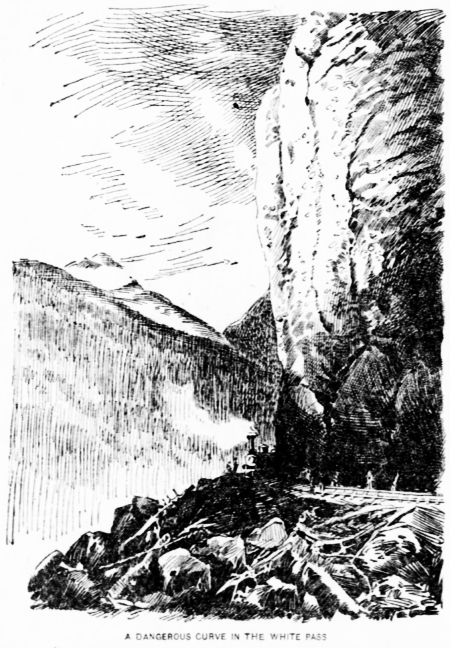
A Dangerous Curve in the White Pass, 1899

    There are now in Dawson and the camps near to that city more than enough provisions to supply the needs of the present population for a period of eighteen months. No man has ever starved to death in any of the mining camps on the Yukon, and probably never will, for the miners of Alaska and British Columbia will divide their last meal with a needy friend.

    Dawson is not a backwoods settlement. It has the appearance of a metropolitan city, with its electric lights, gas lights and telephone system from Dawson to all the leading creeks.


    There are thousands of claims which will pay from $8 to $10 per day to the man, but provisions at this date are too high for these claims to be worked with profit. A man had better be working for wages than try to get a living out of a cheap claim of this kind. As soon as cheap transportation can be had into the Klondike so that provisions will be about half the price they are now it will pay to work all these claims, and they will give employment to thousands. Cheap and quick transportation will allow a man to go into the gold regions in the early spring and come out in the following fall. Then thousands of miners will go in at the opening of spring and work these cheap claims, coming out in the fall and returning home for the winter.

    The country at present is in its infancy. Of course considerable mining has been done in Alaska, but the area that has been prospected is very small. As yet they have only worked three small places, that is, Forty Mile, Birch Creek and Munnock on the American side, and Bonanza district and a few others in the vicinity of Dawson in the Yukon territory on the Canadian side.

    Two years ago one had to endure great hardships to get into or come out of the Alaskan gold fields. Then it was necessary to pull your own sleds over the summits or pack your outfit on your back, a distance of forty-two miles. Now you are taken over the summit on a railroad train. The officials of this road say that they will, on the 15th day of May, next, have the road completed to the head of Lake Bennett. Then no more hardships on the way to the Yukon. When navigation opens about that date the freight rates will average about two cents per pound from Skaguay to Lake Bennett. The present freight rates from Skaguay to Lake Bennett are about six and one-half cents per pound. One year ago the rate was fifty cents per pound.

Bennett, BC, in 1897
(Note: despite the caption, the drawing above shows Bennett, BC,
probably in the summer of 1897)

    Where once, after crossing the summits, the Yukon pilgrim took a whip-saw and sawed out his lumber to build a boat, now he will step shoard a steamer and travel to the Klondike in style.

    The output of gold for next summer from the Bonanza District will more than double last year's output, which means $20,000,000 or $25,000,000.

    Dawson at the present time is overrun with laboring men, fully five men for each job. If they would travel ninety short miles from Dawson into the American territory they would find good diggings there that have been worked for years and which were abandoned during the Klondike excitement. Now people are flocking back there again.

    Forty-Mile Camp is in Canadian territory. A short distance below Forty-Mile is American Creek, at the mouth of which Eagle City was established last summer. It now has 2,000 population. The creek, from latest reports, is turning out well, and Eagle City will probably be the headquarters of the United States troops.


    Two hundred miles below is Circle City, supply camp for the Birch Creek district. This is the richest camp on the Yukon today. At Munook creek good diggings have been struck and lots of miners have gone up the Tanana, the Porcupine and the Kukukok, each of the last three named being over 600 miles long.

    Alaska is the coming tourist route of the world; a person can leave New York and in fifteen days arrive at Dawson, Northwest Territory. His time will be divided as follows: Five days in crossing the United States from the Atlantic seaboard to Seattle, Wash.; five days traveling by vessels from Seattle to Skaguay, including transfer; three hours from Skaguay to Lake Bennett via White Pass and Yukon route, and forty-five hours from Lake Bennett to White Horse rapids; thence by steamer, three days, to Dawson.


    Between Dawson and St. Michael there are over fifty river steamers running, some of them nearly as fine as the passenger boats on the Mississippi, with first-class accommodations, all modern conveniences and nearly all lighted by electric lights.

    Beginning about June 1, this year, five lines of steamers will be running from Lake Bennett to White Horse Rapids, connecting with the upper Yukon steamers.