I left West Plains on Saturday night about the second of August, 1897, arrived in Kansas City about 7 o'clock the next morning and visited relatives in Kansas City, Kansas. Left there on the 10:45 train for Lawrence, Kansas, stayed one day at Lawrence with my brother and left there at 9 o'clock at night for Denver, Colorado, and arrived there about 7 o'clock the next day; took in the town and left there for Ogden the same evening via U. P. R. R. and Ogden; got into Ogden next morning about 9 o'clock.
The Union Pacific Railroad Co., gave us free tickets at Ogden to visit Salt Lake City, which we did as all others do when west. We stopped in Salt Lake City and visited the Garfield beach, a fine drive into the city; visited the waters where the water is so salt that a man cannot sink in it; visited the big temple built by Brigham Young and his followers, the cost of which was about eleven million dollars, made out of white marble; also visited the Lyon house where Brigham Young kept his wives.
This city is one of the finest in the United States - the way it is built and laid off. The streets are 200 feet wide laid off at right angles and large poplar trees line each side of the streets. Ice-cold water from the mountains flows down the gutters continually and clear as crystal. There is an avenue in Salt Lake City 22 miles long and as straight as an arrow, level as a floor.
Left Salt Lake at about 9 o'clock in the evening and arrived at Ogden about 12 o'clock and left at 12 o'clock that night for Sacramento; went through Nevada, Carson City and arrived at Sacramento about seven o'clock on the second morning. Visited the city until about twelve and then left for Portland. We spent the night in Chinese quarters.
Then left for Portland, Oregon, over what they called the Central Pacific road and over the Cascade mountains and the mountain scenery through thuis section is wild and grand.
Arrived in Portland about 8 o'clock the second morning and visited Sulphur Springs and the Hot Springs; left Portland at 12 o'clock that day and arrived at Seattle at 6 o'clock that evening over the Northern Pacific. Seattle is a nice, pleasant place to live, the temperature is so even, it never gets colder than 15 degrees below freezing and in the summer never goes over 80 or 85 in the shade. They don't know what dry weather is there; the grass is always green, all kinds of vegetables grow fine and are cheap.
Fine salmon sells at 2 and 3 cts. per pound. Large, fine white potatoes were selling when I left there at 50 cts. per 100 lbs., apples same price, eggs 20 cents per doz., chickens 10 cents per lb. We remained in Seattle a week and during that time I got acquainted with a young man from Grand Junction, Colorado, one was prosecuting attorney there and the other was a furniture dealer; and the four of us joined issue and bought our outfits together. The bill was as follows:
"ORIGINAL."
I do solemnly swear that the goods enumerated on the invoice or copy of entry No. - herewith attached and numbered 385, an outward entry are the product or manufacture of Canada or are duty paid at the port of Victoria, British Columbia, No. of package being 53.
Sworn to before me at Victoria, B.C., this 13th day of Aug., 1897.
J. C. DUNCAN,
Canada Collector of Customs.
I hereby certify that the number of packages No. 53 of goods described herein are entitled to entry in the custom station at Tagish Lake N. W. T. and the mounted police N. W. T. without further examination of packages.
Collector of Customs.
Two of the party, Messrs. Beltz & Lamb, Klondike, bought of Simon Leiser & Co., Wholesale Grocers as follows:
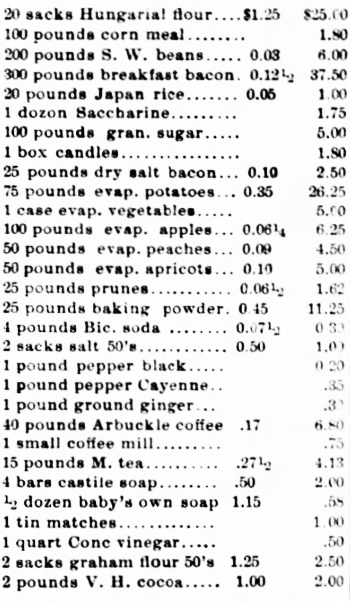
These were bought in Canada as we had to pay duty on American produce by crossing over the line into Alaska and in Seattle we bought our outfit of clothing such as McIntosh coats, arctic stockings and gum boots. We bought two yoke of cattle at Seattle, paid $40 a piece for them or $160 for the four head. The freight on them to Skaguay bay was $20 a head which was a distance of 1,000 miles from Seattle.
We shipped them over the sound on the steamer from Victoria and learned that it would be three days before the steamer Bristol would be ready to sail from Victoria. The vessel was advertised to sail on Tuesday but did not go until Sunday morning as freight kept coming in and she refused to sail as long as anything came to ship.
We had eight steers aboard, 400 horses and about 400 passengers and 25 dogs and about 500 bales of hay. The hay was stacked up on the upper deck partly up on the mast. The lower deck had horses and the third deck had men and bunks and the fourth deck had horses over the men and on the fifth deck was hay piled up even on the mast.
The steamer was chock full when we left Victoria. We left Sunday morning about 7 o'clock and went to a place called Union to take on coal, at about 4 o'clock in the afternoon same day and in going into Union we carried off a coal (shute) which damaged the vessel a little and the coal chute about $100. The coal chute fell on the deck and came near killing 3 men, and next morning we sailed for Mary's Island where the United States Custom House is located and here we entered Alaska waters, we had sailed through British waters. Going up we passed a number of small steamers coming down and we signaled each of them with three whistles and a farewell salute; also passed the Canaries on the shore which we likewise saluted.
We arrived at Mary's Island on the fourth day out from Victoria. Here is located the custom house or officers on board. Stayed there about two hours and took one of the custom house officers on board. As a custom house officer comes aboard all vessels here and remains on there till it returns again. This is done in order to see that no whiskey is carried on the vessel as none is allowed in Alaska. We arrived at Juno two days from Mary's Island and stopped there about 3 hours when we left for Skaguay Bay where we arrived about 6 o'clock on the morning of the 7th day.
When we arrived at Skaguay Bay a heavy fog was on and that delayed us about three hours before we could go ashore. The Purser wanted to put our goods over on the rocks but the passengers would not have it that way; they did want their goods put above tide water. They wanted them put on the beach out of reach of the tide water.
So the goods and horses remained on the vessel three days before we got them off. When we did unload they had to hire a scow with which to put the stuff ashore and the expense of $5 per ton which was more than half as much as what the steamer got for bringing them 1000 miles.
So we were about 5 days getting our goods ashore; the horses were lowered overboard and the cattle the same way and they swam out which was a distance of one half mile. The tide rises and falls 20 feet in S. Bay, and the scow that the goods were placed on floated ashore at high tide and when the tide went down it was left high and dry on the beach.
The people then put them into wagons and hauled them out before the tide rose again. We had our oxen taken ashore two days before we got our goods; and we made a sled (what they call a go-devil) as we had no wagon and hauled our goods from the boat up from the high water mark, got our tent set up and stayed there about a wek on the beach.
It took us two or three days to get our oxen ready to pack with, as we had to make pack saddles, etc., then we commenced to pack on the Skaguay trail four miles up to the foot of Skaguay Pass. When we got the most of our goods packed up there the Skaguay trail was shut down for repairs for three days and when they opened it again it was no better than before and most of the people were coming down who had attempted to go up, saying that it was impassable.
Then we thought we had gone far enough; if they could not make the trip it was useless for us to attempt it. We then packed our goods back again to where we started - to the beach.
Then we went into Dyea Bay from Skaguay. A steamer tug then brought the
boat up to Dyea at an expense of about $40. Mr. Johnson was the owner of these 2 schows and they probably didn't cost over $500 each but he made at least $20,000 in 3 months time by taking freight from steamers from Skaguay to Dyea, a distance of five miles.
We landed there about 6 o'clock in the evening and it was 12 o'clock before we got our goods off of the scows. Had to wait for the tide to go out. We had no wagon and had to make our oxen pull our goods about half a mile. We had almost three tons
of goods. So the hext morning we bought a flat bottomed boat for $5 - a 24 foot boat and it must have cost about $40, but we bought it cheap because there were so many boats left there, the people could not take them with them over the pass. The parties we bought this
boat of had hauled their goods in it up to the head of canoe navigation, up to Chillcoute river.
Continued on Thursday, November 4, 1897
So we loaded about 1,800 pounds of our goods into our boat and we had a long tow line about 300 feet long and three of us got a hold of the end of the tow line and pulled the boat up the river, and we also had a pole about ten feet long and one man steered the boat to keep it off the logs and boulders as we had to dodge them. In pulling
the boat up we all had to walk in shallow water and finally we come to a perpendicular bluff at the side of the stream.
Then we had to cross over and while doing this the boat fell back 500 yards owing to the great swiftness of the water. The stream was not more than 100 feet wide. In going up the six miles we had to do this six times where the banks were perpendicular and up near the head of canoe navigation the water was so swift that it took us an hour to go one-half a mile and we had a hard pull to do that.
While going up, the first time there occurred a sad accident to an Indian canoe coming down. It struck a boulder in the river and knocked a hole in it about two feet square and turned it a complete summersault and threw the passengers into the river baggage and all. There were five Indians, four white men, one Indian squaw and Indian baby. They were all thrown inte the icy water and we rescued them and helped to save their baggage which came down past us. It happened about half a mile in front of us. They were
coming down, we were going up. We built a fire and they stripped and dried their clothes. The baby took a chill and died that night from the effects of the cold bath in the icy water.
When we got up to the head of canoe navigation we unloaded our goods at the mouth of a little mountain stream at the foot of the mountain. We got into a boat and two of us took oars and propelled the boat, it took us half hour to come back which it took six to go up. The stream was swift and one stood behind and steered the boat. And the
next day we did the same thing and the same for four days in succession.
We would take our dinner along and make a fire in the woods and cook it and make coffee. The fourth day we took up our last load; then we concluded to pack with oxen up to the place called the mouth of the cannon four miles further up. In the meantime one of our party got a letter from home urging him to accept a Chinese marshallship from the United States government and we advised him to take it as it was a good position, paid $2,000 a year and everything found him. He concluded to take it but to remain their until January first.
So when he made up his mind to quit the party and we saw there was no possible show of making it through this winter we thought we could make money by coming back and try it again in the spring. So I concluded to sell out my interest in the stock of provisions held by the four of us and did sell, and return home until spring.
The other boys will go into camp at Lake Linderman and it will be almost a month before they can get through from the present camp to Lake Linderman by packing their goods, fifty pounds at a time each day.
From the top of Finnigan's point where we landed the goods we packed them up with the oxen and did that in about four days time. When we got up as far as the mouth of the canyon the boys concluded that they would pack it on their backs the rest of the way as the trail was very bad for horses and oxen to go over. There we sold out our oxen at a good profit. We had to have the oxen shod which cost us $10 apiece and we sold two for $150 each and one for $200 and the boys retained the other for beef and they were going to get him over if they have to kill him and pack him over.
We met a good many people on the pass who were coming down and they said there was any amount of money there and if we could get through with our supplies that we could earn fifteen dollars a day in case we had our own provisions. And this was a fact if a man had his provisions but without them he is perfectly helpless.
I left the boys on Saturday morning at the mouth of the canyon and they had carried about 150 pounds of their goods as far as Sheep Camp. That is a distance of
about eight miles up the trail and it was just a week after this time that the great glacier slide took place in which about a dozen people were injured and the boys must have suffered some loss for they must have had considerable of their goods up there by this time. So when I got back I walked down as far as Finigan's point where we left the boat. The boat fell to my share.
I met two men coming back and they wanted to know what I would charge them to take them down to Dyea and I told them that they could have free tickets so far as I was concerned and they agreed that if I would act as captain they would act as sailors. We got the boat down to Dyea in good shape and when we got there we concluded to go to Skaguay a distance of about five miles.
We started out in good shape to go from Dyea to Skaguay and thought we could have an easy trip with the boat but we were three hours trying to make one and a half miles. The tide and wind was against us and we put into shore about that distance away and we then thought we could walk across the headland to Skaguay a distance of about five miles and we walked about one and a half hours and we then were no nearer Skaguay than when we started so we put back to where the boat was and met another boat coming up
with six oarsmen in it and we hailed the party and ask them to take us along and they did not want to do this as they thought they would wreck their boat on the rock as the tide was pretty high. Then one of the party volunteered to wade into the water and hold it off
the rocks.
But anyhow we got to Skaguay that night about eight o'clock and went to the hotel and dried our clothes and suffered no bad effects.
I forgot my coat when leaving Finigan's Point and on the next day (Sunday) concluded to return and get it and also my boat which I left tied to the beach one and a half miles from Dyea.
I had to pay one dollar to get back on a row boat. As I went to Finigan's Point I had the sad experience of having to cross the stream at least six times. So when
I got to Finigan's Poicat there was a man there who had a crippled horse and he requested me to bring him down to Dyea where coarse grass grew, and turn him out on the commons. This of course was very acceptable for I could ride him across the stream.
We wanted to get from Dyea to Skaguay that day and a party offered to take us if we could get a crowd of ten passengers which we finally did at a cost of one dollar each, the distance was about five miles. So we paid the ten dollars and put to water, and the wind was very high and against us and we went about forty miles in order to make the five miles. During the trip the little sail boat went most of the time on its side and if I ever thought my time had come it was about this time but the sailors laughed and joked with each other and said they had seen it harder to travel over than it was at this time.
We would all get on the upper side to keep it from turning over as we well knew that we would take a trip to meet McGinty in case she upset. It kept one man busy as a bee to keep the water baled out of the boat, and we got as wet as rats "and wetter than that word." Finally we succeeded in getting there and if they had had the band out to meet us it would not have attracted our attention, so anxious were we to end that
almost fatal trip.
The Skaguay Bay is about one-half mile wide and enclosed by high mountains on each side and is a perfectly safe harbor if it had a wharf but at present there is none there aud the shipping has to be taken ashore in flat boats and the horses have to swim ashore.
Next day, the weather was nice and calm and the water clear as crystal
and like glass, and I got a man to go with me giving him one-half interest in the boat to go and help me move it. We had to pay one dollar to a row boat man to take us down to where it was. When we got where the boat was we rowed it up to the landing and tried to sell it. First we asked ten dollars for it then come down to five dollars and finally went off and left it.
The Queen Steamship for Seattle arrived Monday with passengers and freight and advertised to sail on Tuesday evening and I took passage on it for Seattle. We
started for Seattle about 5 o'clock Tuesday evening and arrived at Haynes Mission at the mouth of the Dalton trail. We unloaded 5 oxen there and some goods, to go over Dalton trail. The goods were taken out on the ship boats by some of the crew. The steamer then sailed at about 1 A. M. on Wednesday morning and arrived at Sitka, at 5 P. M. the following day.
We unloaded 200 tons of coal at Sitka for a United States man of war, and in doing so it took us two days. We visited the city one day.
Now, Sitka is a town of about 5,000 inhabitants, and is an old settled town, the capital of Alaska and is of modern architecture. The United States has two very
large government buildings there, and it ig a great port of entry where they keep a number of regular soldiers. And there is a temple, a Greek Temple or church, perhaps the finest on this continent, with about $50,000 worth of gold and silver decorations, and $50,000 worth of old paintings, which was brought from Moscow and St. Petersburg 200 years ago.
Sitka has a very fine museum, and I would further add that I have seen
all the fine arts in London, Doublin and other eastern cities, of the old world, but that of Sitka greatly surpasses anything I ever seen in the way of fine arts. The population of Sitka, 1s composed of Indians, Americans and Russians. There are about 2,000 Americans
there. I was surprised to see such magnificent stocks of goods there. There are plenty of stocks there worth $150,000 to $200,000, kept principally by Americans. There is where I purchased all those fine furs I brought home with me - purchased them of the Indians. Sitka is a great summer resort for tourists, but as this was not summer, your humble servant was by no means a tourist in any sense of the word.
We left Sitka about 7 o'clock the second morning, and arrived at Douglas Island, opposite Jueno, about 6 o'clock the next morning. Douglas island is noted for being one of the greatest stamping mills in the world, where they stamp out gold. It took about three hours here to unload what goods there were for that place, and meantime I had an opportunity to look over the great stamping mill. There is perhaps 500 miners
working in the mines at this point at $3 per day, and the product of the mill, called amalgum, is shipped to San Francisco where it is made into gold bricks.
We then sailed over to Jueno, and stayed there two hours, then sailed for Ft. Wrangle and arrived there the next morning at about 1 o'clock and stayed there about two hours. From Ft. Wrangle we made for a place called Yeas where we took on 10,000 cases of salmon and it took us a day to put these aboard. In connection with this I would state that the price charged by the steamer to haul them to San Francisco, is 5c per case and
each case weighs about 70 lbs. All the work at this cannery is done by Chinese, with about four white men as bosses, and it costs just $1 a case to put them up. 4 doz. of 1 lb. salmon in a case. They informed us that they had thrown away as much salmon as they had
saved they came in so fast. This cannery put up 20,000 cases this season and they commenced canning about the 10th of July, and they cleared $20,000 for this season's work, of three months.
We then sailed from Yeas bay to a place called Ketcheycan, and there unloaded some freight and passengers and left. Next we landed at Metlakhatla, where there
is another great salmon fishery, put off a little freight there, and then made for the next landing place, Victoria.
We arrived at Victoria at six o'clock on the morning of the 7th day. We left Victoria at 8 o'clock and pulled for Ft. Townsend, arrived there about 12 o'clock, and then made for Seattle and arrived there at 4 o'clock in the afternoon.
There I bought my ticket for West Plains at the cost of $47.50 over the Northern Pacific. I went next to Portland, Oregon over the Portland and Oregon short line to Ogden, and via Salt Lake and Grand Junction and Colorado Springs, over the Rock Island to Kansas City the fourth day after we left Seattle, and arrived in West Plains on the fifth day.
I made considerable trades on the trip and reached home with $150 more money that I started with and all this experience, which I consider worth at least $1,000 to me now. The trip was a pretty hard one, but I felt well nearly all the time and was anxious to get through, and would have gone through had it been possible to do so this winter, but will try it again in the spring.
Yours Truly,
H. J. BIGGER.
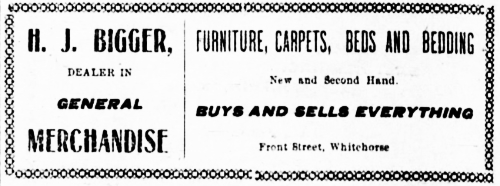
Henry Jones Bigger did return north. On January 17, 1903, he advertised in The Weekly Star, and the editor noted that he was one of the pioneer merchants in town.
H. J. Bigger moved to Woodburn, Oregon, in 1908. His son Alfred stayed in Whitehorse for another year, but closed the business, which had been scaled back to just groceries, in July 1909.
H. J. Bigger's children were Lillian "Lilly" Bigger (married Frank E. Harbottle in Whitehorse in September 1904), Frank Bigger, Joe Bigger, Alfred Bigger, Jean Bigger (married Gordon Spragge in Whitehorse in September 1903; lived in Atlin), Miss? Bigger (married George Askew) and Edna M. Bigger (married John Piper and later Fred Langholtz).