The other day, thinking about sourdoughs who have gone over the great divide and others who will be meeting in Vancouver next month, it struck me that, if there was one thing that made for success on the Trail of '98, it was resourcefulness.
Good health, grit and a grubstake counted, of course, but ingenuity built a lot of mansions hereabouts for Klondike veterans, and lack of it left some up Cheechako Creek without a paddle.
Take Joe Ableson - we knew him only as Joe Able, and that about fitted, even if he was just a little fellow. He never lived to build a mansion, for Joe Ableson is the first name listed among the 313 sourdoughs who drowned on the way south when the Princess Sophia slid off that reef in Lynn Canal in 1918.
Joe was a tailor before he left Hamilton in '97 or '98. He went to Dawson by Edmonton and the Mackenzie River with a partner, freighting their stuff across the
Rockies and down the Stewart, which flows into the Yukon River 60 or 70 miles above Dawson. Well, about 50 miles up from the mouth of the Stewart they struck a hay flat, and having a scythe they put up eight tons of the stuff. They built a raft, loaded the hay, grubstake and gear, and floated everything clear down to Dawson.
That hay brought $1600, and even at $200 a ton it was cheap. Joe Able had never made more than $30 a month, so he and his partner wound up that venture by ordering $5 worth of ham and eggs apiece.
Or take Tom Houri. Tom was a prairie Indian, all six feet four inches of him, who was credited with being the man who really captured Louis Riel in 1885. Anyhow, Tom was out hunting in deep snow about six miles west of Grand Forks, the junction of
Bonanza and Eldorado creeks.
He found his moose, but he didn't shoot. Why tote the critter all that way if he could be made to go under his own steam? In deep snow lanky Tom on snowshoes had the edge on the moose, so he herded his meat on the hoof to within 100 yards of the main street of Bonanza town at the forks. There he shot the moose, got hold of the local butcher and sold him the carcass for several hundred dollars. Tom died in Dawson in the early days, but he is well remembered.
In fact you almost had to be ingenious at times around Dawson to stay alive, and even at that a man could have a serious accident. There was Los Bernard. By the spring of '99 the whole camp was out of sugar. About the only way to get any was to buy an outfit for about $500, in which case the dealer might throw in 50 pounds of sugar at $1 a pound. Los - he's a newspaperman in Seattle now, running a print shop - managed to do a favor and get 20 pounds of sugar. But carrying it to his cabin up around the bluff on
Klondike River his paper bag slipped, hit a rock, and his precious sugar slithered down the slope on the snow. The blow almost killed Los - seemed to get him down for months - and I bet he thinks about it to this day when he puts three lumps in his coffee.
Well, any sourdough who saw the boom years can tell these 24-karat stories from now till the last Big Clean-up, but there's another I'd like to shovel into
the sluice right now. It's that the men and women who hit the Trail of '98 had a lot to do with putting Vancouver and Victoria on the map in a big way. So when they come to town for their international reunion on August 12 to 15, give them a whoop and a cheer - not just for old times' sake, but because they bought mountains of stuff in these towns when they outfitted. And they brought millions of dollars back and put them into the building of B.C.
I outfitted in Vancouver, the same as thousands of others did, and as other thousands did in other coast cities. Vancouver was small and pretty primitive.
Several of the mercantile companies that have since become famous were small concerns, and the miners gave them a great upward push. They spent millions of dollars, and everybody got some of it. Even every dog that was big enough to hold a set of
harness was mustered for the long trip - not just Vancouver dogs, but from surrounding country and the prairie. They took care of all the musty bacon, rolled oats, etc., that would other wise be a dead loss to owners.
There were thousands of horses, mules and jackasses bought to help miners get their outfits over the trail. In Dead Horse Canyon alone there were 5000 carcasses of horses that had fallen off the White Pass trail into the canyon, from which there was no exit except by death. Feed had to be bought for all stock, so they were big years and prices for farmers.
Steamship companies had some of the busiest years in the history of the port. All vessels that were seaworthy, and some that weren't, were put into service,
and ships came from China to get in on the boom.
There had been gold rushes before that had built whole cities, but I doubt that any of them boosted their territory as much as the Klondike rush boosted this
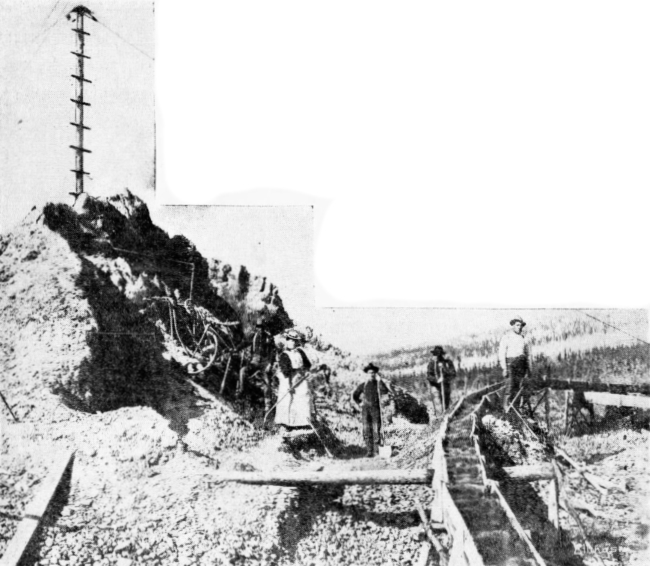
west coast. It was the hardest trip to make, into the toughest country, so that a man had to take along enough provisions to last him a year, as well as materials to build his boat and put his home and mining gear together. It was the toughest climate, calling for lots of warm clothing and footwear. There were some 500 miles by shortest route to be mushed after disembarking at Skagway or Dyea, over uncharted, rugged country from Lynn Canal to within a couple of hundred miles of the Arctic Circle.
The famous Soapy Smith was at the height of his glory when we arrived in Skagway, but he did not bother us much. There was lots of money around when we were there, and it was not until after the miners had gone on into the interior and things slowed up that the famous, or infamous, Soapy really began to get on the nerves of Skagway people.
When his gang got hungry and had to use more desperate means to gain a livelihood the citizens decided they would have to do something about Soapy. This was soon done, though Frank Reid, the man who terminated his career, lost his own life in the duel with Soapy.
Lake Bennett was a busy place in the spring of '98. There were thousands of men there building boats to make the perilous trip down lakes and rivers that was to bring them to the land of promise. A lot of these boats were being built by men who hardly knew what a boat was, and I wish you could have seen some of the contraptions that were put together to hold a couple of tons of provisions and make the run through Miles Canyon, Whitehorse and Squaw Rapids, and some of the big lakes that had to be crossed, where a storm might come up at a moment's notice.
The amazing part of the whole thing was that a lot of the silliest looking boats got through and a lot that looked as though they ought to be able to go anywhere foundered.
However, there were a lot of them that never got to Dawson. One man counted over 200 boats that were wrecked on the treacherous Thirty Mile River and most of us considered that our troubles were over when we got past Whitehorse Rapids.
The run down the Yukon from the Pelly River to Dawson was uneventful aside from the fact that it was almost impossible for us to sleep at night because it was daylight all night and the mosquitoes were terrible. The current in the Yukon is very
swift so it was unnecessary for us to row. We were making about 10 miles an hour with the
current and we kept a sharp lookout for the famed mining camp, for we knew that if we
were too far out in the current we would drift past it before we could get into shore, and have a hard time to get back up river.
We finally arrived and though we were among the early ones, we found that there was not a vacant place to tie a boat on the mile-and-a half shore line that fronts the city of Dawson. In most places the boats were already three and four deep along the water front.
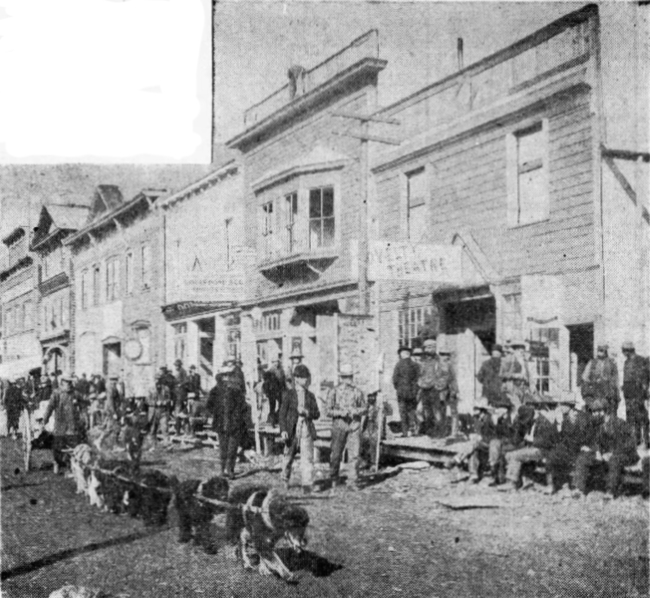
Dawson was one of the busiest places I had ever seen. Dance-halls, saloons, gambling houses and pack trains everywhere, and everybody in high gear. The town itself was strictly western, and it seemed that everybody was building. There were theatres, dance halls and saloons being built everywhere on Front Street and everybody seemed to be trying to get ahead of everybody else. The city, which seemed to run back on a flat from the waterfront for about six or seven blocks to the foot of the hill, was, with the exception of about 200 feet from the edge of the river, a swamp that was covered with niggerheads, a_ breeding ground for mosquitoes and disease.
The Mounted Police seemed to be in charge of things in the district, which was a good thing, and they saw that the city would have to be drained. There was
no money to pay for the work as the influx of people had been so sudden that the government, thousands of miles away in Ottawa, had not made preparations or voted the money necessary to carry on the business of the territory.
This is where the Mounted Police exhibited their resourcefulness. Gambling and prostitution were illegal in Canada so the Mounties brought them all into
court each month and fined them each a hundred dollars. There were hundreds of them
and the fines were paid without protest. The fines for various dealers in the gambling houses were paid by owners of establishments and the gigolos and such ilk looked after the affairs of the women, who were of all shades and nationalities. This went on for three or four years until May 1, 1902, if my memory serves me right. Then gambling was closed down by order of the police.
The fines, however, were used for a good purpose - to drain the townsite and make it a fit place in which to live. However, this was not before a terrible epidemic of typhoid fever broke out in the summer of 1898 and took the lives of hundreds of miners
before it was checked.
I do not think that we will ever see anything distantly resembling another Dawson. The world has become too small. During the first years in Dawson it was impossible, during the greater part of the year, to get mail or any word of what was
going on outside in less than a month or two, and most of the people were living in a world of their own and gave very little thought to the rest of the globe. It was just about the time when the Boer War was over that the first telegraph line reached Dawson and we were in contact with the outside world.