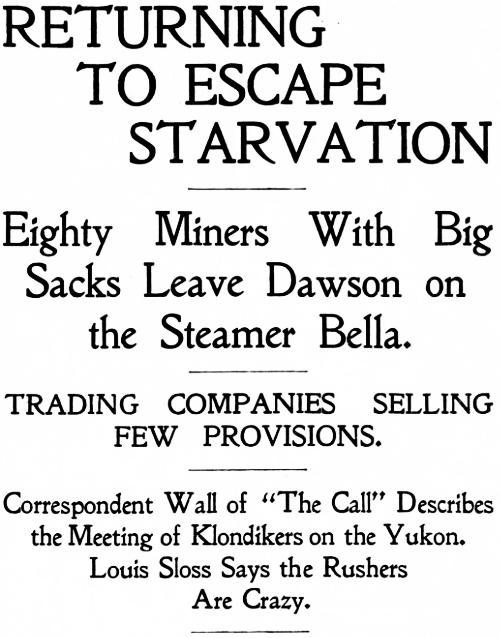
ANVIK, YUKON RIVER, ALASKA, Aug. 23 (via Seattle, Wash., Sept. 13). - When the steamer Hamilton drew up to this little Indian village and wood station this afternoon it found the Alaska Commercial Company's river boat Bella tied up to the bank. She is taking down some eighty miners, neariy all of them with a big "sack."
As the Hamilton drew in the Bella's passengers lined upon the shore to greet her and the newcomers. Many of those on the boat were quick to discover acquaintances in the line on shore and there followed a noisy exchange of greetings. Louis Sloss of the Alaska Commercial Company, coming out for the winter, was evidently astonished at the number of those going up the river at a time of year when he and other wise ones are going down. Answering the greetings of a number of acquaintances he said:
"You people have gone crazy."
Later Mr. Sloss was informed that another shipload of people were waiting at St. Michael for the Bella. He said at once that he would advise them to go back whence they came, declaring flatly that there is not food enough on the river to supply them.
The people coming in over the pass are not bringing food with them in sufficient quantities, and a messenger had been sent to be stationed at Chilcoot Pass to
warn such as might not have a full supply to go back. Both the trading companies have quit selling provisions to any but miners, and to them only in the most limited quantities. A check is kept upon all sales, and no more than provision for a few days was sold to any one person. This precaution was found necessary, as a few of the wealthiest miners were buying up all the stores as rapidly as they were landed, to the exclusion of others. The
company's store was closed for a few days after the arrival of the Bella, so that stock
could be taken and arrangements made to defeat the schemes for cornering what there was.
Mr. Sloss said that this policy of limiting the sales will be continued. This plan, however, works both ways. While it prevents the heaviest operators securing all they desire, to the exciusion of the individual, it also prevents the individual from securing enough to enable him to go into the hills for the winter prospecting.
"All records have been broken this year," said Mr. Sloss, "and there is no basis for computing what demands will be made upon our stores. We have not taken provisions into the country in any proportion to the number of people who have gone in in excess of the amount and the number of last vear. That would have been impossible, as the facilities were not commensurate. So far as my observation goes, too, the people who were coming in over the pass were not bringing provisions with them. Therefore, there cannot help being a scarcity and consequent distress, and my advice to such as these is to turn round and go back. I intend to advise the passengers who came upon our boat, the Excelsior, and who are now at St. Michael, to go back to San Francisco, and I will give them free transportation if they will accept it."
As to the richness of the new diggings, the near approach to them does not in any wise alter or amend the glittering tales that were told by the first invoice of
suddenly enriched miners, who dazzled San Francisco only about six weeks ago. If there be any alteration it is to strengthen the story as originally told.
The eighty miners on board the Bella are carrying out with them a net weight of gold valued at not less than three-quarters of a million doilars. lt is impossible to get at a close estimate, for many individuals are wary and refuse to give
the amount they carry, while they keep such close guard over it as to leave no doubt that it is treasure. Those who took pains to make inquiries on the way down give widely varying figures. One placed it at half a million dollars, another 80,000 ounces or $1,120,000. Let either be true, this much is certain that the new diggings are rich beyond anything in the history of placer mining.
"You will see more gold in one saloon in Dawson City," said Hugh Haggerty, one of the number, "than you ever dreamed of. Money or gold is nothing there - grub is everything. If the boats make another trip I believe there will be plenty, but if there is any interruption it will be tough. Most of the men aboard the Bella are going out, because they don't want to take chances in there this winter."
Jack McQuestion, who has charge of the Alaska Commercial Company's store
at Circle City, one of the earliest of the pioneers and best known men on the Yukon, had this to say concerning the situation:
"There are not provisions enough on the Yukon for the people. There are
about 3500 more people in this country now than there were in the spring. How many thousand have come since or are still coming it is impossible to say, but they seem to be hurrying in as fast as they can.
If all the boats were doing all that they might under the best conditions
there would still be a scarcity, but none of the boats will be able to make more than one more trip. Two of them have missed a trip through mishaps and may not be able to make another. The Marguerite is stuck on a bar twenty miles above Fort Yukon and the Weare is fast in the sand thirty miles above there. The Alice was compelled to leave her barge at
Fort Yukon, being unable to get it over the bar at that place. This has cost the Weare a trip, although it is expected that the Marguerite will get off. She has also already lost a trip. She will come down and take up the barge left by the Alice. The Bella and Alice will be able to make but one trip more before going into winter quarters.
It may be estimated that these mishaps to tne Weare and Marguerite mean the loss of 1000 tons of provisions in the camp, 500 each with their barges. With the last boats, of course, it will be known in just what shape the situation is, and those who wish to can come down with them. The Alice and the Bella can bring 600. I would advise every man who has not sufficient food for the winter to get out of the country."
McQuestion is going to San Francisco on private business.
Charles Rupel of Tacoma, one of the party of miners, comes from Munook
Creek, about which much has been said lately. He says that the diggings on the creek, while not so fabulously rich as on the Klondike, are good, and he would not be coming out now but he feared the scarcity of provisions. He believed that very many on the Bella were coming out for the same reason. And at the same time he said the outlook on the Munook was much better than further up, as the bar at Fort Yukon presented such difficulties to navigation that a quantity of stores always remained there.
Rupel said the boats were not carrying in the provisions they might or should, a great deal of space and weight being given to whisky. It was Rupel who said the
Bella was taking out 80,000 ounces of gold.
Mrs. I. D. Barnes, a passenger on the Hamilton, who is going in to join her husband, who owns an interest in No. 21 Bonanza above, and No 38 El Dorado, two of the richest claims, received advice from him to the effect that he is coming out, and that they will both return with the Hamilton. Mr. Barnes' partner, George W. Vogel, was on the Bella on his way out and brought this news to Mrs. Barnes. The last Mrs. Barnes had heard
direct from her husband was at Seattle, where an enthusiastic letter had advised her to come to the diggings.
The effect of all this upon the big boat-load of passengers going into the country is naturally very depressing. They have been changed from a party of buoyant,
enthusiastic gold-hunters into a party of grub-hunters. The most important question with every man on board now is not how much to the pan he can take out, but whether he will be able to get enough plain grub to keep him from starving. The conversation hour by hour faithfully reported would scarcely discover the fact that these people ever expected to find fortune in this wilderness, but would indicate nothing more than that they were in an anxious quest for something to eat.
"A man who has provisions here is rich," as expressed by a saloon passenger, is the sentiment of all. A few have already expressed a determination of going
back if, upon arrival at Dawson, the reports brought down are found to be true. The majority reserve judgment for the "last boat down," when they expect to be in possession of all the facts, while a few express a determination to stay in any case. For the returning miners, going toward plenty t eat with plenty wherewith to buy it, have an air of such self-satisfaction and tell such wonderful stories of quickly accumulated wealth that a vivid imagination is almost outdone. There are four men on the Bella who have
between them in their satchels $100,000 in dust and nuggets, and they stand guard over it in regularly organized reliefs through the twenty-four hours.
Mr. Knutson of Tacoma, part owner in 36 and 37, El Dorado, has taken out with his three partners, A. Olson, Arthur Sellers and Cornelius Vanalstine, $90,000 from six box lengths.
Knutson has with him a single chunk of gold worth $583.25 taken by him from claim 36. Louis Sloss offered him $1000 for it as a curio, but Knutson refused the
offer. The claim sold by Bell, one of the party that went to Seattle on the Portland,
for $32,000, No. 2 El Dorado, is being negotiated for by Henry Bratnobe, representing the Exploration Company, composed of large European capitalists, with the Rothschilds at their head. Bratnobe offered $125,000, but it was refused.
Frank Densmore, who went down the river on the Healey a few days ago, bought 25, above Bonanza, for $35,000 in January, payment to be made in July. He took the
purchase price out of the ground in his preliminary preparations for mining.
No. 32, El Dorado, was worked by John Anderson. He refused $15,000 for it, and a few days later realized $45,000 after having taken $40,000 out himself.
No. 7, above on Bonanza, developed $8000 to the box length.
No. 6 gave $47,000 from one hole and No. 11 washed 22 ounces in one pan, while in one day, August 12 last, $20 000 was washed from dirt thrown into the sluice-box from a hole on No. 30.
It is such tales as these that cause the more strong-headed of the party to declare they will take chances of starvation and remain over the winter.
Ex-Governor John W. McGraw of Washington is suffering from appendicitis. He has been confined to his bed for several days, and although reported better, is not out of danger. He is going to Dawson in company with General Carr, who gives him every attention. Dr. Sidebottom is attending him.
What seemed to be a light fall of rain all day yesterday has added two feet of water to the channel, and we are steaming up the river with better speed and more security, being able to travel at night for the first time since entering the river.