VICTORIA (B.C.), September 3. - The very latest news from the Klondyke gold fields was brought in here to-day by the steamer Rosalie, which touched at Union at 8 o'clock and four hours later continued on her way south.
The returning steamer brings down eleven passengers, five of whom are among the disheartened pilgrims who have given up the tramp in disgust, to try the trail again in the spring or content themselves henceforth with the more modest profits of their
regular avocations.
From the Klondyke there is some interesting information given in a letter dated at Dawson City on the 28th of July, which James McManus of this city has just received from his brother Tom.
"I was out on a stampede," says the writer, "to a new creek that looked well enough. I did not stake, however, as it proved no good. But I will get there yet, never fear. I have come down to 175 pounds in weight and am in fine condition, when the mosquitoes will let me alone. They are a constant terror. Night and day is all the same. Meals are still $1 50 and very bad at that. Bread sells at 50 cents a loaf. I am still working, and if I work for wages this winter I expect to get an ounce a day or more. I may get a 'lay' yet and make a stake.
"It is terribly hot here at present. Victoria is not in it. Yet I would not miss this chance for anything. I would like to let the boys know all about this place but I do not want to encourage any one to come in, for there is no use talking, it is a tough trip with dangers and privations and hardships on every side. I had to find them out and I guess they had better do the same.
"A young fellow left here on the last boat with $25,000. He used to drive a dray in Victoria. Twenty-five thousand dollars is common enough luck here. This is the hottest town I ever struck. Moose meat is 75 cents a pound and some of it is about as tough as Dawson City.
"For fish, we have trout, grayling and suckers, the same kind that are in the St. John river. Papers are three months old when we get them. It will take quite a sum
to provide for the long winter as everything is so dear. Many have worked so hard that they are not able to keep it up. The big wages set them crazy and they overworked themselves. I heard that a man had just arrived from Ottawa to buy up claims. I wish I had one to sell. I will have one yet for I intend to remain here until I do get a stake, and I don’t intend to stop long either. We are charged $1 each for sending our letters out. I hope you don't have to pay that to send yours in."
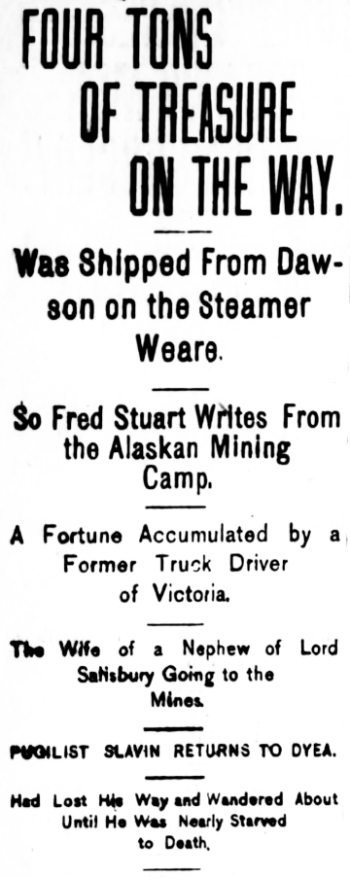
Another Klondyke letter of the same date is from Fred Stuart, who gives the news that Ross Eckhardt and his brother of this city have been fortunate in two or three speculations recently and the former will in consequence bring out $25,000 or $30,000 when he comes out for the winter. MacAuley, his partner, has disposed of a lot at Dawson which cost him $5,000 last season for $12,000 and he, too, has been lucky in individual investments.
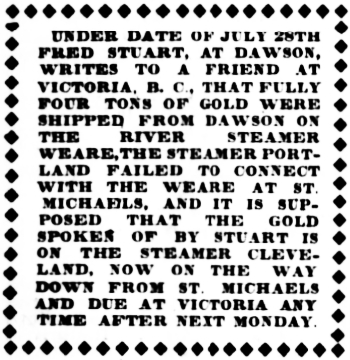
Stuart says there are now fully four tons of gold on the way down, the greater part on the steamer Weare, with which the Portland failed to connect on her last trip, but which should have arrived in Dyea in time to connect with the steamer Cleveland,
mow on her way down and due at any time after Monday next.
Clad in serviceable mackinaw, after bloomer pattern, three plucky women took passage at Victoria on board the City of Seattle for Skaguay. The reports brought down from the North on Sunday have had no effect in the way of weakening the determination
of these ladies to accompany their husbands to Klondyke. Their names are: Mrs. Nelson, Mrs. Shand and Mrs. Cecil. Leaving behind them all home comforts, which have hitherto been a part of their life, and venturing for the first time upon the hardships and privations of the northern country, it would not be unnatural to expect that some indication of doubt
as to the chances they were taking might have been discernible in their demeanor. But, whatever might have been their thoughts, no sign of weakening, no expression of doubt, made itself apparent to the closest observer. Mrs. Nelson, who hails from Michigan, accompanies her husband in the interest of the Louisville "Democrat-Leader." The second member of the party a frail-looking, highly cultured lady, is Mrs. Cecil, whose husband is a nephew of Lord Salisbury. The fascination of the yellow metal is the sole influence which has brought them to try their fortune in the frozen North. Gold hunting would seem to be inherent in the Ceci! blood, for who has not heard of the experience which the Marquis himself has had in the mining districts of Australia. Mrs. David Shand, who makes
up this trio of women, knows better than anyone can tell her what to expect on the journey over the White Pass, for her husband is no stranger to the trail, having put in some years in the now much-talked-of Klondyke country, and she says "nothing is so bad in the realization as it appears to be in anticipation."
The weather at Skaguay is reported much improved and freight is being moved rapidly over the passes. Most of the men who are now at Skaguay or on the mountains expect to get into the Yukon country before the snow files.
On her way down, and while entering Seymour narrows, the Rosalie passed the outlaw river-boat Eugene, bound north, and which, for some reason best known to her commander, signalled as the City of Skaguay. The Bristol was passed half an hour later, but apparently making no effort to overhaul the Eugene.