




|
|
The Klondike News, 1898
Klondike Gold Rush
Dateline: March 16, 2024.
|
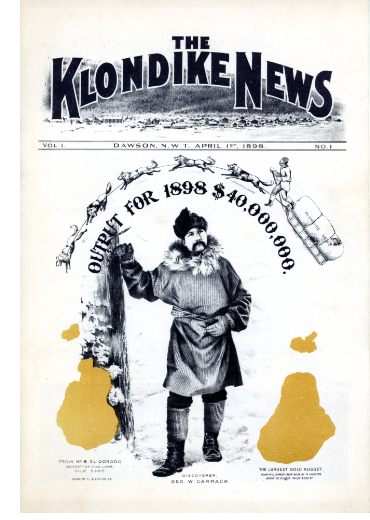
The 40-page Klondike News, compiled under editor Virgil Moore, is a gem of a resource for studying the Klondike gold fields and its main characters. We have never seen an original copy and don't know how large it was, but we have an undated reproduction, and the type on its 7x10-inch pages is very tiny.
Although the masthead on Page 20 of this souvenir edition of The Klondike News stated that it would be issued quarterly, this was the only edition printed.
We have done a high-resolution scan (400 dpi) of the reproduction, which you can download from the Public folder of our Dropbox. Pages 9/10 and 27/28 are missing from our stapled copy.
|
Some background on The Klondike News
In late July 1897, Virgil Moore headed for the Yukon with a group of other men from Santa Rosa, California. The party consisted of Arthur Bueil, J. J. Poat, Mart Tarwater, and Clarence Temple. Poat quit at Dyea and returned home. Moore said in a letter home in late August that he was not very enthusiastic about getting to Dawson that Fall, and might go to the Stewart River region instead of the Klondike as originally intended.
On March 7, 1898, a letter from Virgil Moore, "a practical assayer" at Dawson City, was published, reporting on a discovery on Eldorado Creek that assayed $280,000 to the ton.
On April 17, 1898, the San Francisco Chronicle and the Los Angeles Times made the first mention of The Klondike News, with a glimpse at how the paper was being financed (the people and companies described in it paid to be there):
Several parties of Yukon men have arrived at Seattle within the past two days, all of them bringing gold and drafts of large or small value. To-day brought "Arizona Charlie" Meadows, Virgil Moore of Santa Rosa, Cal., and J. A. Carlisle of Seattle with the materials for publishing the Klondike News, a publication intended to advertise the gold fields. They exhibited contracts with owners and others for a total of $38,000. Part of their outfit consists of prize nuggets from El Dorado, Bear and Napoleon creeks and the Skookum gulch bench diggings. The largest nuggets, running about the size of a hen's egg came from No. 8 on El Dorado. They are owned by Charles Lamb, who was formerly a
street-car conductor in Los Angeles.
On April 24, 1898, The Age-Herald (Birmingham, Alabama) described more of what Moore's party was doing:
Captain Barnette's dog team is the best to start from Dawson for the outside. Several persons taking out properties will accompany him. The Klondike News company party, consisting of C. E. Meadows, Virgil Moore and three others, starts tomorrow. Meadows and Moore own a three-quarter interest in the Klondike News, and they are going out to have the paper published in either Chicago or Cincinnati. The Klondike News is to be an illustrated paper containing paid "write-up" advertisements at the rate of $1,000 a page. Contracts to the amount of $30,000 have been obtained here. The Klondike
News party have caught the craze for bonding properties to sell outside and have loaded up with a large number of claims on various creeks. They have also purchased a collection of $2,500 worth of nuggets (taken principally from Skookum gulch and El Dorado creek) to be displayed in their office window on the outside.
On September 28, 1898, The Daily Inter Ocean (Chicago, Illinois) gave its readers a bit of information about the publication:
A copy of the Klondike News, which Mr. Wardner obtained about Sept. 1, when he was leaving Dawson City, is an interesting souvenir of the region. It is in magazine form, handsomely illustrated, and printed in San Francisco. Its editor, business manager, and artist did their work in Dawson City last winter, riding 500 miles on dog
sleds to get out of the country. Some of the miners paid as high as $2,500 for write-ups and cuts in this publication, the profits amounting to $100,000. The edition was delivered in Dawson about Sept. 1, although it bears the date of April. Mr. Wardner says it is impossible to obtain copies in the United States. Virgil Moore, the editor; Charles
Meadows, the business manager, and W. C. Wilkins, the artist, are satisfied with their
venture, and will not repeat it, preferring to remain in the "States."
On April 20, 1899, The San Francisco Call published an update, on a page written at Dawson, about Californians who went to the Klondike:
VIRGIL MOORE of Santa Rosa returned to the country last fall, bringing with him his wife. They live in a cozy cabin on the hillside and are enjoying great expectations from certain interests Mr. Moore holds on Skookum Gulch and Toronto Creek. Moore was in here last winter and went out among the last people to leave Dawson over the ice. He was interested with Charley Meadows and others in the Kiondike News scheme, the illustrated paper published outside, and containing, besides a quantity of descriptive matter of the country and the mines, write-ups of mining men and mining properties. The scheme was only in a measure successful, for Moore and Meadows were detained on the outside until late in the summer, and when they arrived here many of those who had been written up had gone out, and the notes which they gave in payment for the advertisements could not be collected.
The editor, Virgil Moore, appears on Page 15:
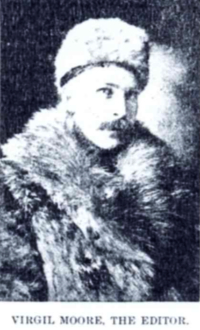
The above cut is a flattering likeness of the Editor of the "News." He was born in California some 34 years ago, where he has resided almost ever since and done nothing worthy of note. He spends his time in Dawson in buying and selling mines, practicing law, writing syndicate letters to the newspapers and editing the "News." He
distinguished himself last year by riding over the Chilcoot Pass on a horse and walking around the White Horse Rapids. He will return to his home in Santa Rosa, Cal., (if he ever gets money enough) and buy a chicken ranch.
On Page 16, the creation and printing of the newspaper is described, concluding by saying that the editor will soon be at work on a summer edition.
ADIOS.
TO-NIGHT the Editor sleeps. For full five months he has been in a state of insominous inoxuetude.
The first three months of the year he spent in running up and down the creeks seeking the information contained in these pages. Then came six weeks of tramping
over the ice and traveling by steamer and rail from the sanctum in Dawson to the composing room at San Francisco, and now we are finished. Hurrah! The printer's devil from the Schmidt Label and Lithographic Co., (who did the mechanical work for us) has just arrived to say that the foreman wants more copy to complete the last form. We hasten to comply and take the opportunity of paying a well deserved compliment to our printers for the handsome
paper they have turned out.
The Schmidt Label and Litho Co., has been the leading house of its kind on the Pacific Coast for many years and in fact is the largest this side of Chicago.
Max Schmidt the president and manager, commenced business in San Francisco just 25 years ago with a capital of $40.
Now, a hundred of complicated presses are whirling in the immense establishment and giving employment to 250 hands.
The ten forms composing the "Klondike News" will soon be issuing from ten of these presses at the rate of 1,500 per hour for each machine.
A half a hundred pretty girls will be engaged before the day is over in gathering and binding the forms together and the finishing touches will be put upon the first edition before this time to-morrow. Selah!
If we have interested the reader and given him any information, our mission is accomplished. We did not write to boom the country - it needs no booming, and
what is said here is but the simple truth of a wonderful country.
Now a little rest and then - "The Summer Edition." VALE.
On the left in the image below is our reproduction - on the right is the Discovery Day 1967 edition of The Whitehorse Star, which used the front cover, the centre 2-page spread, and the map on the back page.
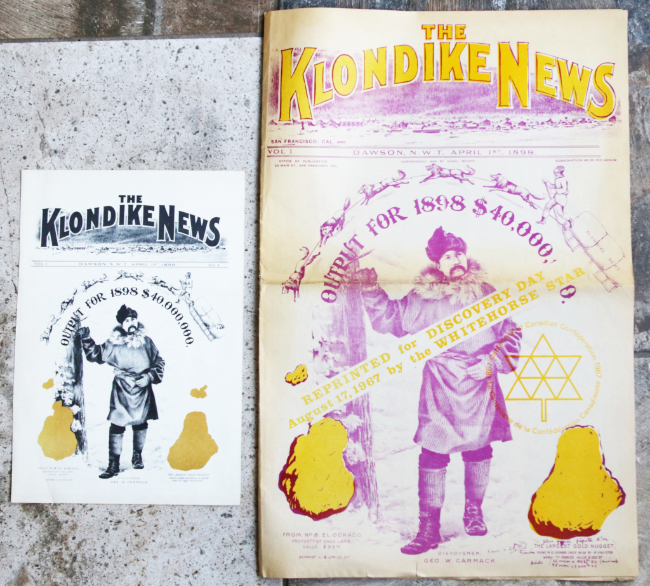
On July 17, 1967, The Whitehorse Star told the story of how they got the cover image seen on the right above. The story says that the images were used for the 1966 Discovery issue, so it appears they were used for at least two years. Read that story here.
Some highlights from The Klondike News
Creeks:
People:
Companies:
|


