Princess Louisa Marine Park
Boat Tour to Princess Louisa Inlet and Chatterbox Falls, 2017
Dateline: January 23, 2024.
This 8-page, 2-fold, 4x8-inch brochure was published by BC Parks in 1988.
Princess Louisa Inlet, a royal fjord like so many of its kind and yet unlike any other in the world, has a charm and scenic beauty that no words can adequately describe. It must be seen and experienced to be known.
Far inland, approached from the Strait of Georgia, by way of Jervis Inlet, this magnificent granite-walled gorge was cut by an ice-glacier of milleniums past through the snow-tipped mountains that rise sharply from the water's edge to heights in excess of 2,100 metres (7,000 feet). As placid as a mountain lake, the ocean waters of Princess Louisa Inlet move constantly with the tides, but currents are practically non-existent except for the seven-to-ten-knot Malibu Rapids at the entrance. The inlet, almost completely enclosed, is 300 metres (1,000 feet) deep and never over 800 metres (1 mile) wide in its eight-kilometre (five-mile) length.
Until mid-June the warm sun melting the snows of the mountains creates more than sixty waterfalls that cascade and spume down precipitous sides to mingle with
the water of this finger of the sea. Beautiful Chatterbox Falls at the head of the inlet tumbles 40 metres (120 feet) into the water to shatter the stillness that is otherwise
disturbed only by the murmur of boat motors or the lap of water against hulls and pontoons. During July and August the waters a short distance from Chatterbox Falls are in the comfortable 20 degree Celsius (70°F) range.
Princess Louisa Inlet, called by the Indians "Suivoolot", meaning sunny and warm, has beckoned sea travellers since first it was seen by man. And, except for aircraft, the sea is the only way there. No public road is closer than 68 kilometres (40 miles) away, and four-wheeled vehicles are, and probably always will be unknown.
The privilege of enjoying this bit of paradise comes through the generosity and foresightedness of James F. "Mac" Macdonald, who first saw and experienced the charm of Princess Louisa Inlet in 1919. He learned of the inlet from an uncle who had sailed it in 1907. Mr. Macdonald remembered the spectacular beauty of the inlet as he travelled over the world. In 1926, after years of prospecting in Nevada, "Mac" "struck it rich. With his new-found riches he was able to attain his real Eldorado, Princess Louisa Inlet. He obtained the land surrounding Chatterbox Falls in 1927 and built a lovely log cabin that stood until 1940 when it was destroyed by fire.
After years of acting as host to visiting yachtsmen and sailors, "Mac" had an inspiration! "This beautiful, peaceful haven should never belong to one individual," he said. "I don't ever want it to be commercialized. Indians, trappers, loggers, fishermen and yachtsmen have always been welcome to any hospitality I had to offer. I have felt that I was only the custodian of the property for Nature and it has been my duty to extend every courtesy."
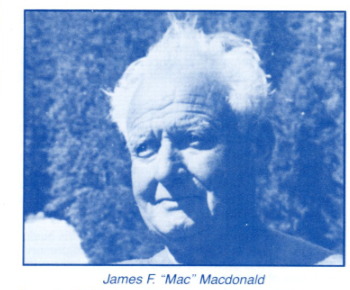 It was in 1953 when "Mac" made his decision. "I wish to turn this property over to the yachtsmen of the Northwest," he stated. "In giving it to the boating public I feel as if I am completing a trust. It is one of the most spectacular beauty spots in the world. To me it is Yosemite Valley, the fjords of Norway and bits of many other places all wrought into the background of our Pacific Northwest conifer forest."
To maintain the perpetual trust for Mr. Macdonald, the non-profit Princess Louisa International Society was formed with an equal number of Canadian and American trustees. The formation of this society ensured the preservation of this enchantingly beautiful place for all future generations.
At the time, "Mac" commented, "I am turning it over in perpetuity as an international project so that you, your children, and your children's children, ad infinitum, all may enjoy its peace and beauty as God created it, unspoiled by the hand of man."
It was stipulated that Mr. Macdonald would always have a place near Chatterbox Falls to moor his houseboat. In 1972, in his 83rd year, "Mac" spent his last summer at the inlet. He died in 1978.
"Mac" annual guest register contained the names and appreciative comments of visitors, many of them famous and well known, from all over the world. It would be
impossible to mention all the visitors and unfair to mention only a few.
Mr. Macdonald had always enjoyed telling the stories of historical lore of his beloved Princess Louisa Inlet. There was one of why Suivoolot was taboo for the Sechelt Indians for generations. And the great tale of Chieftain's Rock rising perpendicularly from the water to a shelf 50 metres (150 feet) overhead. Young Indians had to climb it with a heavy rock strapped to their backs to prove their manhood. Echo Rock and the ledge where dwells Old Man Echo was another of "Mac's" memorable stories and
there were many others. Also there was his demonstration of the fire ceremony and dance, an illustration of how young Indian braves showed their stamina in the face of severe pain.
The Princess Louisa International Society decided, after ten years of careful guardianship, that, for greater public benefit, administration of the property should pass to the Government of the Province of British Columbia. With the blessing of Mr. Macdonald the transfer took place. And with the understanding that all previous stipulations would remain in effect, the property became Princess Louisa Provincial Marine Park.
It is your park now, for you to enjoy. We are all its custodians. Your help and cooperation in helping to preserve and maintain it is earnestly sought. Please observe the courtesies of the sea whether afloat or ashore. It is our responsibility to make sure that this magnificent park remains as beautiful as it always has been.
Perhaps Erle Stanley Gardner's description of Princess Louisa Inlet in his Log of a Landlubber will help us in our efforts to keep this park in its state of serene natural beauty. Mr. Gardner wrote, "There is no use describing that inlet. Perhaps an atheist could view it and remain an atheist, but I doubt it.
"There is a calm tranquility which stretches from the smooth surface of the reflecting water straight up into infinity. The deep calm of eternal silence is only disturbed by the muffled roar of throbbing waterfalls as they plunge down from sheer cliffs.
"There is no scenery in the world that can beat it. Not that I've seen the rest of the world. I don't need to, I've seen Princess Louisa Inlet.
"Every day showed some new glimpse of nature. Constantly changing clouds clung to the sheer cliffs for companionship, drifting lightly from crag to crag, lazily floating along above their swimming reflections giving ever new light combinations, new contours. Clouds, water, trees, mountains, snow and sky all seem to be perpetually the same through the countless ages of eternal time, and yet to be changing hourly. One views the scenery with bared head and choking feeling of the throat. It is more than beautiful. It is sacred."
And so today, over half a century after "Mac" first saw this unique and lovely fjord, people still come, many of them again and again, to thrill to its beauty which is ever new and always changing yet still the same, a place where, as "Mac" said, "A person can find the peace that passeth understanding."