
|





|
|
Explosion in Sitka, Alaska, October 1941
An Explorer's Guide to Sitka, Alaska
War Fears in Sitka, Alaska, December 1941
Dateline: December 14, 2023.
The Daily Missoulian (Missoula, Montana), Monday October 13, 1941
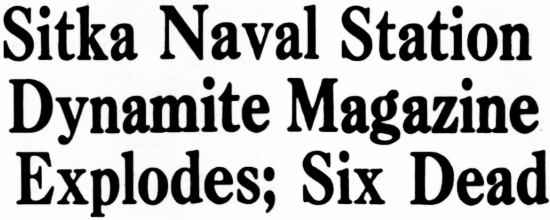
Sitka, Alaska, Oct. 12 - (AP) - An officially unexplained explosion in an underground dynamite magazine at the Sitka naval air station shortly after noon today killed at least six service men, injured dozens of persons in the nearby fishing village and damaged defense and private construction.
The blast reverberated across quiet Baranof island just as hundreds of civilians and Army families were listening to the benediction in a Sitka church at 12:10 p. m. The concussion sent windows cascading into the streets in showers of broken glass, inflicting cuts on many women and children walking out of the church and along the narrow streets of this island town.
The list of dead, as provided by naval officials, included Captain Francis C. Allen of Kentfield, Cal., a former official of the Standard Oil Company of California at San Francisco and more recently provost marshal at the air station. Others
were Private Ralph E. Kirkbridge, Los Gatos, Cal.; Hedley C. Eastabrooks (rank and home address not immediately available); Private Frank E. Hayton, San Francisco; and Private Albert A. Spurling, Evertsville, W. Va. All of these were soldiers.
Thomas A. Baskom, a Marine, whose home address was not made public by the Navy immediately, was the sixth fatality.
Many of the homes built recently for officers as part of the $5,000,000
improvements on the air station were among the structures damaged.
(Although the station is being operated by the Navy, an Army detachment has also been assigned here, as well as a number of Marines.)
Settlement Windows Broken.
Navy reluctance to give details made an immediate accurate check of property damage inside the station impossible. However, much of the construction there has been completed, including large hangars which may have been endangered. In Millerville, a tiny civilian settlement at the gates of the government property, windows were blown out of the station and houses. Sitka property is three miles from Millerville.
A Navy official said the dynamite which exploded had been stored in the magazine by contractors employed to build hangars and houses on the government property.
A naval board of inquiry was called immediately.
The Sitka naval air base is one of five being constructed in Alaska by the Army and Navy at a total cost of $25,000,000. Although the Sitka base is still under construction to some extent, hangars have been in use since last July. On February 12 of this year, President Roosevelt recommended an expenditure of $5,396,000 for the Sitka base, located on Baranof island in Southeastern Alaska. Previously, an appropriation of $2,900,000 had been made.
Commander J. R. Tate, commanding the air station, said 15 injured persons were being treated by naval physicians, all for minor hurts.
Unofficial sources said that the explosion was caused by a grass fire which spread over the small island. The men killed, these sources said, were on a fire truck which approached the magazine just as more than 43,000 pounds of dynamite exploded from heat. The Navy confirmed this in part by listing a fire truck as lost in the explosion.
Santa Cruz Evening News (Santa Cruz, California), Friday November 28, 1941

An explosion apparently caused when over 20 tons of dynamite were ignited by a grass fire at the Sitka, Alaska, naval air station, Sunday cost the lives of at least
six soldiers, one an officer well known here.
He was Captain Francis C. Allen, provost marshal at the air station and formerly in charge of military police at Camp McQuaide. Captain Allen was with the headquarters company of the 250th Coast Artillery and left for the Alaskan post late in August.
The blast, which rocked the area for miles and broke windows in Sitka, occurred when a grass fire reached a shed which contained dynamite caps, detonating them and the 43,000 pounds of dynamite. The United Press reported today that Captain Allen was in charge of the fire truck which had responded to the alarm and he and two soldiers were blown up when the fire ignited the caps and dynamite. They were attempting to quench the blaze with chemicals when the explosion occurred.
HALF MILE AWAY
So strong was the force of the explosion that a soldier at Fort Ray, half a mile away, was killed when a rock a foot in diameter, hurled from the scene of the blast, struck him in the abdomen. He was crushed.
Captain Allen was employed in the San Francisco offices of the Standard Oil company before being called into active service.
He left Camp McQuaide in August with the last contingent of the national guard regiment. The captain is survived by his widow and one son, who live at Kentfield, California. He was believed about 51 years of age, friends here said.
The blast, which occurred at 12:10 Sunday afternoon, broke windows in Sitka and sent window glass showering on persons passing by. Dishes were broken in many homes.
SIX OTHERS
The naval air station where the blast occurred is operated by the navy but there are detachments of soldiers and marines on hand. In August a premature explosion killed six men when they were trapped by sliding earth and rock. A seventh escaped.
Listed as victims of the blast, in addition to Allen, were Private Ralph E. Kirkbridge, Los Gatos, Calif.; Hedley C, Easterbrooks (rank and home address not immediately available); Private Frank E. Hayton, San Francisco, and Private Albert A. Spurling, Evertsville, W. Va.
Thomas A. Baskom, a marine, whose home address was not made public by the Navy immediately, was the sixth fatality.
The Holt County Sentinel (Missoula, Montana), Friday November 28, 1941

The following letter, written by Neal Burger under date of September 12 [Note - it was clearly October 12th] to Mr. and Mrs. J. I. Henninger of Oregon, explains some of the details of the dynamite explosion at the Marine Corps base in Sitka, Alaska:
Sept. 12, 1941
Naval Air Station
Sitka, Alaska
You probably will have already heard the news by the time you get this, but here goes. Fifteen tons of of dynamite went off in the dynamite storage area at 1:20 today, killing our Marine sentry and six soldiers. The Marine was a friend of mine ever
since Scout Camp days. I was in my bunk asleep when the siren went off, four minutes later the blast went off while I was on guard by the administration building.
It seemed as though my feet completely left the ground, and glass and
rocks showered all around me. One of the soldiers was killed by a boulder and he was a good three-quarters of a mile from the blast. The Marine guard had fired all 14 rounds in his riot gun, whether or not he fired to attract attention or whether he was firing at someone, no one knows. The five soldiers that were killed were on a fire truck right in front of the magazine. The truck was unbelievably torn up and trees two acres around the blast were leveled.
It's been the most horrible thing I've ever seen. Providence must have
been with me when the first sergeant made out the guard list, because I usually catch that post every few days.
With Baskins' body lying in the next room, everything is pretty quiet
in the barracks. I know it's the closest shave I've ever had. I came damned near catching the fire truck out. Two Marines were called off of it for other duties just before it pulled out.
We've doubled the guard so I have to go back on post pretty quick.
Oct. 21, 1941
Dear Folks:
I gave you all the information I could in my last letter. I wrote you
one as quick as I got off duty, hope you've gotten it by now.
We held honors for Baskins (embarkation ceremony) last Tuesday on the ship's dock before he was placed aboard. I was on the firing squad that fired the salute. As his body was lowered into the hold, the bugler sounded "Taps." You've never seen a more impressive thing than a military funeral. Our Captain led the procession with a black
wreath on his arm. It hit him as hard as it did the rest of us - he cried like a baby when Taps sounded. Baskins was cited for bravery in the face of death. He stayed by his post
keeping the people back when he could have taken cover himself. We had a wreath made up in the States in the shape of the anchor and globe - our emblem - with the words "Semper Fidelis" above it.
Our liberty has been cut off ever since the blast. All we're doing is
standing watches and sleeping. It's been a nightmare ever since the blast. Lots of civilians have moved off the island. Everyone is as nervous as a one-armed paper hanger with the hives. That post where Baskins was killed always was wierd, buried deep out in the woods with all that dynamite, but it's worse than ever now. I stood a midnight watch on it the other night, had to walk around that huge crater every round. Boy! Was I edgy.
They've rushed up a huge bunch of new books - fixed us up a small library, got us four new pool tables. Guess that'll bolster the morale a little.
(Note: Causing the explosion was a fire of undetermined origin which ignited the explosives - ED.)
|

|
